What Customs Duty Relief Measures Did Budget 2026-27 Introduce to Enhance Manufacturing and Exports?

Synopsis
In a significant move, Finance Minister Nirmala Sitharaman announced a series of customs duty reductions aimed at revitalizing manufacturing and exports. This comprehensive approach targets various sectors, including marine products and textiles, promising to create jobs and stimulate economic growth. Discover how these measures will reshape India’s trade landscape.
Key Takeaways
Customs duty cuts introduced across various sectors.
Increased duty-free limits for marine products.
Extended export timelines for certain products.
Exemptions for capital goods in the nuclear sector.
Focus on job creation and economic growth.
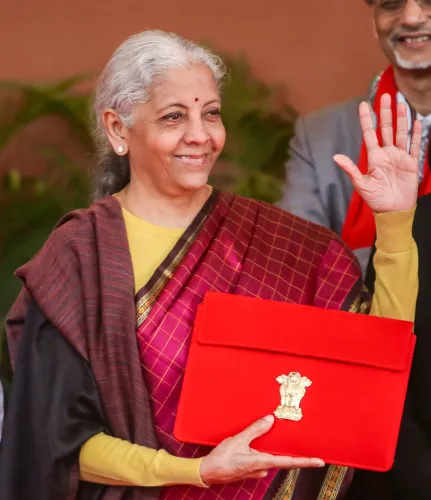
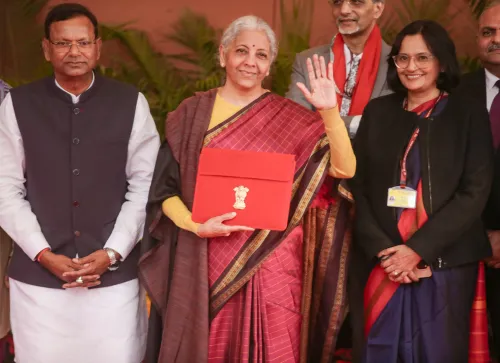
New Delhi, Feb 1 (NationPress) Finance Minister Nirmala Sitharaman unveiled an assortment of customs duty reductions targeting various sectors including marine products, textiles, leather, as well as defence and aviation. These measures are aimed at enhancing manufacturing capabilities and boosting exports as part of the Union Budget for 2026-27 introduced in the Lok Sabha on Sunday.
To specifically aid the marine products sector, the Finance Minister suggested increasing the threshold for duty-free importation of certain inputs utilized in seafood processing for export from 1 percent to 3 percent of the FOB (free-on-board) value based on the previous year's export turnover.
Furthermore, she proposed extending the current duty-free import privileges for specified inputs, which are presently available for leather or synthetic footwear exports, to include exports of shoe uppers. This initiative is designed to uplift exports in these labor-intensive sectors, thereby enhancing jobs and income levels.
The timeline for exporting final products has been extended from six months to one year for exporters involved in leather or textile garments, leather or synthetic footwear, and other leather items, according to Sitharaman.
Additionally, the Finance Minister declared the extension of the basic customs duty exemption on capital goods employed in the manufacturing of lithium-ion cells for batteries to also cover those utilized in battery energy storage systems. Additionally, the import of sodium antimonate for the production of solar glass will be exempt from customs duties.
The Budget outlines provisions for exempting customs duties on components and parts essential for manufacturing civilian training and other aircraft. There is also a proposed exemption on raw materials imported for the production of aircraft parts utilized in maintenance, repair, and overhaul by defence sector units.
Moreover, the Finance Minister suggested removing BCD on specific parts used in the creation of microwave ovens.
To address the issue of under-utilization of manufacturing capacity within special economic zones (SEZs) caused by global trade disruptions, Sitharaman introduced a one-time initiative permitting qualifying manufacturing units in SEZs to sell products in the domestic tariff area at reduced duty rates.
In the nuclear power arena, the Finance Minister proposed prolonging the existing customs duty exemption on the import of goods necessary for nuclear power projects until 2035, while also extending this advantage to all nuclear facilities regardless of their capacity.
The Budget also includes customs duty exemption on imported capital goods required for processing critical minerals within the country.
The entire value of biogas will be excluded when calculating the central excise duty owed on biogas-blended compressed natural gas (CNG), announced Sitharaman.
Point of View
The Union Budget 2026-27 reflects a strategic approach towards enhancing manufacturing capabilities and stimulating exports across multiple sectors. The measures introduced are timely and essential in addressing current economic challenges, promoting growth, and creating significant employment opportunities across the country.
NationPress
2 Oct 2026
Frequently Asked Questions
What sectors are affected by the customs duty cuts?
The customs duty cuts will impact sectors including marine products, textiles, leather, as well as the defence and aviation sectors.
How does the customs duty exemption for marine products work?
The exemption allows for an increase in the duty-free limit for specific inputs used in seafood processing from 1% to 3% of the FOB value from the previous year's export turnover.
What is the significance of extending the export timeline?
Extending the export timeline from six months to one year for certain products provides exporters additional time to complete their transactions, which can enhance their operational efficiency.
What new exemptions were introduced for the nuclear power sector?
The Budget proposes to extend customs duty exemptions on goods required for nuclear power projects until 2035, expanding the benefits to all nuclear plants regardless of their capacity.
How will these measures impact job creation?
By boosting exports in labor-intensive sectors, the duty cuts are expected to create significant employment opportunities and uplift incomes.