Galbot's tennis robot rallies at World Humanoid Robot Games 2026
Synopsis
Galbot's humanoid robot played tennis against humans — falling down mid-rally and standing back up — at the 2026 World Humanoid Robot Games in Beijing, where 2,056 robots competed across 51 events including new kickboxing and table tennis disciplines.
Key Takeaways
Galbot , a Beijing-based robotics company, staged what it called the world's first human-robot tennis match at the 2026 World Humanoid Robot Games .
The event opened on 23 August 2026 at Beijing's National Speed Skating Oval , the speed-skating venue from the 2022 Winter Olympics .
This year's games feature 51 events , 1,301 matches , more than 600 teams , and 2,056 humanoid robots , according to the organiser.
New competitive categories include table tennis and kickboxing ; scenario-based events now cover industrial production, hotels, homes, and logistics .
Galbot's tennis robot fell during play but self-recovered — rolling over and standing back up before continuing the match.
Beijing-based Galbot debuted what it described as the world's first human-robot tennis match at the second World Humanoid Robot Games, which opened on Saturday, 23 August 2026, at Beijing's National Speed Skating Oval — the same venue that hosted speed-skating events at the 2022 Winter Olympics. The five-day competition brings together more than 2,056 humanoid robots from over 600 teams across 1,301 matches and 51 events, according to the organiser.
A robot that falls — and gets back up
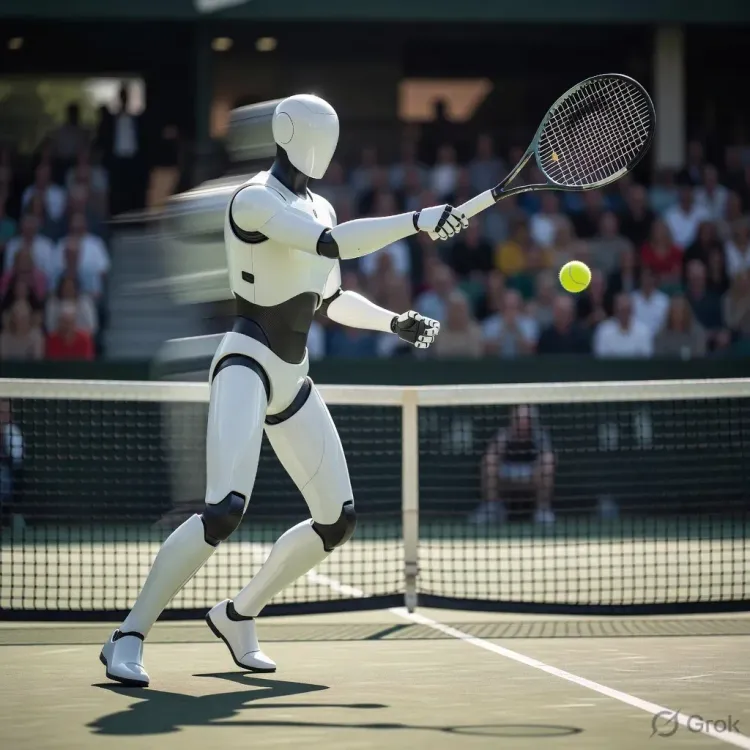
Galbot's tennis robot traded forehands and backhands with human players during singles and mixed-doubles demonstrations. At one point, while chasing a ball, the machine lost its balance and toppled backwards, drawing gasps from the crowd. It then rolled over, pushed itself to its feet and resumed play — a moment that underscored both the progress and the limits of current humanoid locomotion.
Tennis presents one of the most demanding real-time challenges for a humanoid system: the robot must track an incoming ball, predict its landing point, reposition its body, and coordinate torso and arm movements — all within seconds.
Scale and scope of the 2026 games
This year's edition is significantly larger than its predecessor. New competitive disciplines include table tennis and kickboxing, while scenario-based events have been expanded to simulate real-world environments spanning industrial production, hotels, homes, and logistics. The breadth of categories signals a deliberate push by organisers to stress-test humanoid robots beyond controlled lab settings.
The choice of the National Speed Skating Oval — an iconic 2022 Winter Olympics landmark — as the host venue lends the event a high-profile platform that amplifies China's ambitions in the humanoid robotics sector.
Why it matters
China's humanoid robotics industry has accelerated sharply over the past two years, with dozens of domestic manufacturers racing to demonstrate commercial-grade dexterity and mobility. Public showcases like the World Humanoid Robot Games serve a dual purpose: stress-testing hardware under unpredictable conditions and generating the kind of viral visibility that attracts investment and government support.
The inclusion of unscripted sports — where ball trajectories, opponent movements, and surface conditions cannot be pre-programmed — pushes perception, planning, and actuation systems far harder than warehouse or factory demos.
What's next
With the games running through the week, attention will turn to how robots perform in the expanded scenario-based events, particularly logistics and industrial simulations that carry direct commercial relevance. The results are likely to influence procurement decisions by Chinese manufacturers and logistics operators evaluating humanoid robots for deployment. Global robotics firms watching from the sidelines will be assessing whether China's competitive hardware ecosystem is pulling ahead on real-world task performance.
Point of View
Adversarial environments like tennis rallies, organisers are generating failure-mode data that no controlled lab can replicate at scale. The robot that topples and self-recovers on camera is not an embarrassment; it is a proof-of-concept for fall-recovery algorithms that manufacturers need to validate before factory or hospital deployment. What mainstream coverage misses is the competitive intelligence dimension: with 600-plus teams and 2,056 robots in one venue, Chinese engineers are benchmarking each other's locomotion, perception, and actuation stacks in real time — an accelerant that no single company could fund alone. The West's humanoid robotics players are watching a publicly funded, nationally coordinated capability-building exercise unfold in plain sight.
NationPress
8 Oct 2026
Frequently Asked Questions
What happened at the 2026 World Humanoid Robot Games?
The second World Humanoid Robot Games opened on 23 August 2026 at Beijing's National Speed Skating Oval , featuring 2,056 humanoid robots from more than 600 teams competing across 51 events and 1,301 matches . New disciplines this year include table tennis and kickboxing, alongside expanded scenario-based events covering industrial, hotel, home, and logistics environments.
What did Galbot's tennis robot do at the event?
Galbot 's humanoid robot participated in what the company described as the world's first human-robot tennis match, rallying forehands and backhands with human players in singles and mixed-doubles demonstrations. During one exchange, the robot lost its balance, fell backwards, then rolled over and stood back up before resuming play.
Why is tennis considered difficult for humanoid robots?
Tennis requires a robot to simultaneously track a fast-moving ball, predict its landing position, reposition its entire body, and coordinate torso and arm movements — all within seconds and without the ability to pre-programme opponent behaviour. It is one of the most demanding real-time perception-and-actuation challenges in robotics.
Where was the World Humanoid Robot Games 2026 held?
The event was held at the National Speed Skating Oval in Beijing, China , the venue that hosted speed-skating competitions during the 2022 Winter Olympics .
Which companies and teams participated in the 2026 games?
More than 600 teams took part, with Beijing-based Galbot among the highlighted participants for its tennis demonstration. The organiser reported a total of 2,056 humanoid robots competing, though a full list of all participating manufacturers was not disclosed.