Is India Prepared to Embrace a Techno-Legal Approach to AI Governance?
Click to start listening
Synopsis
India is gearing up to implement a revolutionary techno-legal framework for AI governance, as highlighted by the Principal Scientific Adviser, Prof Ajay Kumar Sood. This initiative aims to enhance accountability and transparency in AI systems, setting a global standard for responsible innovation.
Key Takeaways
- India is set to implement a techno-legal framework for AI governance.
- Integration of legal principles into AI is essential for accountability and transparency.
- Robust data privacy mechanisms are crucial throughout the AI lifecycle.
- Participants emphasized the need for practical and accessible AI solutions.
- A white paper will be released to summarize insights from the roundtable.
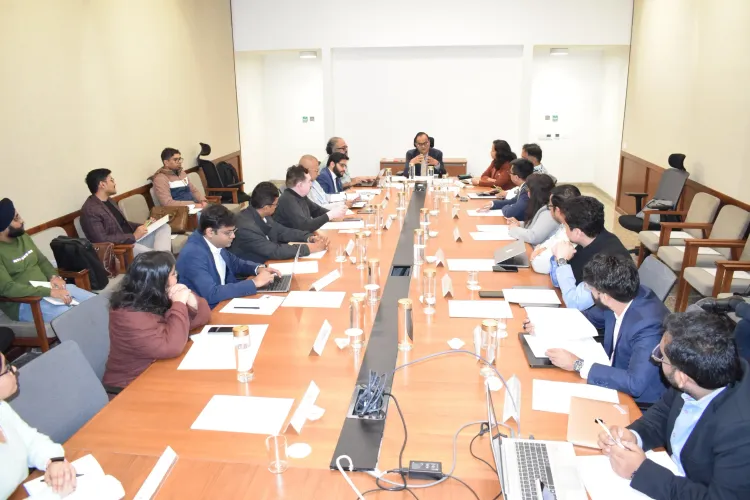
New Delhi, Dec 22 (NationPress) India is poised to implement a techno-legal framework for AI governance, as stated by the Principal Scientific Adviser (PSA) to the government, Prof Ajay Kumar Sood, on Monday.
While addressing a high-level roundtable conference, Prof Sood emphasized the necessity of integrating legal and regulatory frameworks directly into AI systems to guarantee accountability, transparency, data privacy, and cybersecurity by design.
He called on participants to explore various avenues for establishing a techno-legal governance framework.
The roundtable, an official precursor to the India AI Impact Summit 2026, was organized by the Office of the Principal Scientific Adviser in collaboration with the iSPIRT Foundation and the Centre for Responsible AI (IIT Madras). The focus was on "Techno-Legal Regulation for Responsible, Innovation-Aligned AI Governance."
Experts at the event underscored the importance of strong data privacy and consent mechanisms throughout AI training, inference, and deployment. They discussed the convergence with the DEPA framework and the need for compliance-by-design architectures to enhance the global scalability of Indian AI governance models. The dialogue also addressed regulatory measures concerning non-deterministic AI systems and AI-generated content, including copyright issues, while highlighting the challenges in operationalizing techno-legal frameworks for AI governance. Participants stressed that AI model robustness should be balanced with technical and socio-economic trade-offs, emphasizing that emerging solutions need to be practical, accessible, and user-friendly.
The discussions highlighted the necessity of developing a standardized evaluation framework for responsible AI throughout the AI systems lifecycle, translating insights into effective policy measures, and incorporating safety and governance protocols directly into AI technology stacks to mitigate risks and foster equitable access.
The roundtable featured attendees such as Preeti Banzal, Adviser/Scientist ‘G’ from the Office of PSA; Kavita Bhatia, Scientist ‘G’ and Group Coordinator from the Ministry of Electronics and Information Technology; Hari Subramanian, Volunteer from iSPIRT Foundation and Co-founder & CEO of Niti AI; and Prof. Balaraman Ravindran, Head of the Centre for Responsible AI at IIT Madras.
Banzal remarked that the insights gained from the roundtable would contribute to the Safe and Trusted AI Chakra of the India AI Impact Summit 2026, aiding in the creation of a pro-innovation, trustworthy AI ecosystem, and bolstering India’s role in global AI governance. She also addressed India’s approach to techno-legal regulation, stressing the need for a practical implementation strategy and establishing exemplary pathways for AI Governance, enabling policy frameworks, capacity building, and international collaboration.
Co-moderators Subramanian and Ravindran discussed key challenges and metrics, including data protection, leakage risks, differential privacy, accuracy, and throughput, pointing out the trade-offs between privacy and system performance. They emphasized the importance of equity in access, data sovereignty, and broader economic and strategic factors.
Prof. Mayank Vatsa from IIT Jodhpur; Jhalak Kakkar, Director of the Centre for Communication Governance at National Law University, Delhi; Abilash Soundararajan, CEO of PrivaSapien, and other subject-matter experts also participated in the roundtable.
The Office of PSA plans to release a detailed white paper on Techno-Legal Regulation for AI Governance, which will incorporate all the suggestions and recommendations made during the roundtable.
Point of View
We recognize the significance of India's proactive approach to AI governance. The emphasis on a techno-legal framework reflects a commitment to shaping a responsible and equitable technological future, ensuring that innovation aligns with ethical standards.
NationPress
24/12/2025
Frequently Asked Questions
What is the techno-legal approach to AI governance?
The techno-legal approach to AI governance integrates legal and regulatory principles directly into AI systems to ensure accountability, transparency, data privacy, and cybersecurity by design.
Why is India adopting this approach?
India is adopting this approach to create a robust framework that supports responsible AI innovation, enhances data privacy, and addresses regulatory challenges.
Who participated in the roundtable conference?
The roundtable featured experts from various fields, including government officials, scientists, and leaders from the tech industry, all focused on discussing AI governance.
What are the key challenges discussed?
Key challenges include data protection, the trade-offs between privacy and system performance, and operationalizing techno-legal frameworks for AI governance.
What will happen after the roundtable?
The Office of PSA will release a white paper detailing the discussions and recommendations from the roundtable, aiming to guide future AI governance efforts.