Is Kerala Paving the Way for Future Skills through Academia, Industry, and Government Collaboration?

Synopsis
Kerala is on the brink of a transformative educational shift, merging academia with industry needs to cultivate a workforce equipped for the future. This innovative partnership promises to redefine skill development in the state, focusing on cutting-edge sectors such as semiconductor technologies and renewable energy.
Key Takeaways
Collaboration: Uniting academia, industry, and government for skill development.
Focus Areas: Emphasis on Semiconductor Technologies, Biomedical Services, and Renewable Energy.
Job Readiness: Programs designed to make participants globally competitive.
Shift in Education: Moving from degree-centric to capability-based learning.
Strategic Location: Kalamassery identified as a hub for advanced training.
Thiruvananthapuram, Jan 18 (NationPress) In a groundbreaking initiative aimed at future-proofing its workforce and bolstering its skill development framework, Kerala has launched a significant collaboration uniting national and academic institutions.
A coaching institute, a university from Gujarat, and the Additional Skill Acquisition Programme (ASAP) Kerala have formalized a pivotal tripartite memorandum of understanding (MoU) to roll out advanced, industry-focused training programs in the state.
This agreement will be executed at the ASAP Community Skill Park in Kalamassery, establishing Kochi as a central hub for high-level skill training that aligns with global workforce expectations.
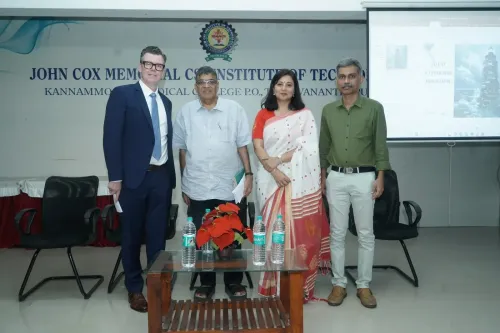
The MoU was officially signed in the presence of Kerala’s Governor, Rajendra Vishwanath Arlekar, highlighting the institutional support for progressive skill development.
Notable attendees included former Union Minister of State for External Affairs Meenakshi Lekhi and Mohanan Kunnummal, Vice-Chancellor of the Kerala University of Health Sciences, emphasizing the national significance of this initiative.
The collaboration aims to bridge the gap between academic education and practical industry needs.
While traditional education systems often emphasize theoretical knowledge, the fast-changing job market increasingly prioritizes practical skills, adaptability, and problem-solving abilities.
This partnership is strategically designed to meet these evolving demands.
Training under this MoU will focus on three vital sectors for the future: Semiconductor Technologies, Biomedical Services, and Renewable Energy.
The programs will merge academic rigor with hands-on, application-based learning, ensuring that participants are job-ready and competitive on a global scale.
Officials noted that this partnership signifies a shift from degree-focused education to skills-based development.
By aligning skill training with emerging technologies and industry demands, Kerala aspires to drive innovation, enhance employability, and establish itself as a national leader in advanced skill development in the forthcoming years.
Point of View
This collaboration in Kerala represents a crucial step towards aligning educational outcomes with the demands of a rapidly evolving job market. By integrating industry needs into academic frameworks, Kerala is setting a precedent for other states to follow, ensuring that graduates are not only knowledgeable but also practically equipped to enter the workforce.
NationPress
19 Sept 2026
Frequently Asked Questions
What is the purpose of the MoU signed in Kerala?
The MoU aims to launch advanced, industry-oriented training programs to bridge the gap between academic education and real-world industry requirements.
Which sectors will the training programs focus on?
The training programs will concentrate on Semiconductor Technologies, Biomedical Services, and Renewable Energy.
Who were the key attendees at the MoU signing?
Key attendees included Kerala’s Governor Rajendra Vishwanath Arlekar, former Union Minister Meenakshi Lekhi, and Vice-Chancellor Mohanan Kunnummal.
Where will the training programs be implemented?
The training programs will be implemented at the ASAP Community Skill Park in Kalamassery.
How does this initiative impact the job market?
This initiative aims to enhance employability by aligning skill training with the practical needs of industries, ensuring participants are job-ready.