LandSpace's Dai Zheng leads China's first reusable rocket booster landing
Synopsis
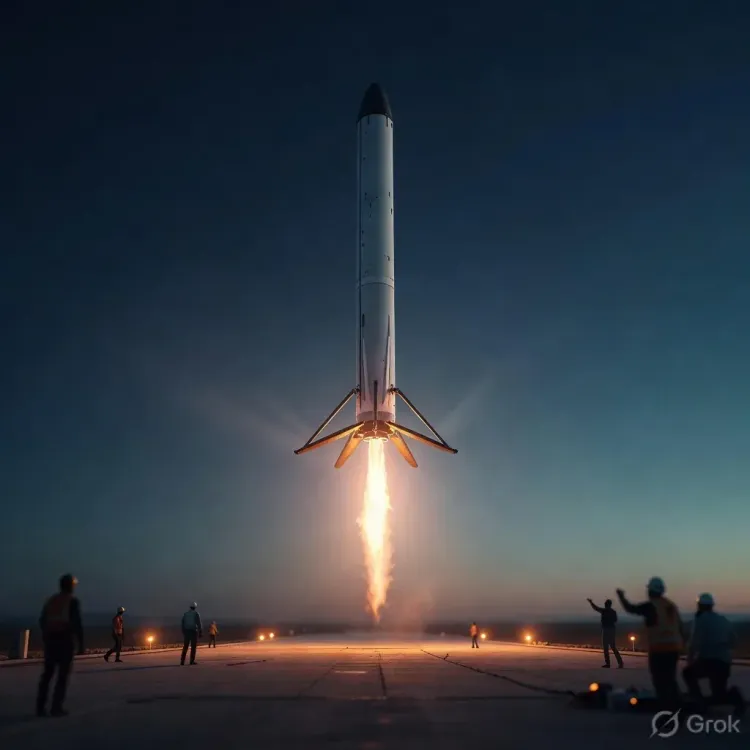
On August 19, 2026, LandSpace's Zhuque-3 booster made the first-ever vertical propulsive landing by a Chinese commercial rocket — capping a decade-long bet by chief commander Dai Zheng, who left China's elite state space programme in 2016 to make reusable rocketry a private-sector reality.
Key Takeaways
LandSpace 's Zhuque-3 booster completed China 's first commercial rocket booster vertical landing on August 19, 2026 .
Chief commander Dai Zheng, 42 , left state-owned CALT in 2016 to join LandSpace as deputy general manager.
The successful landing followed an eight-month recovery effort after a crash during a December 2025 attempt.
Dai was a lead architect of the Long March 5 , China 's first heavy-lift rocket, before moving to the private sector.
He holds a master's degree in engineering mechanics from Tsinghua University and joined CALT in 2009 .
Reusable launch vehicles are central to Beijing 's plans for large-scale low-Earth-orbit satellite constellations.
Dai Zheng, chief commander of Zhuque-3 missions at LandSpace, oversaw a landmark moment in Chinese commercial space history on August 19, 2026, when a rocket booster returned from orbit and touched down upright for the first time — vindicating a decade-long personal and professional gamble on private spaceflight.
A career-defining leap from state to private sector
Dai, now 42, left his senior post at the state-owned China Academy of Launch Vehicle Technology (CALT) in 2016 to join LandSpace as deputy general manager — at the invitation of founder Zhang Changwu. The company was barely a year old at the time. The move meant abandoning a prestigious track at CALT, where he had worked since 2009 following a master's degree in engineering mechanics from Tsinghua University.
As one of the lead architects of the Long March 5, China's first heavy-lift rocket, Dai had been on a fast-rising trajectory inside the state system. The emotional weight of leaving was significant — he reportedly recalled crying the night before submitting his resignation, laying his awards across his bed. 'I entered the state aerospace sector straight after graduation and never thought I would leave,' he said in an interview with state broadcaster CCTV late last year.
Eight months from crash to historic touchdown
The August 19 landing came after an intense eight-month recovery effort following a crash during a failed attempt in December 2025. The successful return of the Zhuque-3 booster represents the first vertical propulsive landing by a Chinese commercial rocket, a milestone the domestic industry had been chasing for years.
The achievement directly addresses one of the most pressing cost challenges in modern launch economics: reusability. By recovering and reflying boosters, operators can dramatically reduce per-launch costs — a model pioneered internationally by SpaceX with its Starlink megaconstellation ambitions in mind.
Why it matters for China's satellite ambitions
Beijing has outlined plans for massive low-Earth-orbit satellite constellations, and reusable launch vehicles are widely seen as a prerequisite for making those programmes economically viable. Dai's decade-long conviction that reusability is essential to cutting launch costs now has a concrete proof point behind it.
LandSpace, headquartered in Beijing and with launch operations linked to sites including Yong'an city in Fujian province, is now positioned as a frontrunner in China's fast-expanding commercial space sector, competing with a growing field of domestic rivals all racing toward similar reusability milestones.
What's next
The immediate question is how quickly LandSpace can move from a single successful landing to a demonstrated rapid-reuse cadence — the metric that ultimately determines competitive relevance in the launch market. Analysts will be watching for a reflown Zhuque-3 booster and any announcements on manifest capacity or commercial contracts that could follow this milestone.
Point of View
Compressing the technology gap with Western counterparts. What mainstream coverage underplays is the strategic urgency: Beijing's planned mega-constellations make reusable launch not a nice-to-have but a fiscal necessity, and a single successful landing now creates real pressure on rival domestic start-ups. The eight-month turnaround from crash to success also suggests LandSpace has built genuine engineering resilience, not just a one-off demonstration. Investors and launch customers globally will be recalibrating their China risk assumptions accordingly.
NationPress
9 Oct 2026
Frequently Asked Questions
What did LandSpace achieve on August 19, 2026?
LandSpace successfully landed a Zhuque-3 rocket booster vertically for the first time in Chinese commercial space history on August 19, 2026. The touchdown marked the culmination of an eight-month recovery effort following a failed attempt in December 2025.
Who is Dai Zheng and what is his role at LandSpace?
Dai Zheng, 42, is the chief commander of Zhuque-3 missions at LandSpace. He joined the company in 2016 as deputy general manager after leaving a senior post at the state-owned China Academy of Launch Vehicle Technology, where he was a lead architect of the Long March 5 rocket.
Why does reusable rocket technology matter for China?
Reusable launch vehicles are essential for reducing per-launch costs, which is critical to the economic viability of Beijing's planned large-scale low-Earth-orbit satellite constellations. Without reusability, the cost of deploying and maintaining thousands of satellites would be prohibitive.
How does LandSpace compare to SpaceX in reusable rocketry?
SpaceX pioneered vertical booster recovery and has demonstrated rapid reuse at scale with its Falcon 9. LandSpace's Zhuque-3 landing is China's commercial equivalent of that milestone, though the company still needs to demonstrate a reflown booster and a sustained reuse cadence to match SpaceX's operational tempo.
What is next for LandSpace after the Zhuque-3 landing?
The key next step for LandSpace is demonstrating rapid turnaround and reflying the recovered booster, which would confirm operational reusability rather than a one-time feat. Commercial launch contracts and expanded manifest capacity are also expected to follow the milestone.