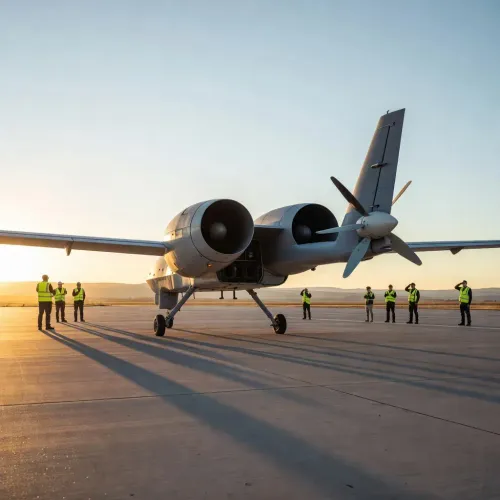
Yivtol eVTOL clears Hong Kong skies with China's first cross-border aviation insurance

Synopsis
Shenzhen eVTOL maker Yivtol has obtained China's first cross-border aviation insurance policy — underwritten on the mainland, issued in Hong Kong — unlocking the city's airspace for its S-Zero aircraft under a HK$20 million, one-year cover. The PICC-brokered deal could become the template for mainland developers entering international markets.
Key Takeaways
Yivtol , headquartered in Shenzhen's Qianhai Special Economic Zone , has secured China's first cross-border eVTOL aviation insurance policy .
The policy carries a total liability of HK$20 million (US$2.6 million) and is valid for one year, expiring June 2027 .
The deal was structured between the Shenzhen branch of PICC (underwriting/risk assessment) and PICC's Hong Kong unit (local compliance and policy issuance).
The covered aircraft, the Yivtol S-Zero , is a single-seat eVTOL with a 90 kg maximum payload , a 50-minute flight limit , and a top speed of 75 km/h .
Under Hong Kong aviation regulations , locally compliant insurance is a mandatory prerequisite for any aircraft to operate in the city.
The milestone was confirmed by the Shenzhen municipal government on 21 July 2026 and positions the Greater Bay Area as a test bed for cross-border urban air mobility frameworks.
Shenzhen-based eVTOL developer Yivtol has secured China's first cross-border aviation insurance policy for a piloted electric vertical take-off and landing aircraft, removing a critical regulatory barrier to commercial operations in Hong Kong. The policy, valued at HK$20 million (US$2.6 million) in total liability, covers a one-year period ending June 2027 and marks a landmark moment for the country's fast-expanding low-altitude economy.
The Groundbreaking Policy
The insurance arrangement was structured as a collaboration between the Shenzhen branch of the People's Insurance Company of China (PICC) Group and its Hong Kong unit. According to a statement from Shenzhen's Qianhai Special Economic Zone — where Yivtol is headquartered — the mainland branch conducted risk assessment and underwriting, while the Hong Kong unit managed local regulatory compliance and formally issued the policy in the city. The Shenzhen municipal government confirmed the milestone in a social media post on Monday, 21 July 2026.
What the Coverage Unlocks
Under Hong Kong's aviation regulations, any aircraft must carry locally compliant aviation insurance before it is permitted to take off or land in the city. For mainland Chinese developers, sourcing such recognised coverage has been one of the most persistent obstacles to entering the Hong Kong market. The new policy directly addresses that gap, giving Yivtol a legally clear path to operate its aircraft in the city.
The Aircraft: Yivtol S-Zero
The policy covers Yivtol's S-Zero, a single-seat piloted eVTOL with a maximum payload of 90 kg. According to the policy screenshot published in Monday's statement, the aircraft is authorised to fly for a maximum of 50 minutes at a top speed of 75 km/h. The S-Zero is positioned as an early-stage commercial platform for urban air mobility in the Guangdong-Hong Kong-Macao Greater Bay Area.
Why It Matters for China's Low-Altitude Economy
Beijing has identified the low-altitude economy — encompassing drones, eVTOLs, and autonomous aerial vehicles — as a strategic growth sector. Cross-border insurance frameworks are a foundational piece of the regulatory infrastructure needed to commercialise that vision. The PICC collaboration model, bridging mainland underwriting expertise with Hong Kong's regulatory environment, could serve as a replicable template for other mainland aviation companies eyeing the city as a gateway to international markets.
What's Next
With insurance compliance now secured, Yivtol's immediate focus shifts to flight approvals and route certification within Hong Kong's airspace. The broader industry will be watching closely: if the PICC cross-border model scales, it could accelerate a wave of mainland eVTOL entrants seeking Hong Kong certification as a stepping stone to global commercial operations. Regulatory bodies in both jurisdictions are expected to refine low-altitude economy frameworks through 2026 and into 2027.
Point of View
The bottleneck was never technology; it was the absence of insurance and liability frameworks that foreign and semi-foreign regulators would accept. What mainstream coverage underplays is the role of state-backed insurers like PICC as de facto policy enablers: by straddling both jurisdictions, PICC has effectively done the regulatory arbitrage that private insurers were unwilling to underwrite. If this model scales across the Greater Bay Area, it could compress the commercialisation timeline for dozens of mainland eVTOL developers by years — and quietly reshape how China exports its aviation technology ambitions.
NationPress
20 Oct 2026
Frequently Asked Questions
What is the Yivtol cross-border eVTOL insurance policy?
It is China's first cross-border aviation insurance policy for a piloted eVTOL aircraft, underwritten by the Shenzhen branch of PICC and formally issued by PICC's Hong Kong unit . The policy covers Yivtol's S-Zero aircraft with a total liability of HK$20 million (US$2.6 million) for one year through June 2027 .
Why does Yivtol need insurance to fly in Hong Kong?
Hong Kong aviation regulations require all aircraft to carry locally compliant aviation insurance before they can take off or land in the city. For mainland Chinese developers, obtaining such locally recognised coverage has historically been the primary regulatory barrier to entering the Hong Kong market.
What are the flight capabilities of the Yivtol S-Zero?
The Yivtol S-Zero is a single-seat piloted eVTOL with a maximum payload of 90 kg . Under the terms of the insurance policy, it is authorised to fly for a maximum of 50 minutes at a top speed of 75 km/h .
Who underwrote the Yivtol eVTOL insurance policy?
The policy was a collaboration between the Shenzhen branch of the People's Insurance Company of China (PICC) Group , which conducted risk assessment and underwriting, and PICC's Hong Kong unit , which handled local regulatory compliance and issued the formal policy in the city.
What does this mean for China's low-altitude economy?
The policy is considered a landmark for China's low-altitude economy — a sector covering drones, eVTOLs, and autonomous aerial vehicles that Beijing has designated a strategic growth priority. The PICC cross-border model could serve as a replicable template for other mainland aviation developers seeking to operate in Hong Kong and potentially broader international markets.