Asian Games 2026: Abuduaini ends China's 24-year men's discus drought in Nagoya
Synopsis
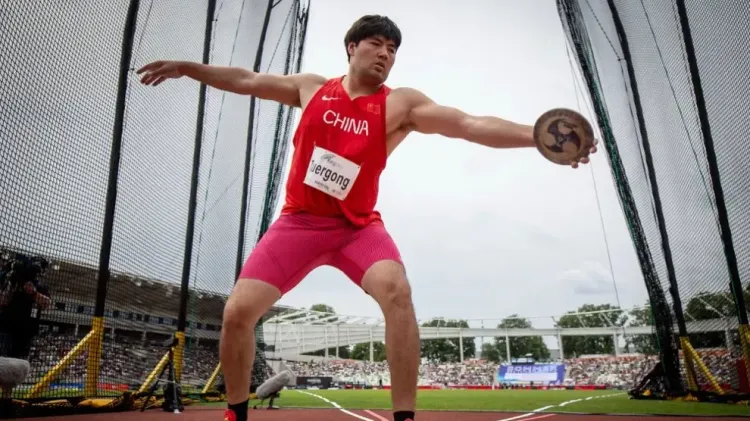
China's Abuduaini Tuergong didn't just win a discus gold in Nagoya — he ended a 24-year drought, adding more than 20kg to his frame since his bronze three years ago to do it. Meanwhile, Bahrain's Winfred Yavi ran her first-ever competitive 10,000m and won it in Asian Games record-contending fashion, signalling a seismic shift in her event ambitions.
Key Takeaways
Abuduaini Tuergong won men's discus gold at the Asian Games 2026 in Nagoya with a throw of 64.26 metres on his third attempt.
The victory ended China's 24-year wait for the men's discus title at the Asian Games.
Abuduaini deliberately gained over 20 kilograms since Hangzhou 2023 , rising from ~ 113-114 kg to 140 kg , to improve stability and performance.
Winfred Yavi of Bahrain won the women's 10,000m in 32:39.18 — her first-ever competitive 10,000m race.
Thailand's Puripol Boonson led the men's 100m heats with a season-best 9.95 seconds ; the final is yet to be contested.
Defending women's 100m champion Ge Manqi failed to advance after suffering leg cramps, finishing in 12.13 seconds .
Abuduaini Tuergong claimed the men's discus gold at the Asian Games 2026 in Nagoya, Japan on Thursday, 24 September, ending a 24-year wait for China to reclaim the title in the event. The 29-year-old sealed the win with a throw of 64.26 metres on his third attempt, with compatriot Wu Nanjun taking silver at 61.58m.
Abuduaini's Gold: From Bronze to Champion
Abuduaini, a two-time Asian Championships winner who broke the Chinese national record multiple times last year, was visibly emotional following his victory. 'It's been more than 20 years since China last won the title. Now we've brought it back,' he said. 'I'll call my family and friends when I get back to my hotel, and then have a good sleep.'
The performance marks a dramatic turnaround from Hangzhou 2023, where Abuduaini had to settle for bronze. He attributed his improved form to a deliberate and significant weight gain. 'I weighed around 113 to 114 kilograms in 2023, and now I'm 140 kilograms,' he said. 'I made that sacrifice to improve my performance. Adding more than 20 kilograms has made me more stable in all aspects.' The gain of more than 20 kilograms over three years reflects a calculated physical overhaul rather than coincidence — a reminder that elite field athletics is as much about biomechanics as technique.
Yavi Makes History in Women's 10,000m
Bahrain's Winfred Yavi, the reigning Olympic and world champion in the women's 3,000-metre steeplechase, added another title to her collection by winning the women's 10,000 metres in 32 minutes and 39.18 seconds — and she did it in her very first competitive 10,000m race. 'It feels so special because it's my first 10k at the Asian Games and I did it for the first time in my life in a competition,' Yavi said. 'It felt so good, entering such an event and getting a gold medal.'
Yavi indicated she plans to gradually shift her competitive focus from the steeplechase to the 5,000 and 10,000 metres going forward — a transition that could redefine the middle- and long-distance landscape in Asia.
Other Key Results from the Track and Field Programme
Uzbekistan's Sharifa Davronova claimed gold in the women's triple jump with a personal-best 14.35 metres, with China's Huang Yingying and Li Yi taking silver and bronze respectively. Bahrain's quartet set an Asian Games record of 3:12.87 in the mixed 4x400-metre relay.
In the men's 100 metres preliminaries, Thailand's Puripol Boonson posted a season-best 9.95 seconds to lead the heats. The 20-year-old — who set a personal best of 9.94 seconds last year — said: 'I am extremely happy now because I never expected to reach this result. My initial goal was around 10 seconds.' Boonson, the Hangzhou Asian Games silver medallist, expressed confidence ahead of the final. China's Zeng Keli progressed in 10.22 seconds, while defending champion Xie Zhenye advanced from another heat in 10.30 seconds.
On the women's side, 17-year-old Chinese sprinter Chen Yujie recorded the fastest preliminary time of 11.41 seconds in the women's 100 metres heats — just outside the Asian junior record of 11.08 seconds she set at a domestic meet in August, which is also the fastest women's 100m time in Asia this season. Defending champion Ge Manqi suffered leg cramps during the fourth heat and finished in 12.13 seconds, failing to advance.
What to Watch Next
With the men's and women's 100m semifinals and finals still ahead, Boonson's bid for Thailand's sprint gold and Chen Yujie's quest to back up her junior record will be among the most anticipated moments remaining on the track programme in Nagoya.
Point of View
And it paid off. Yet the broader narrative of the Nagoya athletics programme is the versatility of Bahrain's Winfred Yavi: winning a global steeplechase title and then claiming an Asian Games 10,000m gold on debut in the distance suggests her best years are being spent at the wrong event. For China, the discus result masks the mixed signals from the sprint lanes — a 17-year-old prodigy and a defending champion knocked out by cramps rarely coexist in the same programme without raising questions about squad depth and event management.
NationPress
25 Sept 2026
Frequently Asked Questions
Who won the men's discus gold at the Asian Games 2026?
China's Abuduaini Tuergong won the men's discus gold at the Asian Games 2026 in Nagoya, Japan, with a throw of 64.26 metres on his third attempt. Compatriot Wu Nanjun finished second with 61.58m.
How long had China waited for men's discus gold at the Asian Games?
China had not won the men's discus title at the Asian Games for 24 years before Abuduaini's victory on 24 September 2026. Abuduaini himself took bronze at the previous edition in Hangzhou in 2023.
Why did Abuduaini gain over 20 kilograms since 2023?
Abuduaini deliberately gained more than 20 kilograms — rising from around 113-114 kg to 140 kg — as a strategic move to improve stability and overall performance in the discus throw. He described it as a sacrifice aimed at enhancing his competitive output.
What did Winfred Yavi achieve at the Asian Games 2026?
Bahrain's Winfred Yavi, the reigning Olympic and world steeplechase champion, won the women's 10,000 metres at the Asian Games 2026 in a time of 32:39.18 — remarkably, it was her very first competitive 10,000m race. She indicated plans to gradually transition from the steeplechase to longer track distances.
What happened in the men's 100m at the Asian Games 2026?
Thailand's Puripol Boonson posted the fastest preliminary time of 9.95 seconds in the men's 100m heats, a season-best effort for the 20-year-old Hangzhou silver medallist. China's Zeng Keli and defending champion Xie Zhenye also advanced; the final is yet to be held.