Argentina risk FIFA ban after Falklands banner at World Cup SF
Synopsis
Argentina's World Cup semi-final win over England was overshadowed by a politically loaded act: players brandished a Falklands sovereignty banner on the pitch in Atlanta, echoing a stunt that cost the AFA £20,000 in 2014. With the Vice-President publicly backing the gesture, FIFA now faces pressure to act — and Argentina face a potential ban cloud heading into the final.
Key Takeaways
Argentina defeated England 2-1 in the FIFA World Cup 2026 semi-final in Atlanta on 16 July , with goals from Enzo Fernandez and Lautaro Martinez .
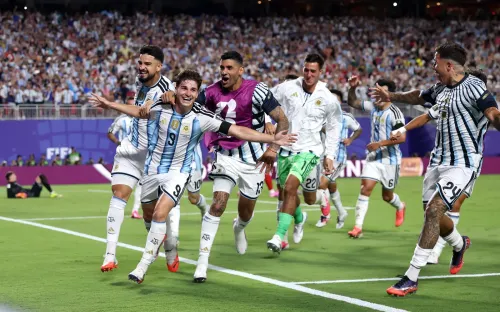
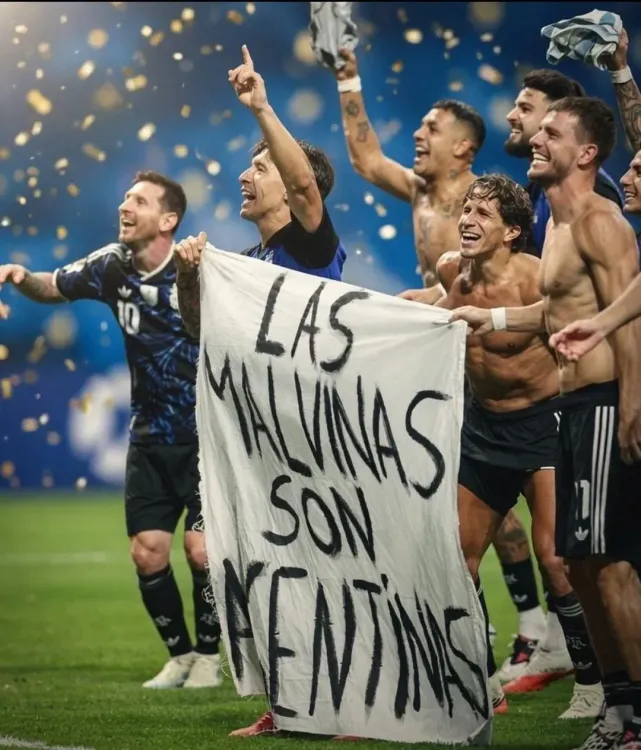
Argentine players celebrated by displaying a banner reading 'Las Malvinas son Argentinas' ('The Falklands are Argentine') and leaving it on the pitch.
Vice-President Victoria Villarruel publicly endorsed the gesture in a post on X, stating the Falklands are 'carried in our blood and our hearts'.
FIFA previously fined the Argentine Football Association £20,000 for an identical banner display before a friendly against Slovenia in 2014 .
The 1982 Falklands War lasted 74 days and resulted in 907 deaths ; the sovereignty dispute between Britain and Argentina remains unresolved.
FIFA has not yet issued a formal statement; a disciplinary review is widely expected.
Argentina face potential disciplinary action from FIFA after players celebrated their FIFA World Cup 2026 semi-final victory over England on 16 July in Atlanta by brandishing a banner reading 'Las Malvinas son Argentinas' — 'The Falklands are Argentine' — before leaving it on the pitch. The incident has reignited a politically charged dispute that stretches well beyond football.
The Incident on the Pitch
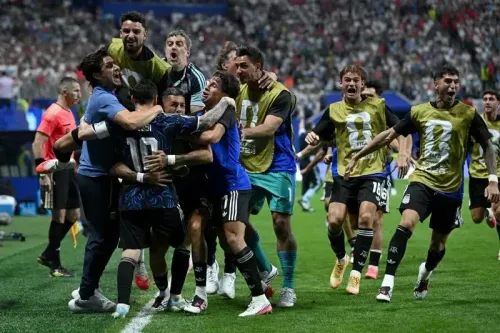
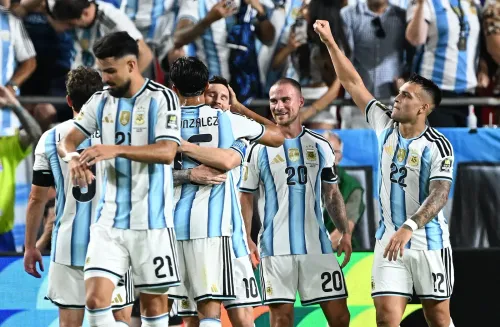
Argentina staged a dramatic late comeback to defeat England 2-1, with goals from Enzo Fernandez and Lautaro Martinez sealing a place in the World Cup 2026 final. As the final whistle sounded, Argentine players produced the banner asserting sovereignty over the Falkland Islands — a British Overseas Territory in the south-west Atlantic Ocean — and held it aloft before the stadium cameras.
The display was not an isolated act of post-match emotion. Argentine players had reportedly sung chants referencing the Falklands, as well as football legends Diego Maradona and Lionel Messi, following their earlier 3-2 victory over Egypt in the round of 16. The pattern suggests a coordinated expression of national sentiment rather than a spontaneous gesture.
Argentina Vice-President Weighs In
Argentina's Vice-President Victoria Villarruel amplified the controversy with a post on X following the semi-final, writing: 'The Falklands are Argentine! They banned bringing them to the stadium and forgot that we carry them in our blood and our hearts.'
Villarruel had also made her position clear before kick-off, stating: 'This isn't just another match. I'm not going to be politically correct or cold-hearted; against the English, it's always something more. It's the Malvinas, it's Diego, it's Leo's last one, and it's putting the brakes on the invaders. Go Argentina! Because until our last breath, we're going to claim what's ours!' The remarks drew attention to how deeply the sovereignty dispute is embedded in Argentine political identity.
The Historical Context
The Falkland Islands are an archipelago off the Atlantic coast of Argentina but function as a British Overseas Territory. Argentina's military junta invaded the islands in 1982, prompting Britain to dispatch its naval fleet across the Atlantic. The ensuing 74-day conflict ended with Britain retaking the islands at the cost of 907 lives. The sovereignty question has remained unresolved ever since, and matches between the two nations — in any sport — carry a weight that extends far beyond the scoreline.
Notably, the semi-final was held under heightened security measures, specifically because of the well-documented historical tensions between the two nations.
FIFA's Prior Precedent
This is not the first time the banner has appeared in an international football context. FIFA previously fined the Argentine Football Association (AFA) £20,000 after players displayed an identical banner with the same message ahead of a friendly against Slovenia in 2014. That precedent makes a fresh disciplinary investigation highly probable, though FIFA has not yet issued a formal statement on the latest incident.
What Happens Next
FIFA's disciplinary committee is expected to review the footage and assess whether the banner constitutes a political statement in violation of its regulations on the use of stadiums and playing areas. A formal charge against the AFA would likely follow the pattern set in 2014, though the scale of the occasion — a World Cup semi-final — could invite a heavier sanction. Argentina now prepare for the final, but the Falklands banner may prove a significant off-field distraction in the days ahead.
Point of View
000 fine set a precedent, but a World Cup semi-final is an entirely different stage, and the involvement of a sitting Vice-President makes this a state-level political provocation, not merely a dressing-room stunt. The governing body's credibility on its own 'no politics on the pitch' rules depends on whether it treats this case with the same rigour it applies to smaller nations. There is also a harder question mainstream coverage is avoiding: by scheduling a high-tension England-Argentina match under 'heightened security' and then expressing surprise at political expression, FIFA may have underestimated how inseparable football and sovereignty are in Argentine national identity.
NationPress
16 Jul 2026
Frequently Asked Questions
What banner did Argentina players display after beating England at the World Cup 2026?
Argentine players held up a banner reading 'Las Malvinas son Argentinas' — meaning 'The Falklands are Argentine' — after their 2-1 semi-final win over England in Atlanta on 16 July 2026. The banner was left on the pitch before the players left the field.
Has FIFA punished Argentina for a Falklands banner before?
Yes. FIFA fined the Argentine Football Association £20,000 in 2014 after players displayed an identical banner with the same message before a friendly match against Slovenia. That precedent makes fresh disciplinary action likely.
What did Argentina's Vice-President say about the banner?
Vice-President Victoria Villarruel posted on X after the semi-final: 'The Falklands are Argentine! They banned bringing them to the stadium and forgot that we carry them in our blood and our hearts.' Before the match, she had also described the fixture as being about 'the Malvinas, Diego, and putting the brakes on the invaders'.
What is the history of the Falklands dispute between Argentina and Britain?
The Falkland Islands are a British Overseas Territory in the south-west Atlantic, claimed by Argentina as the Malvinas. Argentina's military junta invaded the islands in 1982; Britain retook them after a 74-day conflict that resulted in 907 deaths. The sovereignty dispute has never been formally resolved.
What action could FIFA take against Argentina?
FIFA's disciplinary committee is expected to review the incident. Based on the 2014 precedent, a fine against the Argentine Football Association is the most likely outcome, though the higher-profile setting of a World Cup semi-final could result in a heavier sanction. No formal charge has been announced yet.