England vs Argentina FIFA World Cup 2026 semifinal: 60 years of rivalry renewed
Synopsis
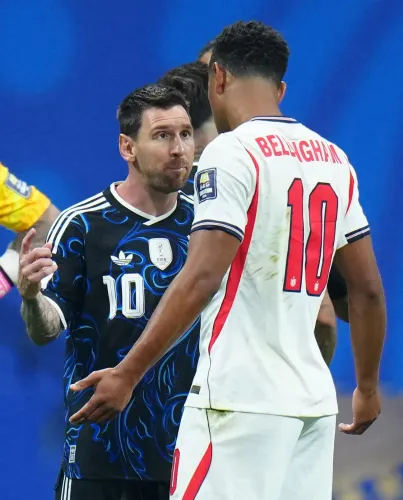
England and Argentina have not met competitively since 2002, but their World Cup history — the Hand of God, Beckham's red card, Rattin's dismissal — makes this 2026 semifinal in Atlanta feel like unfinished business. Messi never played England in his entire career; now, in his absence, the fixture must forge its own new mythology.
Key Takeaways
England and Argentina meet in the FIFA World Cup 2026 semifinal in Atlanta on Wednesday .
The teams have faced each other five times at the World Cup — three England wins , two Argentina wins (one on penalties).
Diego Maradona's 'Hand of God' and his solo goal in the 1986 quarterfinal at the Azteca Stadium remain the rivalry's defining moments.
David Beckham was sent off in the 1998 last-16 clash; Argentina won 4-3 on penalties.
Simeone later admitted exaggerating the incident.
Their last competitive meeting was a 1-0 England win in the 2002 group stage in Sapporo .
Lionel Messi has never played against England in any fixture throughout his international career.
England and Argentina will renew one of football's most charged rivalries when they face off in the FIFA World Cup 2026 semifinal in Atlanta on Wednesday, marking their first competitive meeting in more than two decades. The two nations have met five times at the World Cup, producing three England wins and two Argentina victories — one of them on penalties — though raw statistics have never come close to capturing what this fixture means.
The 1966 Flashpoint That Started It All
Though the teams first crossed paths at the 1962 World Cup — England winning 3-1 in the group stage — the rivalry's true roots were planted at Wembley during the 1966 quarterfinals. England edged through 1-0, but the match is remembered not for Geoff Hurst's late winner, but for the dismissal of Argentina captain Antonio Rattin by West German referee Rudolf Kreitlein.
Rattin was sent off for dissent after just 35 minutes and famously refused to leave the field for several minutes. Argentina maintained the dismissal reflected home-nation bias; England insisted their opponents had been persistently fouling throughout. The bad blood outlasted the final whistle — England manager Alf Ramsey intervened to prevent George Cohen from exchanging shirts with Alberto Gonzalez. England went on to lift the trophy, but the ill feeling endured for decades.
Maradona's Defining Moment at the Azteca
The rivalry reached its most iconic chapter on 22 June 1986 at Mexico City's Azteca Stadium. Diego Maradona scored both goals in Argentina's 2-1 quarterfinal victory — the first with his hand, the second after a breathtaking solo run past several England players before beating goalkeeper Peter Shilton. The two goals arrived within four minutes of each other and came to embody the contradictions of Maradona's genius.
The first, infamously labelled the 'Hand of God', remains one of football's most debated moments. The second is widely regarded as the greatest goal in World Cup history. Gary Lineker pulled one back, but Argentina held on and ultimately claimed the title. The match did not merely define the rivalry — it defined an era.
Beckham, Simeone, and France 1998
A 1998 last-16 clash in France added fresh layers of controversy. A teenage Michael Owen announced himself to the world with a stunning solo goal, but David Beckham was sent off early in the second half for kicking out at Diego Simeone. England held on through extra time before Argentina advanced 4-3 on penalties.
Beckham returned home to widespread criticism in England. Years later, Simeone — now one of football's most respected managers — acknowledged he had exaggerated the impact of the incident. The admission did little to soften the memory.
Beckham's Redemption and the Last Meeting
Beckham found partial redemption four years later when the teams met in the 2002 group stage in Sapporo. He converted a penalty — awarded after Mauricio Pochettino was judged to have fouled Owen — to give England a 1-0 victory. That result remains their most recent competitive encounter.
The two sides last met in a 2005 friendly in Geneva, with England winning 3-2 courtesy of two late Owen goals. Notably, an 18-year-old Lionel Messi missed that match through suspension, having been sent off on his Argentina debut against Hungary three months earlier. Despite an international career spanning more than two decades, Messi has never faced England in any fixture — a curiosity that the 2026 semifinal will not resolve, given his retirement from international football.
What Wednesday's Semifinal Means
When the two nations step out in Atlanta on Wednesday, they do so carrying 60 years of accumulated history — disputed goals, red cards, penalty heartbreak, and moments of individual brilliance that transcended the sport. For both sets of supporters, this is never simply a football match. The FIFA World Cup 2026 semifinal will add another chapter to a story that shows no sign of reaching a tidy conclusion.
Point of View
Beckham's boot, Rattin's refusal to leave the field. What is striking heading into Atlanta is how much of the narrative has been shaped by individuals rather than teams: no single fixture in this rivalry has been settled purely on collective merit. The absence of Messi — the one player who might have added his own defining chapter — means the 2026 edition must generate its own icon or incident. That is both the burden and the opportunity for this generation of players.
NationPress
12 Oct 2026
Frequently Asked Questions
When and where is the England vs Argentina FIFA World Cup 2026 semifinal?
The semifinal is scheduled for Wednesday in Atlanta. It is the first competitive meeting between the two nations since the 2002 World Cup group stage in Sapporo, where England won 1-0.
What is the overall World Cup record between England and Argentina?
The two teams have met five times at the World Cup, with England winning three and Argentina winning two — including one victory on penalties in 1998. Their meetings span from 1962 to 2002.
What happened in the famous 1986 World Cup match between England and Argentina?
Argentina defeated England 2-1 in the 1986 quarterfinal at Mexico City's Azteca Stadium. Diego Maradona scored both goals — the first with his hand (the 'Hand of God') and the second after a solo run widely regarded as the greatest goal in World Cup history. Gary Lineker scored for England, but Argentina held on to win the match and eventually the tournament.
Why was David Beckham sent off against Argentina in 1998?
David Beckham was dismissed in the second half of England's 1998 last-16 clash against Argentina for kicking out at Diego Simeone. Argentina won 4-3 on penalties after extra time. Simeone later acknowledged he had exaggerated the impact of the incident.
Has Lionel Messi ever played against England?
No. Despite an international career spanning more than two decades, Messi has never faced England in any fixture. He missed their last meeting — a 2005 friendly in Geneva — due to suspension, having been sent off on his Argentina debut against Hungary three months earlier.