Asian Games 2026: Asha Ilango misses triple jump medal on countback, Niharika 10th
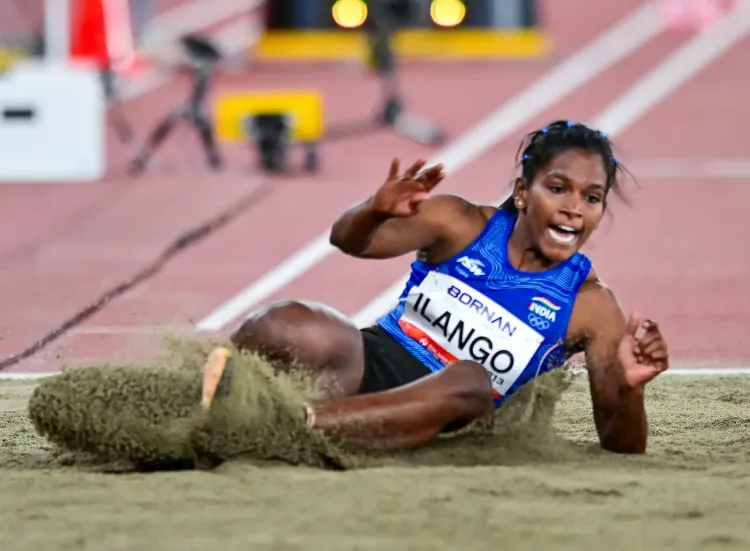
Synopsis
Asha Ilango matched the bronze medallist's best jump of 13.83m but lost out on countback — one of sport's cruellest tiebreakers — to finish fourth in the women's triple jump at the 2026 Asian Games. Her season-best of 13.89m would have won bronze; on the day, a single missed centimetre made all the difference.
Key Takeaways
Asha Ilango finished fourth on countback in the women's triple jump at the 2026 Asian Games in Aichi on 24 September .
She matched bronze medallist Li Yi of China with a best jump of 13.83m , but lost the tiebreak on second-best efforts.
Asha's season-best of 13.89m — better than the winning bronze mark — was not reproduced in the final.
Gold went to defending champion Sharifa Davronova (Uzbekistan) with a personal-best 14.35m ; silver to China's Huang Yingying with 14.12m .
Niharika Vashisht finished 10th , eliminated after the first three rounds with a best of 13.00m , below her season-best of 13.64m .
India's Asha Ilango suffered a heartbreaking near-miss in the women's triple jump at the 2026 Asian Games in Aichi, Japan on Thursday, 24 September, finishing fourth on countback after matching China's Li Yi with an identical best effort of 13.83m. The narrow margin denied India a podium finish in what was a fiercely contested final.
How the Countback Decided It
With Asha and Li Yi level on their best marks, the tiebreaker came down to their second-best jumps. Li held the advantage there, meaning Asha needed to surpass 13.79m with her sixth and final attempt to claim bronze. She could only manage 13.59m, sealing a fourth-place finish that will sting given how close the margins were.
Asha's Six-Attempt Campaign
The Indian athlete began with a solid 13.43m in her opening round before fouling her second attempt. Her breakthrough came in the third round, where she reached 13.83m — her competition best — to move into medal contention and secure three additional attempts. Her subsequent efforts of 13.63m, 13.65m and 13.59m could not surpass that third-round mark. Notably, her season's best entering the Games was 13.89m — a mark that, had it been reproduced, would almost certainly have secured a medal.
Niharika Vashisht's Difficult Day
The second Indian in the event, Niharika Vashisht, finished 10th overall, with her challenge ending after the opening three rounds. She fouled her first attempt before recording 13.00m and 12.60m, leaving her outside the top eight required to advance to the final three jumps. Niharika had entered the competition with a season's best of 13.64m but was unable to replicate that form on the day.
How the Medals Were Settled
Uzbekistan's defending champion Sharifa Davronova retained the title in dominant fashion with a personal-best 14.35m. China's Huang Yingying claimed silver with 14.12m, while compatriot Li Yi took bronze with 13.83m — the same distance Asha had recorded, separated only by the countback rule.
India's Aichi Athletics Picture
The fourth-place finish means Asha's strong campaign did not add to India's athletics medal tally at the Aichi-Nagoya Games. This is not the first time countback rules have denied Indian track-and-field athletes at major multi-sport events, and the result underscores how fine the margins are at continental level. With Asha's season-best still above the bronze-winning mark, the performance nonetheless signals genuine competitive depth heading into future cycles. All eyes will now turn to remaining Indian athletics events at Aichi.
Point of View
And Asha Ilango found that out the hard way in Aichi. What this result really exposes is the gap between India's training-ground marks and competition-day execution: a season-best of 13.89m would have comfortably won bronze, yet in a final that mattered most, Asha could not get past 13.83m. That consistency deficit — performing under pressure at multi-sport events — remains the defining challenge for Indian track-and-field. Niharika's failure to approach her own season-best compounds the concern. The talent is clearly present; the ability to peak at the right moment is still work in progress.
NationPress
24 Sept 2026
Frequently Asked Questions
Why did Asha Ilango miss a medal at the 2026 Asian Games?
Asha Ilango finished fourth on countback after tying with China's Li Yi on their best jump of 13.83m. Because Li held the advantage on the second-best effort, Asha needed to surpass 13.79m on her final attempt but could only manage 13.59m, ruling her out of the bronze medal.
Who won the women's triple jump at the 2026 Asian Games?
Uzbekistan's Sharifa Davronova retained the Asian Games title with a personal-best 14.35m. China's Huang Yingying took silver with 14.12m, and China's Li Yi claimed bronze with 13.83m.
How did Niharika Vashisht perform at the 2026 Asian Games triple jump?
Niharika Vashisht finished 10th overall. She fouled her first attempt and recorded 13.00m and 12.60m in her next two jumps, which was not enough to finish in the top eight needed to advance to the final three rounds.
What was Asha Ilango's season-best before the 2026 Asian Games?
Asha Ilango entered the Asian Games with a season-best of 13.89m. That mark would have been enough to win the bronze medal, but she was unable to reproduce it during the final, with her best effort in Aichi being 13.83m.
What is the countback rule in triple jump competitions?
When two athletes record the same best distance, the countback rule compares their second-best jumps to determine the higher-placed finisher. If still level, third-best jumps are compared. In Aichi, China's Li Yi held a superior second-best effort over Asha Ilango, which awarded Li the bronze medal.