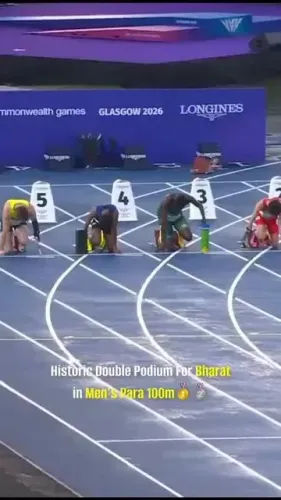
Pranav Desai wins bronze in 100m T64 at Para Asian Games Nagoya 2026
Synopsis
Pranav Desai's bronze in Nagoya ended a four-year wait after his fourth-place finish in Hangzhou — and it landed on India's biggest para-athletics day at these Games. With Dilip Gavit and Mohammed Basil sweeping gold and silver in the 100m T47 and setting a Games Record, India's adaptive sprinters are no longer outliers — they are a force.
Key Takeaways
Pranav Desai won bronze in the men's 100m T64 at the Para Asian Games, Nagoya on 21 October 2026 , clocking 11.96 seconds .
Desai had finished fourth at the Hangzhou Para Asian Games 2022 with a time of 11.91 seconds , improving his position by one place.
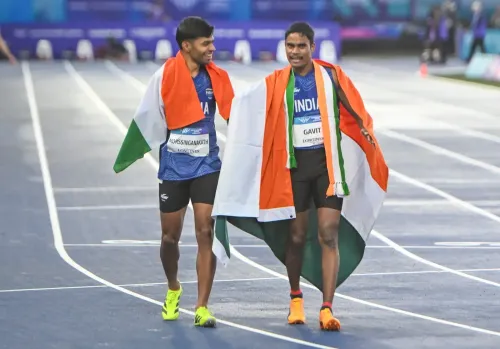
Dilip Gavit Mahadu won gold in the Men's 100m T47 with a time of 10.69 seconds .
Mohammed Basil Morssinganakathi took silver with 10.72 seconds , setting a new Games Record .
The Gavit-Basil one-two mirrors their result at the Commonwealth Games 2026 , where both also swept gold and silver.
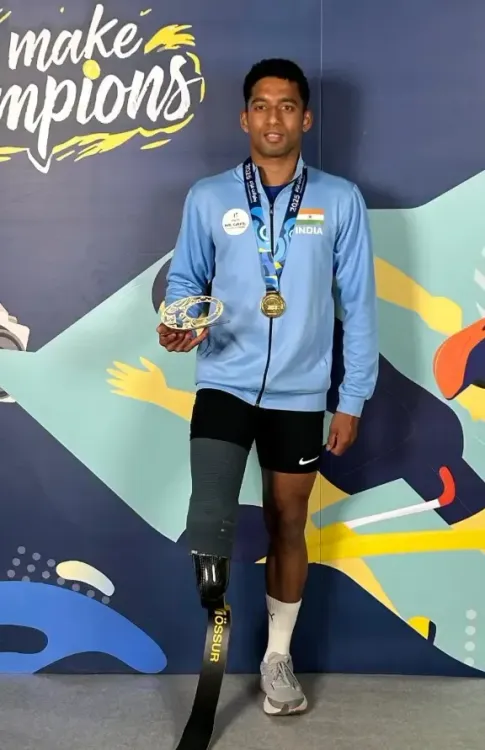
Pranav Desai is a congenital right below-knee amputee from Thane, Maharashtra , competing in para-athletics since 2017 .
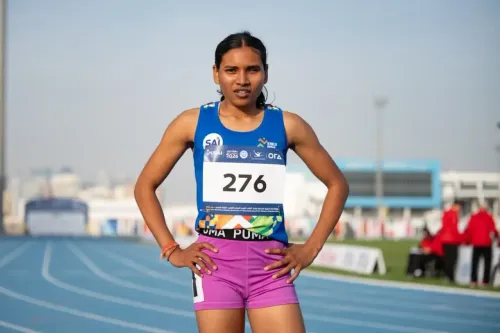
Pranav Desai from Thane, Maharashtra claimed a bronze medal in the men's 100m T64 event at the Para Asian Games in Nagoya on Wednesday, 21 October 2026, clocking 11.96 seconds. The result marks a step forward for the 25-year-old sprinter, who had finished fourth in the same event at the Hangzhou Para Asian Games 2022 with a time of 11.91 seconds.
Pranav's Journey to the Podium
Desai improved his finishing position by one place compared to Hangzhou, even as his time was marginally slower by 0.05 seconds — a reflection of the heightened competition at this edition. A congenital right below-knee amputee, Pranav competes in the T64 classification, which covers athletes with lower-limb impairments who run with a prosthesis — including those with limb deficiency and leg length differences.
He entered para-athletics in 2017 and has since specialised in the T64 sprint category, competing primarily in the 100m and 200m. His Nagoya bronze is widely seen as the culmination of years of disciplined training and consistency on the international circuit.
India's Dominant Day in Para Athletics
Pranav's bronze arrived on a landmark day for Indian para-athletics at Nagoya. Earlier in the session, Dilip Gavit Mahadu, competing in the T46 category, claimed the gold medal in the Men's 100m T47 with a blistering time of 10.69 seconds. His compatriot Mohammed Basil Morssinganakathi, competing in the T47 category, took the silver medal with a time of 10.72 seconds — a new Games Record for the event.
The Gavit-Basil one-two was a direct replica of their performance at the Commonwealth Games 2026, where Dilip Gavit had won gold with a Games Record and Basil had secured silver in the same event, making it a dominant Indian sweep on that occasion as well.
Understanding the T46 and T47 Classifications
The T46 classification applies to standing athletes with a single-arm above- or below-elbow amputation or a similarly significant upper-limb impairment. The T47 classification covers a more moderate upper-limb impairment that permits greater wrist and arm function, and primarily affects performance in sprints and jumps. Both categories represent athletes who compete without prosthetic arms, using their natural running mechanics with upper-body adaptations.
What This Means for India
India's haul from the para athletics track at Nagoya — one gold, one silver, and one bronze across two events — underlines the country's growing depth in adaptive sports. Notably, both the 100m T47 podium finishers and the T64 bronze medallist have competitive histories stretching back several years, suggesting that India's para-athletics pipeline is maturing rather than relying on one-off performances. As the Games continue, India's athletics contingent will look to add further medals in field events and longer sprint distances.
Point of View
And Pranav Desai's T64 bronze consolidates a podium presence that was tantalisingly close in Hangzhou. What mainstream coverage often misses is the classification nuance: these are not interchangeable categories but distinct physical profiles, meaning India is developing depth across multiple impairment bands simultaneously. The challenge ahead is institutional — whether Sports Authority of India and Paralympic Committee of India can convert this track momentum into structured pathways for the next generation of para-sprinters before Los Angeles 2028.
NationPress
21 Oct 2026
Frequently Asked Questions
Who is Pranav Desai and what medal did he win at the Para Asian Games 2026?
Pranav Desai is a para-athlete from Thane, Maharashtra, who won a bronze medal in the men's 100m T64 at the Para Asian Games in Nagoya on 21 October 2026, with a timing of 11.96 seconds. He is a congenital right below-knee amputee competing in para-athletics since 2017.
How does Pranav Desai's 2026 result compare to his Hangzhou 2022 performance?
At the Hangzhou Para Asian Games 2022, Pranav finished fourth with a time of 11.91 seconds. In Nagoya 2026, he clocked 11.96 seconds but improved his finishing position by one place, claiming the bronze medal despite the marginal timing difference.
What is the T64 classification in para-athletics?
The T64 classification is for athletes with lower-limb impairments — including limb deficiency and leg length differences — who compete using a prosthesis. Sprinters in this category run with a blade or running prosthesis on one or both legs.
What did Dilip Gavit and Mohammed Basil achieve in Nagoya?
Dilip Gavit Mahadu won gold in the Men's 100m T47 with a time of 10.69 seconds, while Mohammed Basil Morssinganakathi took silver in 10.72 seconds — a new Games Record. The pair replicated their gold-silver finish from the Commonwealth Games 2026.
What is the difference between T46 and T47 classifications?
T46 applies to athletes with a single-arm above- or below-elbow amputation or a similarly significant upper-limb impairment, while T47 covers a more moderate upper-limb impairment allowing greater wrist and arm function. Both categories are for standing athletes, and the classifications primarily affect sprints and jumps.