BWF World Championships golden-point rule: How 30-29 ended India's thriller
Synopsis
A single rally at 29-29 — badminton's golden point — ended India's 71-minute BWF World Championships thriller against Turkey. Surya and Pramuthesh had won the first game 21-16 and pushed the decider to 24-22, but the sport's hard 30-point ceiling meant one rally in the second game decided everything. It is a rule most fans rarely encounter, and it has never felt more consequential.
Key Takeaways
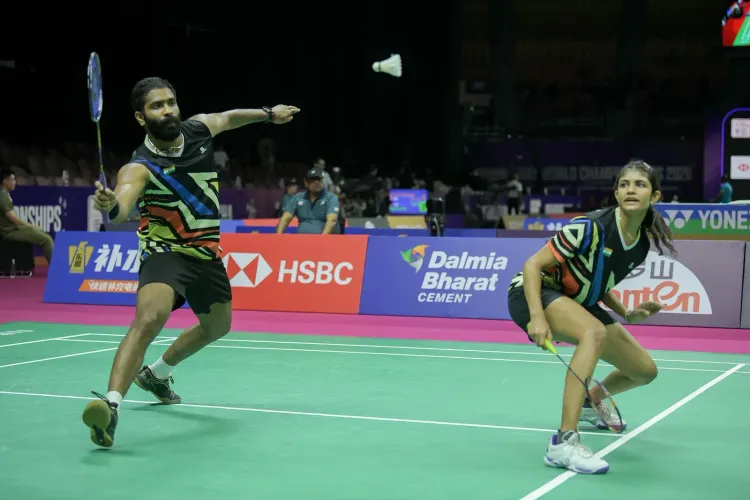
Ashith Surya and Amrutha Pramuthesh lost their BWF World Championships debut to Turkey's Emre Sonmez and Yasemen Bektas 16-21, 30-29, 22-24 at the Indira Gandhi Indoor Stadium on 18 August .
Under badminton's scoring rules, once a game reaches 29-29 , the two-point advantage requirement is waived and the next rally decides the game at 30-29 — the so-called golden point .
Turkey won the decisive 29-29 rally in the second game to level the match, then held on to win the decider 24-22 .
A similar 30-29 scoreline appeared in the 2021 All England final , when Lee Zii Jia beat Viktor Axelsen in the opening game.
The BWF 's proposed 3×15 format would shift the sudden-death threshold to 14-14 , changing how such endgame situations unfold in future tournaments.
Ashith Surya and Amrutha Pramuthesh bowed out of the BWF World Championships on Tuesday, 18 August after a gruelling 71-minute mixed doubles contest against Turkey's Emre Sonmez and Yasemen Bektas at the Indira Gandhi Indoor Stadium in New Delhi. The match ended 16-21, 30-29, 22-24 in Turkey's favour — with a single golden-point rally in the second game proving the decisive turning point of the Indian pair's World Championships debut.
How the Golden-Point Rule Works
Under badminton's standard 21-point scoring system, a player or pair must reach 21 to win a game. Once the score reaches 20-20, however, a two-point cushion is required — meaning the game can extend to 22-20, 23-21, and beyond as long as neither side pulls two clear. There is, crucially, a hard ceiling: once a game reaches 29-29, the two-point requirement is suspended entirely. The very next rally — a single point — decides the game at 30-29. This is what the sport calls the golden point: sudden death with no second chance for the trailing side.
What Happened in the Second Game
Surya and Pramuthesh had taken the opening game comfortably at 21-16, suggesting they had the measure of the Turkish pair. The second game, however, unfolded as an entirely different contest. Neither pair could establish the two-point gap required to close it out. The score climbed through the twenties with both sides matching each other rally for rally, eventually reaching 29-29. At that point, the rules left no room for further drama — one rally would end the game. Sonmez and Bektas won it, levelling the match at one game apiece.
The Golden-Point Rule in Context
The 30-29 scoreline is rare but not without precedent in elite badminton. A notable earlier instance came in the 2021 All England final, when Malaysia's Lee Zii Jia won the opening game against Denmark's Viktor Axelsen 30-29 before claiming the title with a 21-9 win in the decider. The rule exists to prevent games from becoming theoretically endless in the event of sustained deadlock — a practical ceiling that prioritises competitive flow over unlimited extension.
The Proposed Scoring Overhaul
The Badminton World Federation (BWF) has proposed a new 3×15 scoring format that would shift where sudden death comes into play. Under that system, games are played to 15 points; when the score reaches 14-14, the next point is decisive. If a game extends to 20-20, the following rally settles it at 21-20. That format was not in use at the New Delhi World Championships, where the existing 21-point system — with its 30-point ceiling — applied in full.
India's Exit and What It Means
For Surya and Pramuthesh, the defeat was particularly hard to absorb given that they had won the first game convincingly and had multiple opportunities to close out the second before it reached 29-29. The decider also went past the standard winning mark before Turkey finally prevailed 24-22, underlining how competitive the Indian pair remained throughout. Their World Championships debut ended not through a collapse but through the narrowest of margins — one rally at the sport's scoring limit. With the BWF's proposed format changes on the horizon, the dynamics of such endgame situations may look very different in future editions.
Point of View
Designed to reward the stronger side in a tight game, can be entirely neutralised by a single rally at 29-all. For India, the pain is compounded by the fact that they had the first game in hand and came agonisingly close in both subsequent games. The BWF's proposed 3×15 format would lower the sudden-death threshold considerably, but it also raises its own questions about whether shorter games genuinely reward the better pair or simply compress variance. The deeper issue for Indian mixed doubles is not the scoring system — it is the inability to convert leads before the ceiling kicks in.
NationPress
2 Oct 2026
Frequently Asked Questions
What is the golden-point rule in badminton?
The golden-point rule applies when a badminton game reaches 29-29. At that score, the standard two-point advantage requirement is suspended and the very next rally decides the game at 30-29. It functions as sudden death, with no further opportunity for the trailing side.
Why did Turkey win the second game 30-29 without a two-point lead?
Under BWF rules, a two-point cushion is required to win a game once the score reaches 20-20, but that requirement has a hard ceiling at 29-29. Once both pairs reach 29 points, the next rally is decisive regardless of margin. Turkey won that rally to take the second game 30-29.
How did Ashith Surya and Amrutha Pramuthesh perform at the BWF World Championships?
The Indian mixed doubles pair won the opening game 21-16 but lost the second 30-29 at the golden point and the decider 24-22. Their debut lasted 71 minutes in a closely fought three-game contest against Turkey's Emre Sonmez and Yasemen Bektas.
Has a 30-29 scoreline appeared before in elite badminton?
Yes. A notable instance came in the 2021 All England final, when Malaysia's Lee Zii Jia defeated Viktor Axelsen of Denmark 30-29 in the opening game before going on to win the title.
What is the BWF's proposed new scoring format?
The BWF has proposed a 3×15 format in which games are played to 15 points. When the score reaches 14-14, the next point is decisive. If a game extends to 20-20, the following rally settles it at 21-20 — shifting the sudden-death threshold significantly lower than the current 29-29 ceiling.