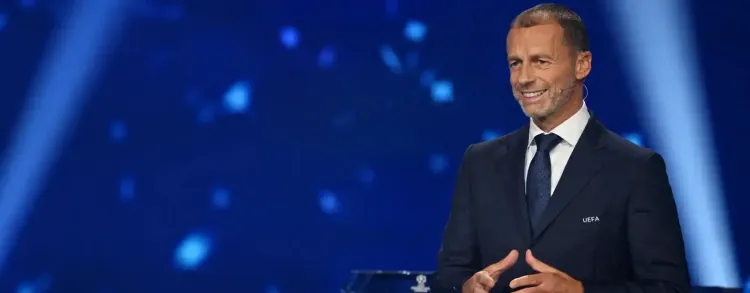
Ceferin to seek final UEFA term after all 55 associations back him
Synopsis
Aleksander Ceferin had already said no — then all 55 UEFA member associations said please. The Slovenian who has steered European football since 2016 through a pandemic, a Super League revolt, and a Champions League overhaul will now stand for one final term at the Astana congress in April 2027, reshaping succession plans across the continent's football establishment.
Key Takeaways
Aleksander Ceferin confirmed he will seek a final term as UEFA President , reversing his earlier decision not to contest the 2027 election .
All 55 UEFA member associations unanimously urged him to reconsider — a level of support described as unprecedented.
The re-election vote will take place at the 51st UEFA Ordinary Congress in Astana, Kazakhstan , on 22 April 2027 .
Ceferin, 58 , has led UEFA since 2016 , overseeing the COVID-19 response, the Super League crisis, and the Champions League format expansion.
The Berlin meeting also produced a near-unanimous UEFA position calling for FIFA governance reforms , with only the Association of Football Federations of Azerbaijan not joining the common position.
Aleksander Ceferin has reversed his earlier decision to step down and will seek a final term as UEFA President, following unanimous backing from all 55 of Europe's national football associations. The Slovenian football administrator confirmed the decision at a meeting with association presidents and general secretaries in Berlin on 8 October 2026.
The Reversal and What Drove It
Ceferin had previously indicated he would not contest the 2027 election. However, sustained pressure from UEFA's member associations — all 55 of them — along with support from other stakeholders across European football, prompted him to reconsider. His confirmation in Berlin marks a significant shift in the succession calculus at one of world sport's most powerful governing bodies.
He will now stand for re-election at the 51st UEFA Ordinary Congress in Astana, Kazakhstan, scheduled for 22 April 2027.
What Ceferin Said
'I want to thank the national associations for their trust. We have faced extraordinary challenges over the past years, and we have faced them as one team. There is still important work ahead, and I have therefore accepted their request,' Ceferin said at the Berlin meeting.
The 58-year-old, who has led UEFA since 2016, framed his decision around continuity and institutional readiness. 'My ambition remains the same: to keep European football united, make our game stronger and leave UEFA ready for the next generation,' he added. He also acknowledged the personal dimension of the choice, thanking his family for their support.
FIFA Governance Also on the Agenda
The Berlin gathering was not solely about Ceferin's candidacy. UEFA members also discussed FIFA governance and leadership, reaching a common position calling for significant reforms at the global body. Notably, all 55 associations backed that position except the Association of Football Federations of Azerbaijan, making it near-unanimous but not entirely without dissent.
This comes amid a broader period of institutional tension between UEFA and FIFA over governance structures, competition formats, and revenue distribution — debates that have sharpened since the collapse of the European Super League proposals in 2021.
What This Means for European Football
Ceferin's decade-long tenure has encompassed the COVID-19 pandemic, the Super League crisis, the expansion of the UEFA Champions League format, and ongoing negotiations over broadcasting rights. A final term would extend his presidency to at least 2031, giving him a runway to embed structural changes before a leadership transition.
With his re-election bid now formalised, attention will turn to whether any rival candidate emerges before the Astana congress — and whether UEFA's push for FIFA reform gains traction under his continued stewardship.
Point of View
But it also signals an absence of a credible successor — a structural problem UEFA has quietly deferred for years. Ceferin's pivot from exit to 'one final term' buys time, but it does not resolve the question of institutional renewal. His tenure has been marked by genuine crises handled with relative coherence, yet UEFA's centralisation of power under his watch has drawn quiet criticism from smaller associations. The pairing of his re-election announcement with a push for FIFA reforms is tactically shrewd — it frames continuity as reform rather than entrenchment. Whether that framing holds depends entirely on what UEFA's FIFA position actually produces in practice.
NationPress
8 Oct 2026
Frequently Asked Questions
Why did Aleksander Ceferin change his mind about seeking re-election as UEFA President?
Ceferin reversed his earlier decision not to contest the 2027 election after all 55 UEFA member associations unanimously urged him to reconsider, alongside broader stakeholder support from across European football. He cited unfinished work and the need for continuity as the reasons for accepting their request.
When and where will the UEFA presidential election take place?
The election will be held at the 51st UEFA Ordinary Congress in Astana, Kazakhstan, on 22 April 2027. Ceferin is currently the only declared candidate.
How long has Aleksander Ceferin been UEFA President?
Ceferin has led UEFA since 2016, making him one of the organisation's longest-serving presidents. A successful re-election in 2027 would extend his tenure to at least 2031.
What did UEFA decide about FIFA governance at the Berlin meeting?
All 55 UEFA member associations, except the Association of Football Federations of Azerbaijan, agreed on a common position calling for significant reforms to FIFA's governance and leadership structures. The near-unanimous stance signals a coordinated push from European football ahead of anticipated debates within FIFA.
What has Aleksander Ceferin's tenure as UEFA President involved?
Ceferin's presidency has spanned the COVID-19 pandemic, the 2021 European Super League crisis, a major overhaul of the UEFA Champions League format, and ongoing negotiations over broadcasting rights and FIFA governance. He has positioned his leadership around keeping European football unified and institutionally strong.