KL Rahul's Historic IPL 152: Six-Hitting Drills with Nayar Changed Everything

Synopsis
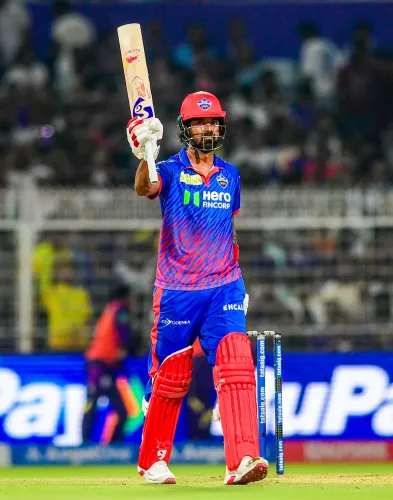
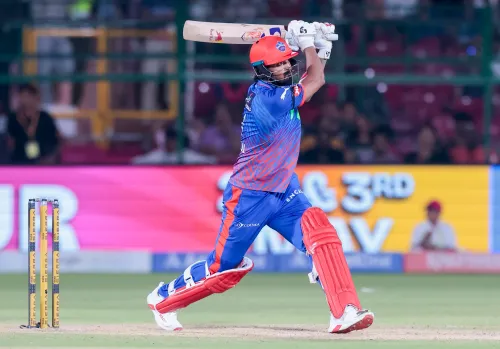
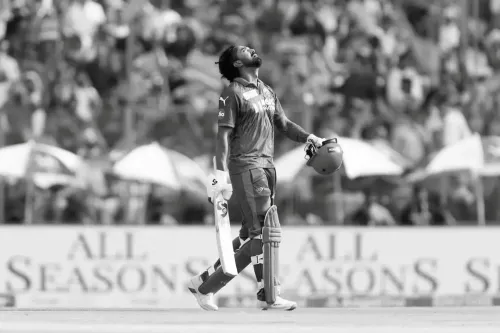
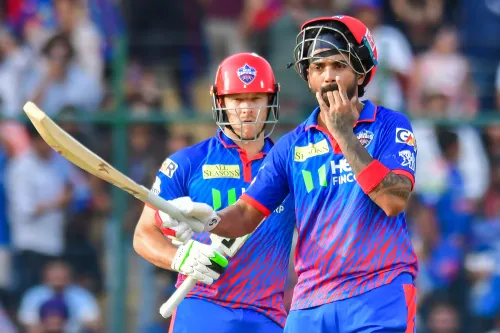
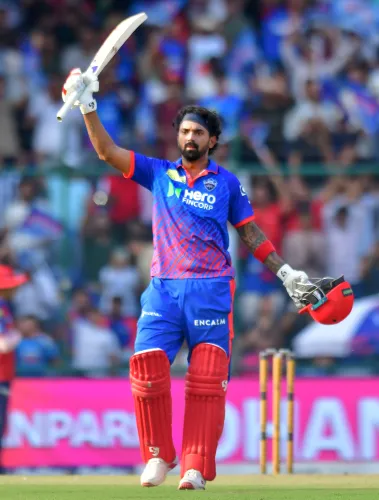
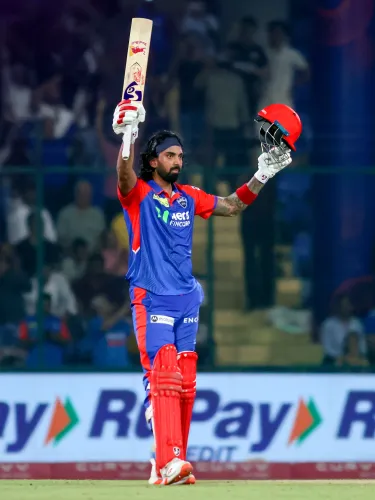
KL Rahul's unbeaten 152 off 67 balls — the highest IPL score by an Indian batter — wasn't luck. It was the product of a deliberate, months-long reinvention under coach Abhishek Nayar, targeting six-hitting and ball-one aggression. At 32, Rahul isn't just breaking records; he's rewriting his entire batting identity.
Key Takeaways
KL Rahul scored an unbeaten 152 off 67 balls for Delhi Capitals at the Arun Jaitley Stadium on April 25 , with a strike rate of 226.86 .
The innings is the highest individual score by an Indian batter in IPL history , surpassing Tilak Varma's previous record.
Rahul credited Abhishek Nayar for helping him overhaul his T20 approach, specifically focusing on six-hitting and ball-one aggression .
Watching the T20 World Cup 2024 and observing younger batters' fearless approach directly prompted Rahul to rethink his Powerplay strategy.
Rahul's score is the third highest in overall IPL history , behind only Chris Gayle (175*) and Brendon McCullum (158*) .
Rahul emphasised that in T20 cricket , targeting 15-16 runs per over through six-hitting is now a necessity, not an option, for opening batters.
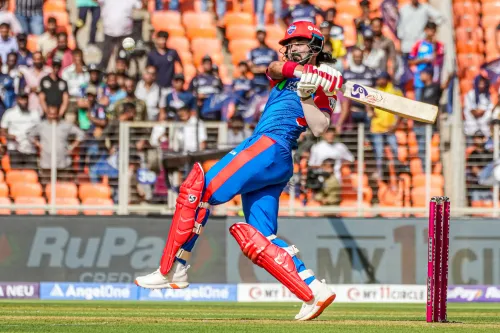
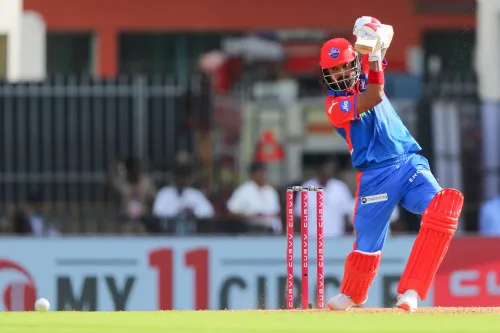
New Delhi, April 25: Delhi Capitals captain KL Rahul blazed his way into IPL history with a stunning unbeaten 152 off 67 balls at the Arun Jaitley Stadium on Saturday, April 25, crediting months of intensive work with batting coach Abhishek Nayar on six-hitting mechanics and Powerplay aggression for the career-defining knock. The innings, studded with 16 fours and nine sixes at a breathtaking strike rate of 226.86, is now the highest individual score by an Indian batter in IPL history and the third highest overall, behind only Chris Gayle (175*) and Brendon McCullum (158*).
A Record-Breaking Innings That Rewrote the History Books
Rahul's 152* also surpassed Tilak Varma's previous record to become the highest individual score by an Indian batter in men's T20 cricket across all competitions. The knock single-handedly propelled Delhi Capitals to what Rahul described as a "winning total" in the IPL 2025 encounter, underlining his transformation from a technically correct accumulator into a modern T20 powerhouse.
Speaking at the post-match presentation ceremony, Rahul was candid about the behind-the-scenes effort that produced this masterclass. "I was very pleased, very happy at the end of the first 20 overs. It's something that I've been working on for a very long time behind the scenes," he said, adding that his extended sessions with Nayar covered both white-ball and red-ball formats but were sharpened specifically for the demands of IPL 2025.
The Nayar Blueprint: Rewiring Rahul's T20 Mindset
Abhishek Nayar, who has worked closely with the Indian national team as an assistant coach and has a reputation for technical precision, played a pivotal role in recalibrating Rahul's approach. Rahul revealed that their conversations centred on one blunt question: what does modern T20 cricket demand, and where was he falling short of those demands?
"We talked a lot about how I can improve, especially in the white-ball game. It was about doing well in the IPL and what I needed to do to catch up with the modern demands of T20 cricket," Rahul explained. The emphasis on six-hitting — not just boundary-hitting — was a deliberate shift, one that Rahul admits required significant mental rewiring alongside physical repetition in the nets.
Notably, Nayar was also part of the support staff during India's T20 World Cup 2024 triumph in the West Indies and USA, where India's batting unit displayed exactly the kind of fearless, from-ball-one aggression that Rahul has now begun to replicate at franchise level. That World Cup, won under Rohit Sharma, became a benchmark Rahul consciously studied.
Watching the T20 World Cup Sparked a Strategic Rethink
Rahul openly admitted that observing younger batters during the T20 World Cup 2024 forced a moment of honest self-assessment. "Watching the T20 World Cup, watching some of the young guys coming in and smashing from ball one — I've spoken about six-hitting and that's something I had to really work on and give myself that freedom to take on the bowling from ball one, ball two," he said.
This is a significant admission from a batter who built his early IPL reputation — most famously during his Punjab Kings and Lucknow Super Giants tenures — on elegant accumulation and calculated acceleration. The T20 landscape has shifted dramatically since those years, with Powerplay run rates now routinely exceeding 10-11 runs per over at the top level, making early aggression non-negotiable.
"There was a time where the T20 game was slightly different where I as an opener could take some time and then accelerate. But today's demand is that the first six overs — the Powerplay — is the most important thing: to get as many runs as you can and put the bowling under pressure," Rahul noted, reflecting a maturity that goes beyond mere technical adjustment.
T20 vs ODI Mindset: No Room for 'Later' in the Shortest Format
Rahul drew a sharp philosophical distinction between the two white-ball formats, one that reveals how deeply he has internalised the T20 ethos. In ODI cricket, he argued, an opener retains the luxury of a short holding phase before unleashing; in T20 cricket, that window simply does not exist.
"In T20 cricket, there's no time to say 'later'. There is time in ODI cricket to say maybe I can hold off for a couple of overs and attack at the back end. But as an opening batter in T20 cricket, I've watched and learned from the guys who've been successful internationally — there's no time to think 'I'm going to go next over'," he said.
He did, however, acknowledge tactical nuance: certain matchups or conditions may still force him to prioritise boundaries over sixes. "There are certain matchups which I feel aren't very favourable and the conditions don't allow me to attack a certain bowler. That's when six-hitting becomes the second option. But throughout the innings, I've had to work really hard on my mental setup to tell myself that six-hitting is what's required and trying to get 15-16 runs in an over is a must in T20 cricket," he explained.
Bigger Picture: What Rahul's Transformation Means for Indian Cricket
Rahul's reinvention carries implications beyond the IPL 2025 points table. At 32, a phase where many top-order batters begin to consolidate rather than evolve, his willingness to deconstruct and rebuild his T20 game is a statement of intent — both for Delhi Capitals and for his India ambitions. The T20I format has seen significant flux in India's opening combination, and a Rahul who can deliver 150-plus scores while maintaining a strike rate above 220 is a compelling case for national recall.
This innings also spotlights the growing influence of specialist batting coaches like Nayar in shaping how elite Indian cricketers approach franchise cricket — a trend that mirrors global T20 ecosystems where data-driven, coach-athlete collaboration is now standard. As IPL 2025 progresses, all eyes will be on whether Rahul can sustain this transformed approach across varied conditions and opposition attacks, potentially making Delhi Capitals genuine title contenders.
Point of View
Rahul has had the intellectual honesty to admit obsolescence and the discipline to act on it. What the mainstream narrative misses is the systemic message here: India's batting culture is finally catching up with the global T20 reality, where technical orthodoxy without explosive intent is a liability, not an asset. If this reinvention holds, the selectors face a compelling dilemma — and Indian T20 cricket becomes richer for it.
NationPress
23 Sept 2026
Frequently Asked Questions
What record did KL Rahul set in IPL 2025?
KL Rahul scored an unbeaten 152 off 67 balls for Delhi Capitals, making it the highest individual score by an Indian batter in IPL history and the third highest overall. He surpassed Tilak Varma's record and now trails only Chris Gayle (175*) and Brendon McCullum (158*) on the all-time list.
How did Abhishek Nayar help KL Rahul improve his T20 game?
Abhishek Nayar worked extensively with KL Rahul on six-hitting technique and the mental approach of attacking from the very first ball. Their sessions focused specifically on adapting to the modern T20 demand of maximising Powerplay overs rather than building an innings gradually.
Why did KL Rahul change his T20 batting approach?
Rahul acknowledged that the T20 format has evolved to the point where early aggression, particularly in the Powerplay, is non-negotiable. Watching young batters dominate during the T20 World Cup 2024 prompted him to re-evaluate his strategy and prioritise six-hitting from ball one.
What is KL Rahul's strike rate in his record IPL innings?
KL Rahul's strike rate in his record 152* innings was 226.86, achieved off 67 balls with 16 fours and nine sixes. It is one of the most dominant Powerplay and overall T20 performances by an Indian batter in IPL history.
How does KL Rahul differentiate between T20 and ODI batting mindset?
Rahul explained that ODI cricket allows an opener to hold back briefly before accelerating, but T20 cricket offers no such window — every over, especially in the Powerplay, must be attacked. He said the mantra in T20 is that there is simply no time to think 'I'll go next over'.