Historic: Sawe Runs Marathon Under 2 Hours at 2026 London
Synopsis
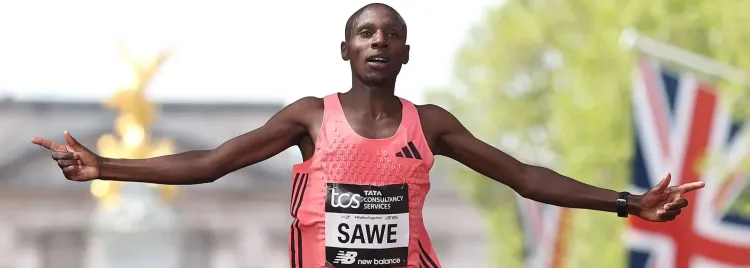
Kenya's Sabastian Sawe made history at the 2026 London Marathon, becoming the first man to legally run a sub-two-hour marathon, clocking 1:59:30 — obliterating Kelvin Kiptum's world record by 65 seconds. Ethiopia's Yomif Kejelcha also broke the barrier in second place, while Tigst Assefa shattered her own women's world record in 2:15:41.
Key Takeaways
Kenya's Sabastian Sawe became the first man in history to legally run a marathon under two hours, finishing the 2026 London Marathon in 1:59:30 on April 26, 2026 .
Sawe's time shattered the previous world record of 2:00:35 set by the late Kelvin Kiptum at the 2023 Chicago Marathon by 65 seconds .
Ethiopia's Yomif Kejelcha also broke the two-hour barrier, finishing second in 1:59:41 — an Ethiopian record and the fastest ever marathon debut in history.
Uganda's Jacob Kiplimo claimed bronze in 2:00:28 , a Ugandan national record that would itself have beaten Kiptum's former world record.
Ethiopia's Tigst Assefa broke her own women's-only marathon world record , winning in 2:15:41 — nine seconds faster than her previous mark of 2:15:50 .
It marked the first time three women finished inside 2:16 in the same race, with Obiri (2:15:53) and Jepkosgei (2:15:55) completing the historic podium.
London, April 27, 2026 (NationPress) — Kenya's Sabastian Sawe etched his name into sporting history on Sunday, April 26, 2026, becoming the first man in history to officially run a marathon in under two hours, clocking 1 hour, 59 minutes, and 30 seconds at the 2026 London Marathon. The 31-year-old Kenyan demolished the previous men's marathon world record of 2:00:35, set by the late Kelvin Kiptum at the 2023 Chicago Marathon, erasing it by a staggering 65 seconds.
A Barrier Humanity Thought Was Impossible
For decades, the two-hour marathon barrier was considered the sport's equivalent of the four-minute mile — a psychological and physiological wall that defined the limits of human endurance. Eliud Kipchoge came agonisingly close in 2019, running 1:59:40.2 in the Ineos 1:59 Challenge in Vienna, but that effort was an unofficial exhibition run — not eligible for world record status due to pacemakers and other controlled conditions. Sawe's achievement in London is the real thing: a legal, competitive, record-breaking sub-two-hour marathon on an open course.
This is not merely a sporting milestone — it is a redefinition of human capability, one that will reverberate through athletics, sports science, and even the global footwear and nutrition industries that have poured billions into making this moment possible.
How the Race Unfolded
From the first kilometre, the 2026 London Marathon was structured for history. The elite lead group — comprising Sawe, Ethiopia's Yomif Kejelcha, Uganda's Jacob Kiplimo (three-time world cross-country champion), Olympic champion Tamirat Tola, 2022 London Marathon winner Amos Kipruto, and Deresa Geleta — moved through the opening 5km in 14:14, equivalent to 2:00:03 pace.
The sextet remained locked together through 10km (28:34) and 15km (43:10), reaching the halfway mark in 1:00:29 — a breathtaking split that signalled something extraordinary was unfolding on the streets of the British capital.
By 30km (1:26:03), the sustained pace began fracturing the group. The decisive breakaway came between 30km and 35km, where Sawe and Kejelcha surged through a 13:54 split, dropping Kiplimo by 21 seconds. The leading duo then accelerated further, covering the next 5km in an electrifying 13:42.
With one mile remaining, defending champion Sawe made the decisive move, breaking clear of Kejelcha to run alone into the history books. He crossed the finish line in 1:59:30 — the first man to legally run a sub-two-hour marathon in competition.
Top Finishers and Record-Breaking Performances
Yomif Kejelcha of Ethiopia finished second in 1:59:41 — an Ethiopian national record, the second-fastest marathon in history, and remarkably, the quickest ever marathon debut by any athlete. Uganda's Jacob Kiplimo claimed bronze in 2:00:28, a Ugandan national record that itself would have beaten Kiptum's former world record.
Amos Kipruto finished fourth in 2:01:39, followed by Tamirat Tola (2:02:59) and Deresa Geleta (2:03:23) — making the top six one of the most extraordinary collections of marathon performances ever assembled in a single race.
Women's Race: Assefa Breaks Her Own World Record
The women's race delivered its own historic chapter. Ethiopia's Tigst Assefa, the defending champion, shattered her own women's-only marathon world record, clocking 2:15:41 — nine seconds faster than the 2:15:50 she had set at the 2025 London Marathon.
A lead quartet of Assefa, Kenya's Hellen Obiri (two-time Boston and New York champion), Joyciline Jepkosgei (2021 London Marathon winner), and Catherine Reline Amanang'ole set an aggressive early tempo, passing 5km in 15:39 and 10km in 31:03. Amanang'ole dropped back before 15km (46:39), leaving the leading trio to reach halfway in 1:06:12 — 30 seconds faster than Assefa's record-setting pace the previous year.
In the closing kilometres, Assefa gradually pulled clear to win in 2:15:41. Obiri, making her London Marathon debut, finished second in a personal best of 2:15:53, with Jepkosgei third in 2:15:55 — marking the first time in history that three women have finished inside 2:16 in the same race.
The Bigger Picture: What This Moment Means for Athletics
The sub-two-hour marathon barrier has long been the sport's most coveted frontier. Kelvin Kiptum, who set the previous record of 2:00:35 in Chicago in October 2023, tragically died in a road accident in Kenya in February 2024, never getting the chance to defend or extend his legacy. Sawe's achievement carries an emotional weight — it builds on a lineage of Kenyan distance running greatness while also closing a chapter that Kiptum's untimely death had left painfully open.
Notably, the role of advanced carbon-plated footwear technology — pioneered by brands like Nike, Adidas, and On Running — cannot be understated. Sports scientists estimate these shoes alone contribute a 2-4% improvement in running economy, a factor that has compressed what once seemed like decades of progress into just a few years. The 2026 London Marathon may well be remembered not just as a sporting event but as the moment that permanently reset what the human body is believed capable of achieving.
As athletics enters this new era, all eyes will turn to whether Sawe can defend his record at future major marathons, and whether the 1:58 barrier — once unthinkable — is now merely a matter of time.
Point of View
The athletic equivalent of the moon landing. What makes this moment even more layered is its emotional backdrop: Sawe's achievement directly supersedes the legacy of Kelvin Kiptum, the Kenyan prodigy who set the previous record and died tragically in 2024 before the world could fully appreciate his genius. The mainstream narrative will celebrate the split times and the shoes — but the deeper story is about how Kenya continues to produce generational talent from economically marginalised communities, while the global sportswear industry quietly harvests billions from their sacrifice. The sub-two-hour barrier has fallen, but the question of who truly benefits from this milestone — the athletes, their nations, or the corporations — deserves equal scrutiny.
NationPress
19 Sept 2026
Frequently Asked Questions
Who was the first man to run a marathon in under two hours?
Kenya's Sabastian Sawe became the first man to officially run a marathon in under two hours, clocking 1:59:30 at the 2026 London Marathon on April 26, 2026. This was a legal, competitive world record, unlike Eliud Kipchoge's 1:59:40 exhibition run in 2019 which did not count as an official record.
What was Sabastian Sawe's time at the 2026 London Marathon?
Sabastian Sawe finished the 2026 London Marathon in 1 hour, 59 minutes, and 30 seconds (1:59:30). This broke the previous world record of 2:00:35 set by Kenya's Kelvin Kiptum at the 2023 Chicago Marathon by 65 seconds.
Did Eliud Kipchoge run a marathon under two hours?
Yes, Eliud Kipchoge ran 1:59:40.2 in the 2019 Ineos 1:59 Challenge in Vienna, but it was an unofficial exhibition run and not eligible for world record status. Sabastian Sawe's 1:59:30 at the 2026 London Marathon is the first legal sub-two-hour marathon in competitive history.
What happened to the previous marathon world record holder Kelvin Kiptum?
Kelvin Kiptum of Kenya set the previous marathon world record of 2:00:35 at the 2023 Chicago Marathon. He tragically died in a road accident in Kenya in February 2024, never having the opportunity to defend his record.
Who won the women's 2026 London Marathon?
Ethiopia's Tigst Assefa won the 2026 London Marathon women's race in 2:15:41, breaking her own women's-only world record of 2:15:50 set at the 2025 London Marathon. Kenya's Hellen Obiri finished second in 2:15:53 and Joyciline Jepkosgei third in 2:15:55.