FIFA World Cup 2026: Uruguay squad arrives in Miami after permit chaos delays Cancun flight

Synopsis
Uruguay's World Cup began not on the pitch but in an airport. A US entry permit error grounded their Cancun flight for two to three hours on Monday, with Telemundo reporting FIFA's administrative lapses as the cause — even as FIFA publicly blamed the airline. With the tournament spanning three nations for the first time, this episode raises real questions about cross-border logistics for the remaining fixtures.
Key Takeaways
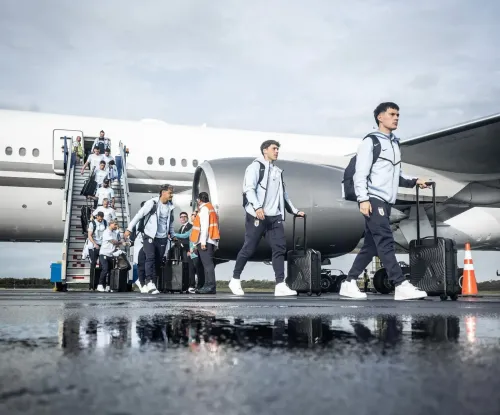
Uruguay's squad arrived in South Florida on Monday, 16 June 2026 after a 2-3 hour delay caused by a US entry permit issue in Cancun, Mexico .
The squad eventually flew out on an Aeromexico flight after the original aircraft was found to lack US airspace clearance.
FIFA attributed the error to 'an airline permitting error in Mexico'; a Telemundo report pointed to FIFA's own administrative lapses.
Uruguay face Saudi Arabia in a Group H opener on Tuesday at Hard Rock Stadium , Miami.
This is Uruguay's 15th World Cup and fifth consecutive appearance since their fourth-place finish at South Africa 2010 .
FIFA World Cup 2026 is the first edition hosted across three nations — the US, Canada, and Mexico — making cross-border logistics a known operational risk.
Uruguay's national football squad touched down in South Florida on Monday, 16 June 2026, after a flight from Cancun, Mexico was held up by a US entry permit issue, disrupting the team's pre-match preparations ahead of their FIFA World Cup 2026 opener. The delay, which pushed the team's schedule back by two to three hours, has drawn scrutiny over logistical arrangements for the tournament.
What Caused the Delay
The Uruguayan squad had completed a training session in Cancun on Sunday morning and was scheduled to depart for Fort Lauderdale at around 2:00 PM on Monday. However, the originally assigned aircraft was not authorised to enter the United States, reportedly due to a paperwork error with the plane's US entry permits.
According to Uruguayan media, the flight the squad was scheduled to board from Cancun lacked the necessary clearance to cross into US airspace. A report by Telemundo claimed that FIFA, the governing body responsible for arranging charter flights for participating teams, caused the hold-up at Cancun Airport due to administrative lapses.
What FIFA Said
FIFA issued a statement acknowledging the disruption but attributed the root cause to the airline rather than its own operations. 'Due to an airline permitting error in Mexico, the Uruguay national team's departure from Cancun to Miami was delayed. The airline has apologised for the inconvenience caused,' FIFA said.
FIFA added that it 'remained in close contact with the Uruguay national team throughout their delay and worked alongside airport and operational partners to help expedite the process and minimise disruption to the team's travel arrangements.' The squad eventually departed on an Aeromexico flight, arriving in South Florida ahead of their scheduled fixture.
Uruguay's World Cup Stakes
La Celeste will face Saudi Arabia in a Group H opener on Tuesday at Hard Rock Stadium in Miami. This marks Uruguay's 15th FIFA World Cup appearance and their fifth consecutive tournament since a memorable return at South Africa 2010, where they finished fourth.
The team secured their place at the 2026 edition through a hard-fought qualification campaign in the South American preliminaries, clinching a direct berth after what was described as a rollercoaster run. The travel disruption adds an unwelcome footnote to their build-up, though the squad did arrive in time to check into their hotel before the match.
Broader Concerns Over Tournament Logistics
The incident is unlikely to be isolated. With FIFA World Cup 2026 being the first edition to span three host nations — the United States, Canada, and Mexico — cross-border logistics for teams, officials, and fans are considerably more complex than previous tournaments. Permit and clearance issues at borders between host countries were flagged as a potential friction point during the planning phase, and this episode suggests those concerns were not entirely resolved ahead of kick-off.
Notably, this is not the first time FIFA's operational management of team travel has faced criticism at a major tournament. Whether the governing body tightens charter flight protocols for the remaining group-stage fixtures remains to be seen.
Point of View
So if the error originated in its own logistics chain, the deflection to the airline is a credibility problem. More broadly, a three-nation World Cup was always going to stress-test cross-border travel protocols, and this incident — days into the group stage — suggests the operational framework has gaps. The question is whether FIFA audits its charter arrangements before a similar disruption hits a team on a tighter turnaround.
NationPress
25 Sept 2026
Frequently Asked Questions
Why was Uruguay's flight from Cancun delayed before the FIFA World Cup 2026?
Uruguay's flight was delayed because the originally assigned aircraft was not authorised to enter the United States, due to a paperwork error with US entry permits. The squad eventually departed Cancun on an Aeromexico flight, arriving in South Florida roughly two to three hours behind schedule.
Who was responsible for the Uruguay flight delay — FIFA or the airline?
FIFA's official statement attributed the error to 'an airline permitting error in Mexico.' However, a Telemundo report claimed FIFA, which is responsible for arranging charter flights for World Cup teams, caused the delay through its own administrative lapses. The exact locus of responsibility remains contested.
When and where does Uruguay play their first FIFA World Cup 2026 match?
Uruguay face Saudi Arabia in a Group H opener on Tuesday at Hard Rock Stadium in Miami, Florida. The match is Uruguay's first fixture of the 2026 tournament.
How many FIFA World Cups has Uruguay participated in?
The FIFA World Cup 2026 is Uruguay's 15th World Cup appearance and their fifth consecutive tournament. They made a memorable return at South Africa 2010, finishing fourth, and have qualified for every edition since.
Why are logistics more complex at the 2026 FIFA World Cup?
The 2026 edition is the first World Cup co-hosted by three nations — the United States, Canada, and Mexico — requiring teams, officials, and fans to navigate cross-border travel and varying permit requirements. This structural complexity was flagged as a potential risk during planning and appears to have contributed to Uruguay's travel disruption.