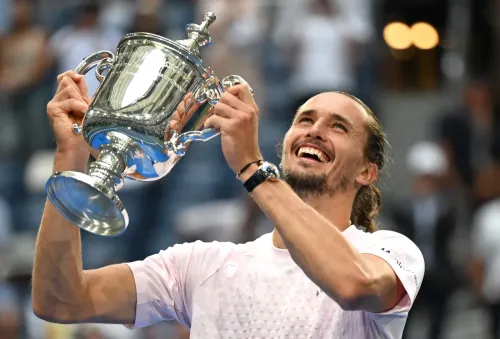
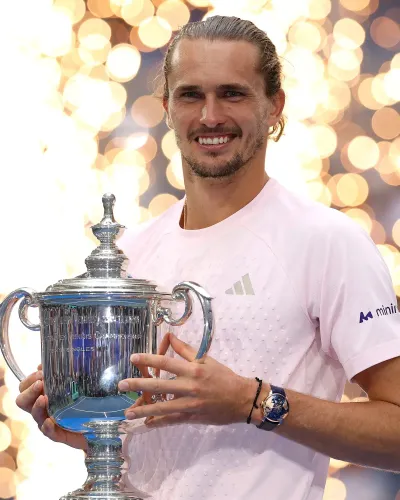
Zverev reaches World No. 1: How Type 1 diabetes shaped his path to the top

Synopsis
Alexander Zverev reached World No. 1 after winning two Grand Slams in 2026 — but the more striking story is what he had to overcome. Diagnosed with Type 1 diabetes at four, told by doctors a pro career was nearly impossible, he has now scaled the sport's highest peak and is using the platform to tell the world's diabetic families: everything is possible.
Key Takeaways
Alexander Zverev became the 30th player to reach World No.
1 on 2 November 2026 , also securing the year-end top spot.
He won his first two Grand Slams in 2026 — Roland Garros and the US Open .
At 29 years and six months , he is the second-oldest player to reach No.
1 for the first time, behind only John Newcombe (1974).
Zverev was diagnosed with Type 1 diabetes at age four ; doctors reportedly told his family a professional sports career would be nearly impossible.
His mother, Irina , shielded him from those medical conversations and coached him until the age of 16 .
He founded the Alexander Zverev Foundation to support children living with diabetes and dedicated the ranking to them.
Alexander Zverev made tennis history on Monday, 2 November 2026, becoming the 30th player ever to reach World No. 1 in men's singles — a milestone made all the more remarkable by a Type 1 diabetes diagnosis he has carried since the age of four. In a personal note published on the ATP website, the German star reflected on how the illness, and his mother's fierce refusal to let it define his future, shaped the champion he has become.
A Historic Rise to the Top
Zverev's ascent to the summit was built on a dominant 2026 season. He claimed his first two Grand Slam titles this year — Roland Garros and the US Open — to complete a long-anticipated breakthrough at the Majors level. At 29 years and six months, he is the second-oldest player to reach World No. 1 for the first time, behind only John Newcombe, who topped the rankings at 30 years old in 1974. Zverev also secured the coveted year-end No. 1 spot, capping a calendar year of extraordinary depth. He is already an Olympic champion, a two-time ATP Finals winner, and a 26-time tour-level title holder.
The Diabetes Diagnosis That Could Have Ended It All
Zverev was diagnosed with Type 1 diabetes at the age of four. Doctors, he recalled, told his family that a professional sports career would be 'nearly impossible' — words his mother, Irina, refused to accept. She shielded her young son from those medical conversations entirely. 'My mom would send me out of the room during those conversations, because she did not want me to hear what was going on,' Zverev wrote. To manage the condition during matches, he takes injections and monitors his blood sugar levels — a routine that began in his earliest school years.
'I don't want to say living with Type 1 diabetes helped me in my tennis career, or in life in general. But it definitely made me grow up a bit quicker than I probably would have done without it,' he said. The discipline required to manage a chronic illness from childhood, he suggested, built a resilience that his rivals without such pressures may not have needed to develop as early.
The Role of His Mother, Irina
With his father, Alexander Sr., and older brother, Mischa, frequently away on junior tour commitments, Irina became the central figure in Zverev's formative years — both as a parent managing a child's diabetes and as his tennis coach until the age of 16. 'When that happened, my mom said, 'Okay, he's still going to be able to play tennis. He's still going to be able to achieve the dreams that he has',' Zverev quoted her as saying. He credited that unflinching belief as the reason he entered adulthood with no doubt about his own potential. 'Because of that, I never really had any doubt that I could achieve anything, and that was thanks to having a very strong mother by my side,' he wrote.
A Ranking Dedicated to Diabetic Families Worldwide
Zverev was candid about the circumstances of the ranking change, acknowledging that current World No. 1 Jannik Sinner's injury played a part. 'It's a weird circumstance because of Jannik's injury. This is not the way that you want to reach the top of the sport,' he admitted. But he framed the achievement in terms larger than himself, connecting it to the Alexander Zverev Foundation, which he established to support children living with diabetes. 'Most importantly, I feel like me being World No. 1 is extremely important to a large group of people who have the same issues with diabetes. This is not about me,' he wrote. He concluded with a message of hope: 'Everything is possible and you will be able to live a fulfilled life with it. I'm proud as a Type 1 diabetic to show that to families dealing with the disease.'
What Comes Next
With two Grand Slams, a year-end No. 1, and a personal narrative that resonates far beyond sport, Zverev enters the final stretch of 2026 as the face of men's tennis. Whether he can sustain the top ranking into the 2027 season — and defend his Slam titles — will be the next chapter of a story that has already defied what doctors once thought possible.
Point of View
But the more consequential story is what it signals for perceptions of chronic illness in elite sport. Diabetes management during Grand Slam matches — mid-game injections, blood-sugar monitoring under competitive pressure — is not a footnote; it is a feat of physiological discipline that most opponents never face. The medical establishment's early prognosis against a professional career, now demonstrably wrong, should prompt reflection on how conservatively such advice is still given to young patients. And Zverev's deliberate use of his World No. 1 platform for the diabetic community, rather than pure personal branding, is a model of athlete advocacy that goes beyond the routine charitable gesture.
NationPress
2 Nov 2026
Frequently Asked Questions
When did Alexander Zverev become World No. 1?
Alexander Zverev reached World No. 1 on 2 November 2026, becoming the 30th player in history to hold the top ranking in men's tennis. He also secured the year-end No. 1 spot for 2026.
How did Zverev reach World No. 1 in 2026?
Zverev won his first two Grand Slams in 2026 — Roland Garros and the US Open — to climb to the top of the ATP rankings. He acknowledged that Jannik Sinner's injury also played a role in the timing of the ranking change.
What is Alexander Zverev's Type 1 diabetes story?
Zverev was diagnosed with Type 1 diabetes at the age of four. Doctors told his family that a professional sports career would be nearly impossible, but his mother Irina refused to accept that prognosis and shielded him from those conversations. He now manages the condition during matches with injections and blood-sugar monitoring.
What is the Alexander Zverev Foundation?
The Alexander Zverev Foundation was established by Zverev to provide support for children living with Type 1 diabetes. He has said that his World No. 1 ranking is dedicated to the wider community of people living with the disease.
Is Zverev the oldest player to become World No. 1 for the first time?
No. At 29 years and six months, Zverev is the second-oldest player to reach World No. 1 for the first time. John Newcombe holds that record, having first topped the rankings at 30 years old in 1974.