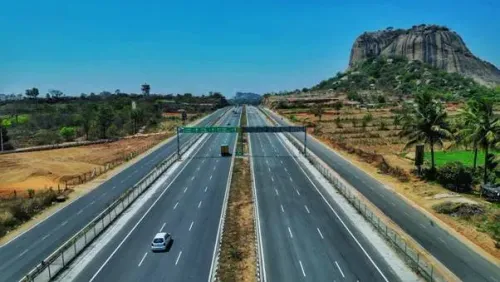
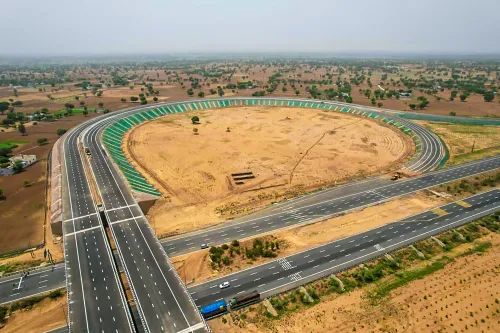
Did the Centre really construct 57,125 km of national highways in the last 5 years?
Synopsis
The Indian government has made significant strides in highway construction, achieving over 57,000 km in five years. This remarkable feat has not only enhanced connectivity but also created millions of job opportunities, emphasizing the infrastructure sector's crucial role in economic growth.
Key Takeaways
The government constructed 57,125 km of National Highways in five years.
Average annual employment generation is approximately 33 crore person-days .
Target to operationalize 18,000 km of Expressways by 2028-29 .
National Highway network length increased from 91,287 km to 1,46,572 km .
Improved logistics efficiency is a driver of economic growth.
New Delhi, Feb 4 (NationPress) The government has successfully built 57,125 km of National Highways over the past five years, averaging 34,215 lane-km per year. This achievement has resulted in an average annual employment generation of approximately 33 crore person-days, encompassing both direct and indirect job opportunities, as reported by Road Transport and Highways Minister Nitin Gadkari in Parliament on Wednesday.
The government aims to operationalize 18,000 km of access-controlled National Expressways by 2028-29. Furthermore, it plans to award 26,000 km of access-controlled Expressways by 2032-33. Development initiatives are also underway for ring roads and bypasses in cities with populations exceeding five lakh, as mentioned by the minister in a written response to the Rajya Sabha.
Moreover, the government is enhancing connectivity to ports based on the priorities set by the Ministry of Shipping, Ports and Waterways, as well as improving access to industrial nodes as per the National Industrial Corridor Development Corporation (NICDC). These developments are expected to enhance logistics efficiency and serve as a catalyst for economic growth, Gadkari asserted.
The minister highlighted that the infrastructure sector serves as the backbone of the economy, contributing significantly to rapid economic growth and development. The length of the National Highway (NH) network has expanded from 91,287 km in March 2014 to 1,46,572 km presently.
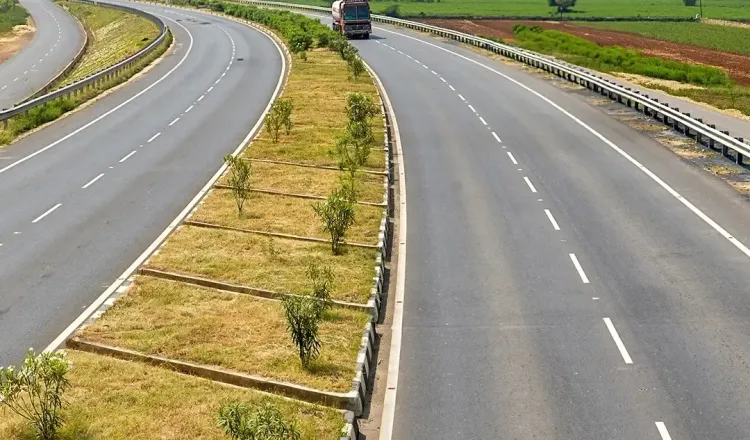
The NHs are primarily designed for long-distance connectivity. With increased budget allocations over the years, the quality of roads has improved significantly. The length of operational access-controlled National High Speed Corridors (HSCs)/Expressways has surged from 93 km in 2014 to 3,052 km today. Additionally, the length of four-lane and above NH networks, including access-controlled HSCs/Expressways, has escalated by 2.6 times from 18,371 km in 2014 to 48,568 km now.
The proportion of NHs with fewer than 2 lanes has declined from 30 percent in 2014 to 9 percent of the total NH network. These advancements have greatly improved connectivity and accessibility for urban, rural, and industrial areas across the country, according to Gadkari.
A study by IIT Kanpur indicates that constructing 1 lane-km of National Highway results in the creation of 4,478 person-days of direct employment and 5,297 person-days of indirect employment. Moreover, the long-term effects of highway construction lead to an induced employment generation of 52,393 person-days per lane-km over seven years, driven by heightened economic activity in the region, he noted.
Point of View
It's clear that the construction of over 57,000 km of national highways is a landmark achievement for the Indian government. This development not only boosts employment but also enhances connectivity which is vital for both urban and rural growth. The focus on infrastructure aligns with national priorities, positioning the country for greater economic progress.
NationPress
19 Sept 2026
Frequently Asked Questions
How many kilometers of national highways have been built in the last five years?
The government has constructed 57,125 km of national highways over the past five years.
What is the average annual employment generated by this construction?
The construction has led to an average annual employment generation of about 33 crore person-days .
What is the target for access-controlled National Expressways?
The government aims to operationalize 18,000 km of access-controlled National Expressways by 2028-29 .
How has the NH network length changed since 2014?
The NH network length has increased from 91,287 km in March 2014 to 1,46,572 km currently.
What impact does highway construction have on employment?
According to a study by IIT Kanpur, constructing 1 lane-km leads to a total of 52,393 person-days of induced employment over seven years.