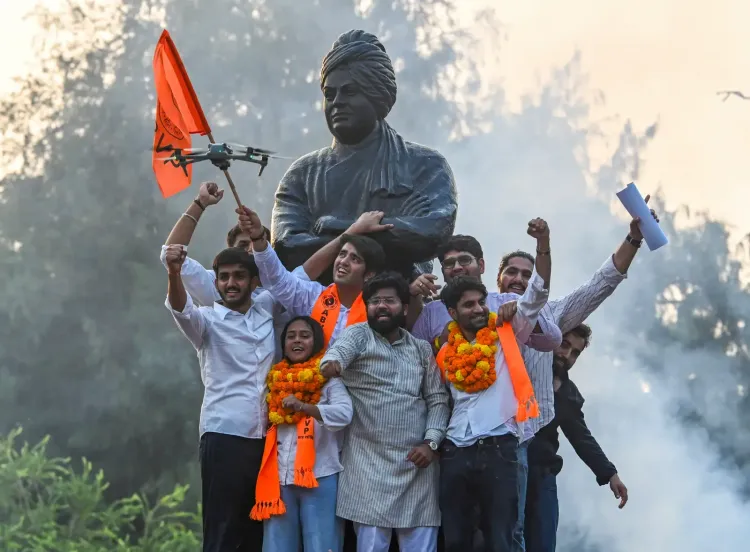
ABVP wins DUSU 2026 polls 3-0, calls it triumph of nationalism over divisive politics
Synopsis
ABVP's 3-0 sweep of DUSU's top posts — President, Secretary, and Joint Secretary — is being framed not merely as a student election win but as a Gen-Z endorsement of nationalism over caste and divisive politics. The result extends ABVP's long dominance at Delhi University and deals a setback to the combined weight of NSUI, Congress, and AAP machinery in a contest both sides treated as a proxy political battle.
Key Takeaways
ABVP won 3 out of 4 seats in the DUSU elections held on 19 September 2026 .
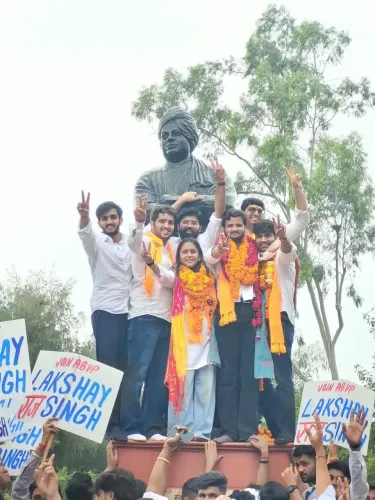
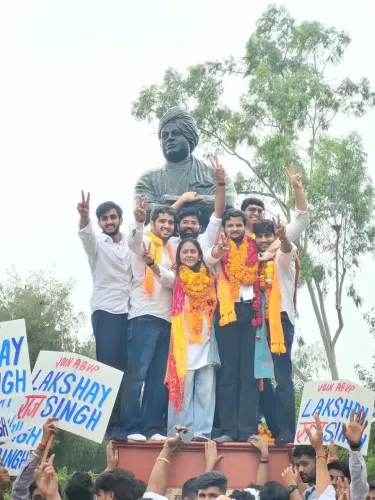
Yash Dabas won the President's post , Riya Chhawadi won the Secretary's post , and Lakshya Raj Singh won the Joint Secretary's post .
ABVP described the win as a triumph of 'harmony, patriotism, and Nation First' values among Delhi University's Gen-Z students.
ABVP National General Secretary Virendra Singh Solanki alleged 'instances of violence and attempts to rig votes' during the polls.
The outfit said it faced the combined opposition of the NSUI , Congress , AAP , and other organisations — and still prevailed on 3 of the 4 seats.
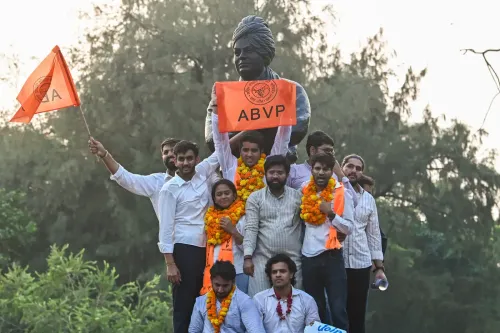
The Akhil Bharatiya Vidyarthi Parishad (ABVP) on Saturday, 19 September 2026 swept three of four contested seats in the Delhi University Students' Union (DUSU) elections, claiming the result as a victory for harmony, patriotism, and a 'Nation First' ethos over what it described as the combined political machinery of rival parties. The wins — covering the posts of President, Secretary, and Joint Secretary — came against candidates backed by the National Students' Union of India (NSUI), the Aam Aadmi Party (AAP), and allied organisations.
Who Won and What They Said
Yash Dabas secured the President's post, Riya Chhawadi won the Secretary's post, and Lakshya Raj Singh claimed the Joint Secretary's post for the ABVP. The fourth seat was not won by the outfit.
Dabas said the mandate 'represents the trust, harmony, and patriotism of the students of Delhi University,' adding that the result sends a message that the students' union must 'rise above caste and divisive politics and work on issues of student interest and national interest.' He pledged to 'strongly raise the voice of every student through the students' union.'
Newly elected Secretary Chhawadi said her priority would be 'the safety of female students, improved student facilities, equal opportunities, and a positive academic environment.' Joint Secretary Singh framed the win as a mandate to 'convert trust into ground work and remain continuously available to solve the problems of every student.'
ABVP's Reading of the Result
ABVP National General Secretary Virendra Singh Solanki acknowledged there were 'instances of violence and attempts to rig votes through fraudulent means during the elections,' but said workers 'remained patient and democratically elected.' He contrasted the ABVP's candidate-selection process — which he described as being driven by internal organisational votes — with what he characterised as top-down decisions taken at Indira Bhawan, a reference to the Congress headquarters.
Solanki said the 3-0 outcome was 'a testament to the students' trust and ABVP's organisational commitment,' and argued that India's Gen Z 'is cultured, nationalistic, and believes in harmony.'
State Unit's Take on Opposition's Role
ABVP Delhi State Secretary Sarthak Sharma said the results demonstrated that 'success in student politics is not possible with the help of the Congress political machinery.' He argued that the NSUI's failure — despite what he described as 'active involvement of the entire Congress political machinery, AAP, and other organisations' — proved that student trust is earned 'through consistent work, ideas, and activism among students,' not political resources or external influence.
Context and What It Means
The DUSU elections are among the most closely watched student union contests in India, often read as a bellwether for youth sentiment in the national capital. The ABVP, backed by the Rashtriya Swayamsevak Sangh (RSS) and aligned with the Bharatiya Janata Party (BJP), has historically dominated the union, and this result extends that pattern. Critics, however, argue that student union contests in Delhi are rarely insulated from adult party politics — a point implicitly acknowledged by both sides' framing of this election as a battle involving national party structures. The NSUI, ABVP's principal rival, is the student wing of the Indian National Congress (Congress).
With the new office-bearers now set to take charge, attention will turn to whether the incoming DUSU leadership delivers on its stated agenda of student welfare, campus safety, and academic improvements — areas that have historically generated friction between the union and university administration.
Point of View
But the framing — 'Gen Z is nationalistic, not casteist' — is doing considerable political work for the BJP's parent ecosystem ahead of a string of state elections. The more interesting question is whether DUSU office-bearers will press the university administration on campus safety and academic access, or whether the union becomes primarily a mobilisation platform. Historically, ABVP-held DUSUs have struggled to separate student welfare from party posturing — and the new leadership's early statements suggest that tension remains unresolved. Allegations of violence and vote-rigging attempts, raised by ABVP itself, also deserve scrutiny beyond the winner's framing.
NationPress
19 Sept 2026
Frequently Asked Questions
Who won the DUSU elections 2026?
ABVP candidates won three of four seats in the 2026 DUSU elections. Yash Dabas won the President's post, Riya Chhawadi won the Secretary's post, and Lakshya Raj Singh won the Joint Secretary's post.
What is the ABVP and who backs it?
The Akhil Bharatiya Vidyarthi Parishad (ABVP) is a student organisation backed by the Rashtriya Swayamsevak Sangh (RSS) and ideologically aligned with the Bharatiya Janata Party (BJP). It is one of the largest student outfits in India and has historically dominated the Delhi University Students' Union.
Which parties backed the opposition in DUSU 2026?
The ABVP's principal rivals were backed by the National Students' Union of India (NSUI), the student wing of the Indian National Congress, along with the Aam Aadmi Party and other organisations, according to ABVP's post-result statements.
Were there any irregularities reported during the DUSU elections?
ABVP National General Secretary Virendra Singh Solanki said there were 'instances of violence and attempts to rig votes through fraudulent means' during the elections. He added that ABVP workers 'remained patient and democratically elected' despite these alleged incidents.
What are the priorities of the newly elected DUSU leadership?
Newly elected President Yash Dabas pledged to raise student issues above caste and divisive politics. Secretary Riya Chhawadi said her focus would be on safety of female students, improved facilities, and a positive academic environment, while Joint Secretary Lakshya Raj Singh committed to addressing the problems of every student.