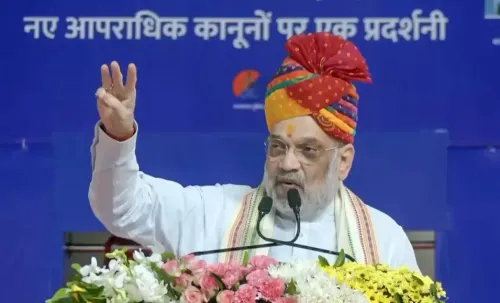
New criminal laws tech-driven, victim-centric: Amit Shah in Kolkata

Synopsis
Amit Shah used a Kolkata exhibition to do two things at once: defend India's new criminal laws as a victim-first, tech-backed overhaul — and land political blows on the outgoing TMC government for allegedly stalling their rollout. With West Bengal now brought under the BNS-BNSS-BSA framework, the real test is whether forensic and digital infrastructure can match the legislative ambition.
Key Takeaways
Home Minister Amit Shah addressed an exhibition in Kolkata on 21 August highlighting provisions of the BNS , BNSS , and BSA .
Shah called the new laws more transparent, technology-oriented, and victim-centric compared to the colonial-era IPC , CrPC , and Evidence Act .
Key features cited: Zero FIR , E-FIR , electronic evidence , forensic evidence , and online court proceedings .
Shah accused the former TMC government of deliberately delaying notification of the new laws in West Bengal .
New Chief Minister Suvendu Adhikari reportedly signed the implementation file as his first official act in office.
Kar , Kasba Law College , Sandeshkhali , and Durgapur Medical College cases as examples of alleged investigative failure under the previous administration.
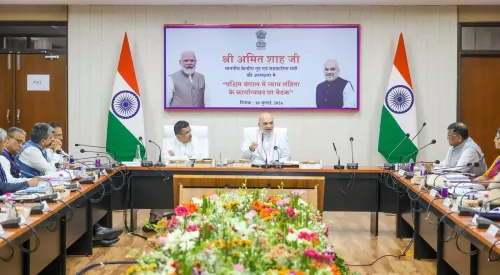
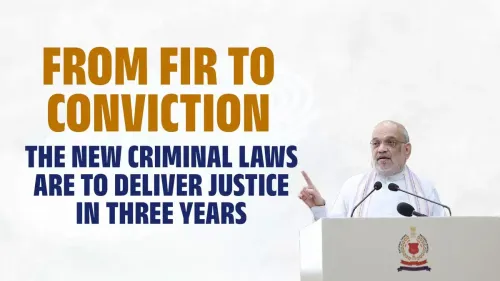
Union Home Minister Amit Shah on Friday, 21 August championed the three new criminal laws — Bharatiya Nyaya Sanhita (BNS), Bharatiya Nagarik Suraksha Sanhita (BNSS), and Bharatiya Sakshya Adhiniyam (BSA) — as a decisive break from India's colonial-era justice framework, calling them more transparent, technology-driven, and timeline-oriented. Shah made the remarks while addressing an exhibition in Kolkata showcasing the provisions of the three laws.
What the New Laws Introduce
Shah underscored that the reformed legal architecture prioritises victims over punishment — a structural departure from the system it replaces. Key provisions he highlighted include Zero FIR, E-FIR, electronic evidence, forensic evidence, and online court proceedings. 'The three new laws are intended to strengthen the protection of citizens, property and victims while speeding up the criminal justice process,' Shah said. 'At the same time, they are more victim-centric rather than punishment-centric, unlike the previous system.'
Shah's Attack on the Previous West Bengal Government
Shah levelled sharp criticism at the former Trinamool Congress (TMC) government led by Chief Minister Mamata Banerjee, accusing it of deliberately withholding the notification required to implement the three laws in West Bengal. 'The notification was not issued deliberately out of fear that the castles of corruption built by the previous ruling party would collapse in minutes following the implementation of the three new laws,' he alleged.
Shah claimed that the first official act of incoming Chief Minister Suvendu Adhikari after assuming office was to sign the file implementing the new codes and retiring the British-era statutes. 'From there, the work of building trust instead of fear began,' he added.
Cases Cited as Evidence of Systemic Failure
The Home Minister went further, alleging that the previous TMC administration failed to conduct proper investigations in several high-profile cases. He specifically named the R.G. Kar rape and murder case, the Kasba Law College case, assaults on women at Sandeshkhali, and the Durgapur Medical College rape case as instances where, he claimed, investigations were inadequate. These references are likely to intensify the political battle between the Bharatiya Janata Party (BJP) and the TMC ahead of the West Bengal assembly cycle.
Technology as the Backbone of Reform
Shah stressed that increased reliance on technology-based evidence collection would directly accelerate trial timelines. 'We are emphasising increased use of technology in the new code of justice so that the police can gather more technology-based evidence in their investigations. This will speed up the trial process,' he said. This comes amid a broader national push to reduce pendency in Indian courts, where millions of cases remain backlogged. The BNS, BNSS, and BSA replaced the Indian Penal Code (IPC), Code of Criminal Procedure (CrPC), and the Indian Evidence Act respectively, coming into force on 1 July 2024.
What Comes Next
With West Bengal now notified under the new framework, attention will turn to implementation on the ground — particularly whether forensic infrastructure and digital court systems are in place to deliver on the laws' promises. Critics and legal experts have previously argued that the success of the new codes depends less on legislative text and more on police training, forensic capacity, and judicial bandwidth.
Point of View
Not exhibition halls.
NationPress
5 Oct 2026
Frequently Asked Questions
What are the BNS, BNSS, and BSA?
The Bharatiya Nyaya Sanhita (BNS), Bharatiya Nagarik Suraksha Sanhita (BNSS), and Bharatiya Sakshya Adhiniyam (BSA) are three laws that replaced the Indian Penal Code, Code of Criminal Procedure, and Indian Evidence Act respectively, coming into force on 1 July 2024. They aim to modernise India's criminal justice system with provisions such as Zero FIR, E-FIR, and digital evidence.
Why did Amit Shah criticise the TMC government over these laws?
Shah alleged that the previous Trinamool Congress government in West Bengal deliberately delayed issuing the notification required to implement the three new laws, which he claimed was motivated by fear that the laws would expose corruption. He said new Chief Minister Suvendu Adhikari signed the implementation order as his first act in office.
What new features do the BNS, BNSS, and BSA introduce?
Key provisions include Zero FIR (allowing a complaint to be filed at any police station regardless of jurisdiction), E-FIR, admissibility of electronic and forensic evidence, and online court proceedings. Home Minister Shah said these features make the system more victim-centric and are designed to speed up trials.
Which cases did Amit Shah reference in his Kolkata address?
Shah cited the R.G. Kar rape and murder case, the Kasba Law College case, assaults on women at Sandeshkhali, and the Durgapur Medical College rape case as instances where, he alleged, the previous TMC administration failed to conduct proper investigations.
How do the new criminal laws affect ordinary citizens?
The new laws are designed to make the justice process faster and more accessible — citizens can file a Zero FIR at any police station, track cases digitally, and benefit from stronger evidentiary standards including forensic and electronic evidence. However, experts note that effective implementation depends on police training and digital infrastructure at the district level.