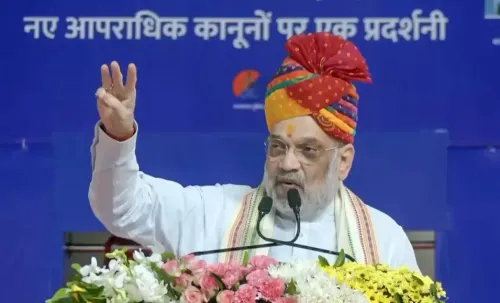
Amit Shah: New Criminal Laws Aim for Justice in 3 Years
Synopsis
Union Home Minister Amit Shah has declared that India's three new criminal laws — the BNS, BNSS, and BSA — are designed to deliver justice from FIR to conviction within three years, reaffirming the government's core promise behind the 2024 overhaul of colonial-era statutes.
Key Takeaways
Union Home Minister Amit Shah stated on 19 June 2026 that the new criminal laws aim to deliver justice from FIR to conviction within three years .
The three laws — Bharatiya Nyaya Sanhita , Bharatiya Nagarik Suraksha Sanhita , and Bharatiya Sakshya Adhiniyam — replaced colonial-era statutes and came into force on 1 July 2024 .
The laws were passed by Parliament in December 2023 , based on a draft by a committee chaired by former Chief Justice Ranjan Gogoi .
The BNSS introduces mandatory timelines for investigation and trial, the primary mechanism for achieving the three-year goal.
India's court pendency exceeds 5 crore cases; the reform aligns with recommendations of the Law Commission and the Malimath Committee .
State compliance reports and early conviction-rate data under the new laws are expected before Parliament in an upcoming session.
Union Home Minister Amit Shah on Friday, 19 June 2026, stated that the three new criminal laws enacted by Parliament are designed to deliver justice from the stage of an FIR to conviction within three years, underscoring the government's push to overhaul India's colonial-era legal framework.
Context
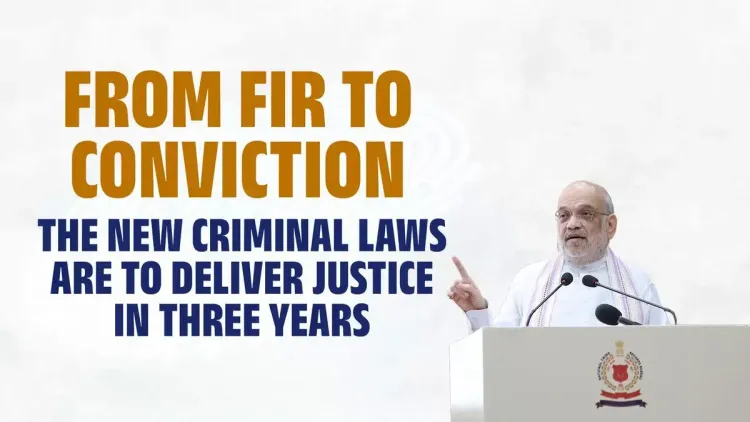
Shah's post, shared on X, states plainly: 'From FIR to conviction, the goal of the new criminal laws is to deliver justice in three years.' The remark frames the three-year timeline as the central ambition of legislation that came into force on 1 July 2024, replacing statutes that had governed India's criminal justice system since the British era.
The three laws — the Bharatiya Nyaya Sanhita (BNS), the Bharatiya Nagarik Suraksha Sanhita (BNSS), and the Bharatiya Sakshya Adhiniyam (BSA) — together replaced the Indian Penal Code 1860, the Code of Criminal Procedure 1973, and the Indian Evidence Act 1872 respectively.
Policy Backdrop
Parliament passed all three bills in December 2023, following a draft prepared by a committee headed by former Chief Justice of India Ranjan Gogoi that was first constituted in 2020. The laws were notified for enforcement from 1 July 2024 across India, with Jammu and Kashmir initially excluded from the rollout.
The Bharatiya Nagarik Suraksha Sanhita, the procedural law among the three, specifically introduces mandatory timelines for investigation and trial — the legislative mechanism through which the three-year goal is intended to be achieved. The Bharatiya Sakshya Adhiniyam modernises rules on digital and forensic evidence, a reform seen as essential to faster adjudication in an era of cybercrime and electronic records.
The overhaul aligns with longstanding recommendations of the Law Commission of India and the Malimath Committee, both of which had called for time-bound trials and stronger forensic mandates to address a backlog of cases. India's court pendency has long exceeded 5 crore matters across all levels of the judiciary.
Stakeholders and Impact
Police forces across states have undergone nationwide training programmes since 2024 to adapt to the new procedural requirements, and state governments have notified their own implementing rules. The laws directly affect crime victims, who under the new framework are entitled to progress updates within specified timeframes — a departure from the largely discretionary older system.
The judiciary faces the most structural pressure, as the BNSS mandates trial completion within defined periods. Legal practitioners and bar associations have raised questions about whether court infrastructure and judicial vacancies can support the pace the laws envision. The Union Ministry of Home Affairs, which shepherded the legislation, has positioned these timelines as enforceable commitments rather than aspirational targets.
What's Next
State-level compliance reports on mandatory investigation and trial timelines, as well as early conviction rate data under the new laws, are expected to be placed before Parliament in an upcoming session. Review petitions challenging specific procedural changes under the BNSS are pending before the Supreme Court of India, and their outcome could shape how strictly the timelines are applied in practice.
Shah's statement signals that the Ministry of Home Affairs intends to keep the three-year benchmark at the centre of its narrative on criminal justice reform — and that performance against this benchmark will likely become a political and administrative accountability metric in the months ahead.
Point of View
Likely ahead of a parliamentary session or a compliance review. The framing shifts the conversation from legislative passage to measurable delivery, raising the stakes for the Ministry of Home Affairs as implementation enters its second year. If conviction-rate data under the new laws falls short of the benchmark, the explicit three-year claim could become a liability rather than an asset. The post also signals that the BNS-BNSS-BSA reform will remain a centrepiece of the BJP's governance narrative, positioned as a clean break from the colonial legal order.
NationPress
19 Sept 2026
Frequently Asked Questions
What is the three-year justice goal in India's new criminal laws?
The three-year goal, as stated by Home Minister Amit Shah, is that the new criminal laws — BNS, BNSS, and BSA — are designed to complete the entire process from the filing of an FIR to a final conviction within three years, through mandatory timelines for investigation and trial.
What are the three new criminal laws in India?
The three new criminal laws are the Bharatiya Nyaya Sanhita (BNS) , which replaced the Indian Penal Code; the Bharatiya Nagarik Suraksha Sanhita (BNSS) , which replaced the Code of Criminal Procedure; and the Bharatiya Sakshya Adhiniyam (BSA) , which replaced the Indian Evidence Act. They came into force on 1 July 2024 .
When did India's new criminal laws come into effect?
India's three new criminal laws came into force on 1 July 2024 , after being passed by Parliament in December 2023 .
How will India's new criminal laws reduce case pendency?
The Bharatiya Nagarik Suraksha Sanhita introduces mandatory timelines for police investigation and court trials, while the Bharatiya Sakshya Adhiniyam modernises evidence rules to include digital and forensic records, both aimed at speeding up proceedings in a system with over 5 crore pending cases.
What happens if the three-year trial deadline is not met under the new laws?
The laws set timelines as procedural mandates, but enforcement mechanisms and consequences for delays are subject to judicial interpretation. Review petitions before the Supreme Court of India on procedural aspects of the BNSS are pending and could clarify how strictly the timelines apply.