How does Arif Khan connect Sardar Patel to Shankaracharya’s mission?
Synopsis
Bihar Governor Arif Mohammed Khan and India Foundation President Ram Madhav recently launched the book ‘Bharat: That Is India - Reclaiming Our Real Identity’ in New Delhi. With insights into India's rich cultural and spiritual heritage, Khan emphasizes the importance of recognizing our true identity amidst modern narratives.
Key Takeaways
Arif Mohammed Khan emphasizes India's cultural and spiritual identity.
The book ‘Bharat: That Is India’ seeks to reclaim India's heritage.
Shankaracharya's role in unifying India is crucial. 'Dharma' is more than religion; it encompasses duty.
The Babri structure demolition marked a significant turning point.
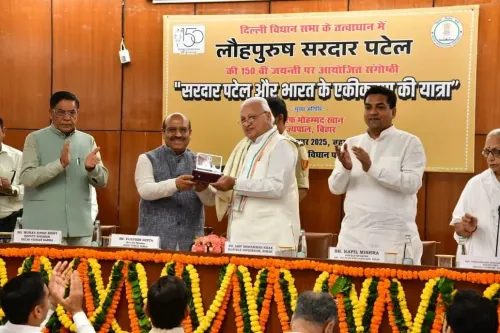
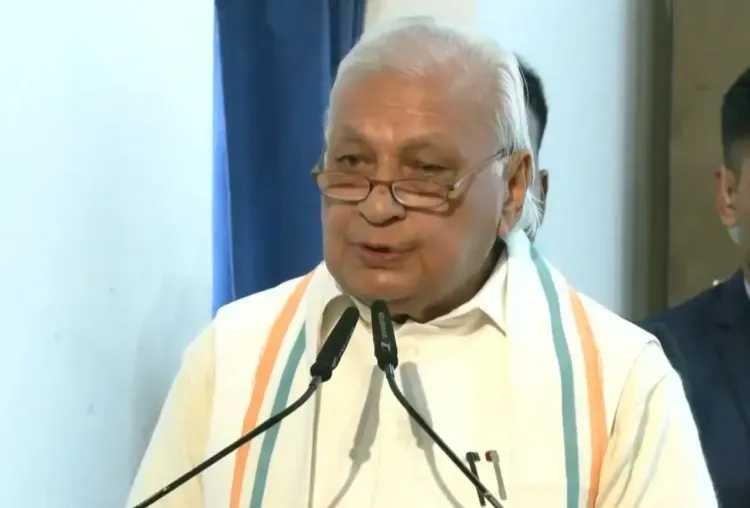
New Delhi, Dec 6 (NationPress) Bihar Governor Arif Mohammed Khan and India Foundation President Ram Madhav took part in a book launch and discussion event in the capital, where the book ‘Bharat: That Is India - Reclaiming Our Real Identity’ was unveiled.
Published by Suruchi Prakashan, the event was hosted by the Kala Nidhi division of the Indira Gandhi National Centre for the Arts (IGNCA). Bihar Governor Khan served as the chief guest, while Madhav was the special guest.
During the gathering, Khan remarked: “We do not need to fit ourselves into frameworks defined by Western nations. Why should we? India is not just a nation-state; we are a cultural nation, a spiritual nation.”
He noted that the knowledge encapsulated in the book spans back 1,100-1,200 years, highlighting that UNESCO officially recognizes the Rig Veda as the world's oldest text.
“If this knowledge hadn’t been deeply ingrained in the populace, Shankaracharya wouldn’t have achieved his mission so easily,” he remarked.
Khan indicated that the unique essence of Indian civilization lies in the divinization of humanity and the humanization of the divine.
He further questioned whether a country could be constructed solely on cultural and spiritual unity, remarking that while India has always excelled in the spiritual domain, its political history has been marred by internal strife.
He recalled how Shankaracharya traversed India to foster cultural and spiritual harmony during a politically fragmented era.
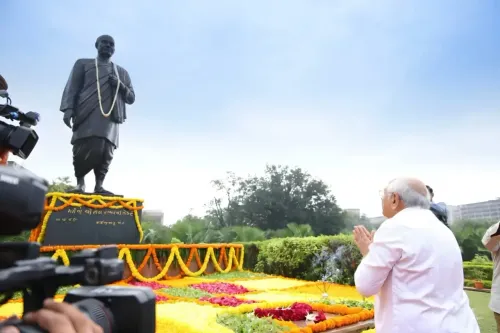
“It seems to me that his soul did not rest until his unfinished mission was completed. To fulfill that mission, his soul took birth again as Sardar Patel,” Khan stated.
Delving into the book's themes, Khan emphasized how the meanings of words transform over time, asserting that equating 'dharma' with 'religion' is a misconception.
“The Amritkosh enumerates 18 definitions of dharma, and the one associated with religion is the least significant. At its heart, dharma is about fulfilling one’s obligations and responsibilities,”
he explained.
He quoted: 'Swakarma dharma vimukhah Krishnam Krishneti vadinam, te Hare Krishna murkhe', elucidating that those who neglect their duties and oppose Krishna are not only foolish but also adversaries of Hari, as Hari incarnates to uphold dharma.
“Dharma is inherently prescriptive. A person must continually reflect on what their duty is -- whether it is Sanatan Dharma, Yoga Dharma, Rashtra Dharma, or most importantly, their own Swadharma,” he added.
Khan also pondered how the idea of the 'nation-state' is relatively contemporary, pointing out that previously, the world acknowledged only empires and tribes. Using pre-Islamic Arabia as an example, he illustrated that tribes often engaged in conflict, and when an empire conquered them, collective responsibility overshadowed individual accountability.
India Foundation President Madhav mentioned that it has been 34 years since the demolition of the Babri structure, an event that incited widespread turmoil yet also marked a pivotal moment.
He expressed that the ensuing developments have propelled India toward realizing its true potential.
Author Abhijit Jogi stated that the fundamental question inspiring him to write the book was: “What is India’s real identity?”
He asserted that a nation's identity is its most treasured asset, yet India's genuine identity has been obscured and replaced with a constructed narrative.
“I aimed to uncover India's authentic identity, discovering numerous facets unknown to the public. I felt it essential to share these truths, which is why I authored this book,”
he concluded.
Point of View
This event serves as a critical reminder of India's rich cultural and spiritual heritage. Arif Mohammed Khan's reflections on reclaiming India's identity resonate deeply, urging a collective understanding of our past to navigate the present and future. This dialogue is vital for fostering a unified national identity.
NationPress
14 Oct 2026
Frequently Asked Questions
What is the main theme of the book launched?
The book focuses on reclaiming India's cultural and civilizational identity, emphasizing the significance of spirituality and duty.
Who were the key speakers at the book launch?
Bihar Governor Arif Mohammed Khan and India Foundation President Ram Madhav were the key speakers at the event.
What is the significance of Shankaracharya in this context?
Shankaracharya is highlighted as a historical figure who worked to unify India's cultural and spiritual identity during a fragmented political period.
How does Khan define 'dharma'?
Khan emphasizes that 'dharma' encompasses a broader range of responsibilities beyond mere religion, focusing on duty and obligations.
What impact did the Babri structure demolition have on India?
Madhav noted that the demolition was a turning point that has led India towards realizing its true potential.