How Does Bihar Governor Arif Mohammad Khan Emphasize Unity for a Developed India?
Synopsis
Bihar Governor Arif Mohammad Khan underscores the importance of unity in achieving a developed India, drawing on the ideals of Sardar Vallabhbhai Patel. In a symposium commemorating Patel's legacy, he advocates for emotional and thoughtful unity as the foundation for national development.
Key Takeaways
Unity is essential for national development.
Sardar Patel's ideals continue to inspire modern India.
True unity arises from shared emotions and thoughts.
Rashtriya Ekta Diwas serves as a reminder of our collective responsibility .
Patel's legacy includes the bloodless unification of princely states.
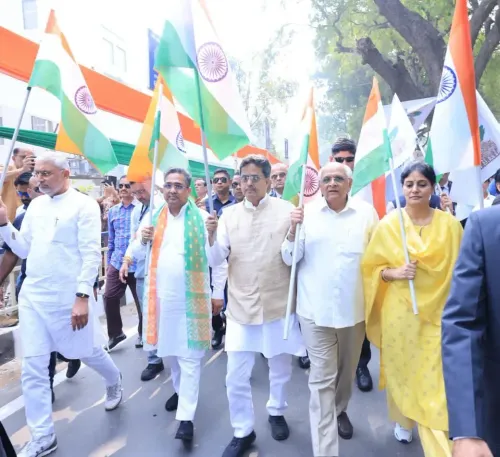
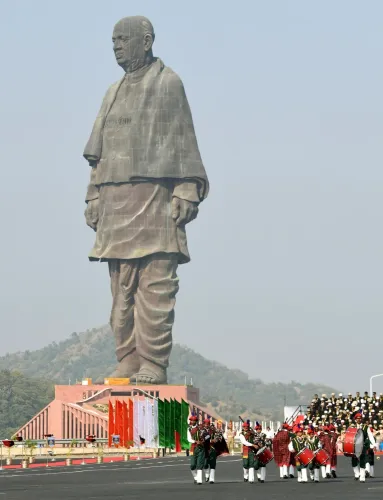
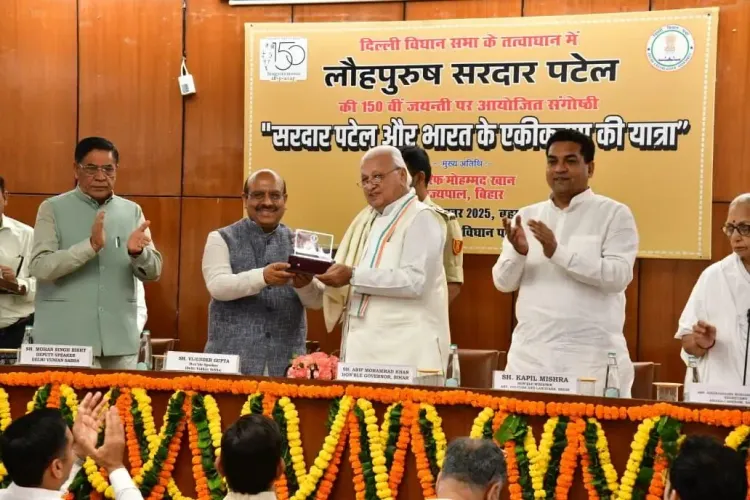
New Delhi, Oct 30 (NationPress) Bihar Governor Arif Mohammad Khan asserted on Thursday that authentic unity emerges from the collective consciousness of a nation. To realize Prime Minister Narendra Modi's vision of a developed India, we must adhere to the ideals and values set forth by Sardar Vallabhbhai Patel.
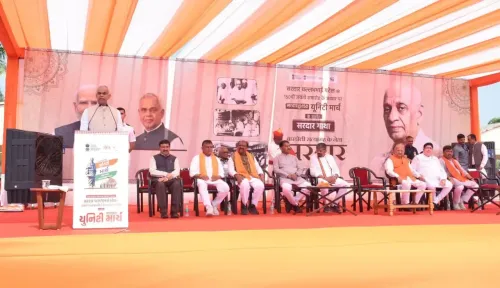
Speaking at a symposium held at the Delhi Legislative Assembly to commemorate the 150th Birth Anniversary of Sardar Patel, Khan remarked: "Unity is not formed by bricks and stones; it is born from emotion, and emotion is rooted in thought."
He emphasized that to realize Prime Minister Modi's ambition of making India a developed and leading nation, "we must continuously remember and revive the principles and values for which Sardar Vallabhbhai Patel devoted his entire life."
Khan noted that just as Adi Shankaracharya established India's spiritual unity through Vedanta, Sardar Patel achieved political unity through courage and conviction.
He highlighted that Sardar Patel’s unification of over 565 princely states was a monumental act of statesmanship—"a feat comparable to that of Bismarck in Germany, if not greater."
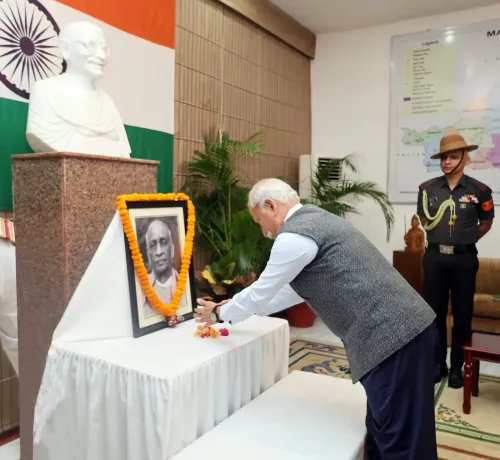
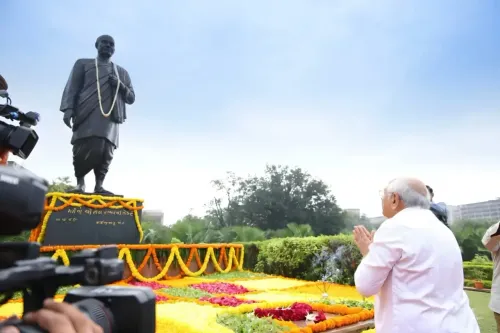
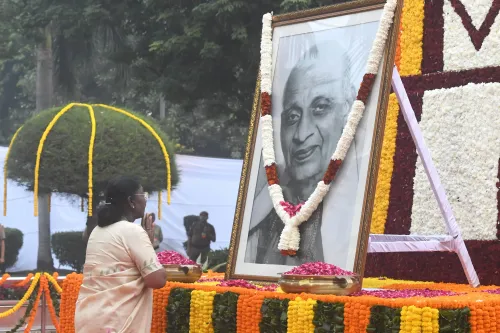
Khan also paid floral tributes at the statue of Shri Vithalbhai Patel alongside Delhi Speaker Vijender Gupta, Deputy Speaker Mohan Singh Bisht, Delhi Cabinet Minister Kapil Mishra, and Niranjanaben Kalarthi, Administrator of Swaraj Ashram, Bardoli (Gujarat).
A special exhibition titled "Sardar Patel and the Journey of India’s Unification" was inaugurated at the Assembly, showcasing rare archival photographs and historical artifacts that celebrate the life, vision, and legacy of the Iron Man of India. Vice Chairman of Gandhi Smriti Vijay Goel, Senior Leader Sudhanshu Mittal, and other MLAs were also in attendance.
Khan commended the Government of India’s decision to observe Sardar Patel’s birth anniversary as Rashtriya Ekta Diwas, calling it "a fitting tribute to the Architect of India’s Unity, reflecting the gratitude and respect of an entire nation for the individual who unified India."
Delhi Speaker Gupta remarked: "The strength of a nation is not measured by its might, but by the unity of hearts and purpose."
He noted that Sardar Patel’s life serves as a reminder that unity is not merely a slogan but a sacred duty. He affirmed that Patel’s principles of discipline, integrity, and selfless service continue to drive India’s progress.
As the nation observes Rashtriya Ekta Diwas, Gupta urged everyone to recommit to preserving the unity that Sardar Patel established and the values he represented.
Niranjanaben Kalarthi, Administrator of Swaraj Ashram, Bardoli (Gujarat), addressing the Symposium, expressed, "It is a point of pride for the world that Sardar Patel achieved the unification of 562 out of 565 princely states without shedding a single drop of blood."
Kalarthi also honored Sardar Patel as the architect of India’s administrative framework and a leader of exceptional compassion. Recalling her childhood experiences at the Swaraj Ashram in Bardoli, established after the successful 1928 Bardoli Satyagraha, she fondly reminisced about meeting Sardar Patel as a child.
"He was the pillar of India’s unity," she remarked, "yet he possessed such a tender heart, speaking gently with children." Describing him as "not just the Iron Man of India, but also a man of compassion and humility," she urged all to uphold his ideals so that "the unity and integrity of India endure forever."
Point of View
Arif Mohammad Khan's remarks resonate deeply with the ongoing dialogue about India's unity and development. His emphasis on Sardar Patel's principles serves as a timely reminder of the importance of collective values in navigating the challenges of modern India.
NationPress
30 Sept 2026
Frequently Asked Questions
What did Bihar Governor Arif Mohammad Khan say about unity?
He stated that true unity is born from the collective consciousness of a nation and is essential for achieving a developed India.
How did Sardar Vallabhbhai Patel contribute to India's unity?
Sardar Patel unified over 565 princely states into a single nation without shedding blood, showcasing his exceptional statesmanship.
What event was commemorated during the symposium?
The symposium commemorated the 150th Birth Anniversary of Sardar Vallabhbhai Patel.
What is Rashtriya Ekta Diwas?
Rashtriya Ekta Diwas is celebrated in honor of Sardar Patel's birth anniversary, emphasizing national unity.
What did Delhi Speaker Vijender Gupta say about national strength?
He remarked that the strength of a nation lies in the unity of hearts and purpose, rather than its military might.