Will Bangladesh's Assistant High Commission in Agartala Suspend Visa and Consular Services?
Key Takeaways
Visa and consular services at the Bangladesh Assistant High Commission will be suspended from December 23.
Increased security measures are in place around the diplomatic mission.
Protests have emerged due to allegations of violence against minorities in Bangladesh.
The political landscape continues to be tense, impacting diplomatic relations.
Concerns remain regarding regional stability and communal harmony.
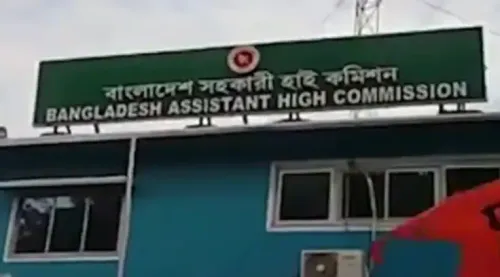
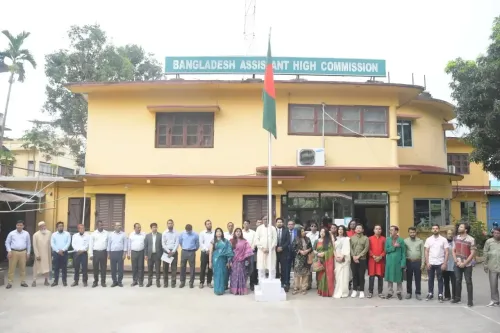
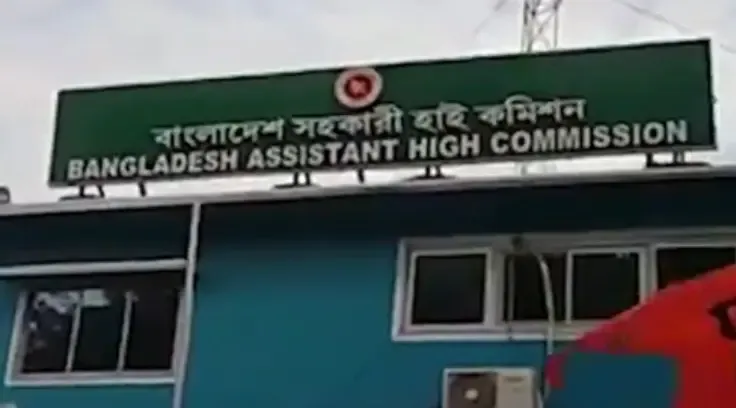
Agartala, Dec 22 (NationPress) The Assistant High Commission of Bangladesh in Agartala has announced that all visa and consular services at the diplomatic mission will be unavailable starting from December 23, officials confirmed.
In an official notification, the First Secretary and Head of Commission, S. M. Almas Hossain, stated, "This announcement serves to inform all stakeholders that, owing to unavoidable circumstances, all visa and consular services at the Bangladesh Assistant High Commission in Agartala will be closed from tomorrow, December 23, until further notice."
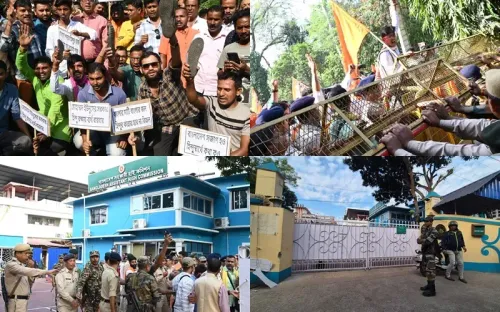
As a precautionary measure, a senior official from Tripura police mentioned that security around the Bangladesh Assistant High Commission has been heightened since August of the previous year.
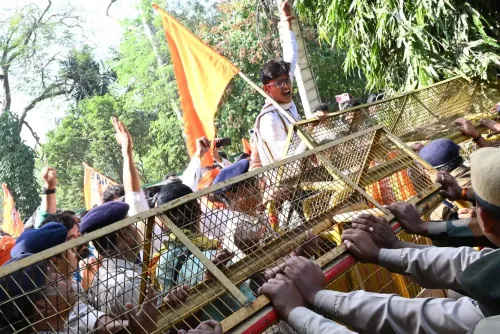
A substantial deployment of the Central Reserve Police Force (CRPF) and Tripura State Rifles has been made to ensure the safety of the officials and the diplomatic mission.
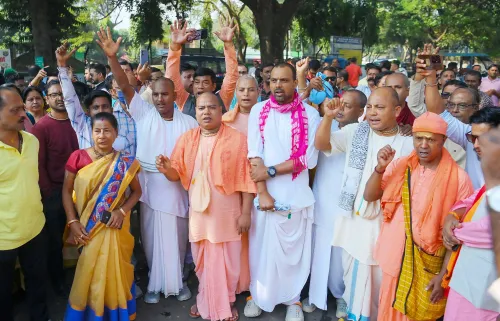
Several organizations and political factions in Tripura have condemned the alleged lynching of a Hindu individual in Bangladesh, criticizing the interim government for its inability to protect religious minorities.
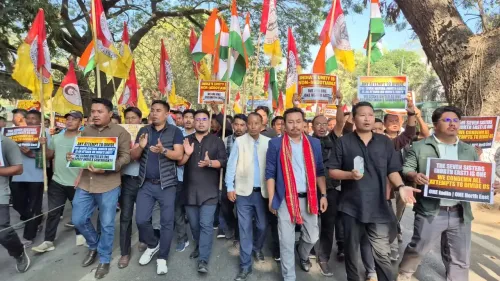
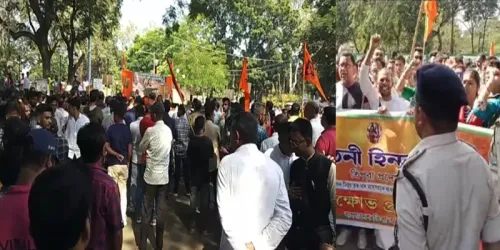
Recently, activists from the Sanatani Hindu Sena and the youth division of the Tipra Motha Party (TMP), a BJP ally, protested outside the Bangladesh Assistant High Commission in Agartala, denouncing recent comments made by Bangladeshi leaders regarding India's Northeast region.
The President of the Youth Tipra Federation (YTF), Suraj Debbarma, who led the protests on December 19, accused Bangladeshi leaders of making unfounded and fabricated "anti-India" remarks and promoting activities detrimental to India.
Debbarma noted that in recent days, demonstrations have occurred in front of the Indian High Commission in Dhaka and other locations in Bangladesh, where slogans deemed "anti-India" were chanted.
"NCP leader Hasnat Abdullah recently asserted that they aim to seize India's 'Seven Sisters' and the Siliguri Corridor to incorporate the region into Bangladesh," he stated.
The Siliguri Corridor, commonly known as the 'Chicken's Neck', links Northeast India with the rest of the country via West Bengal. The seven Northeastern states—Arunachal Pradesh, Assam, Manipur, Meghalaya, Mizoram, Nagaland, and Tripura—are collectively referred to as the 'Seven Sisters'.
Debbarma emphasized that some Bangladeshi leaders seem to have overlooked India's contributions and sacrifices made by the Indian Army during the 1971 Liberation War, which led to the establishment of Bangladesh as a sovereign nation.
"Given India's immense support during the 1971 war and in subsequent years, why are Bangladeshi leaders now framing India as an adversary?" he questioned.
He also cautioned that if Bangladeshi leaders persist in their so-called "futile claims" over Northeast India, TMP supporters may also raise historical issues, including territorial claims over regions like Cox's Bazar, where many minorities reside in the Chittagong Hill Tracts (CHT) of Southeastern Bangladesh.
"It's widely known that TMP is advocating for 'Greater Tipraland', and it's apparent how Bangladesh has reaped benefits from India over the last five decades," Debbarma remarked, asserting that the party would not remain passive if "anti-India" actions and false claims about the Northeast continue.
Meanwhile, another senior TMP leader highlighted that the former 'Chakla Roshnabad' was a zamindari of the erstwhile princely state of Tripura, encompassing territories that were once part of East Pakistan, now located in Bangladesh's Noakhali and Sylhet districts.
Recently, NCP leader Hasnat Abdullah warned of isolating the Northeast's 'Seven Sisters' and providing refuge to separatist factions if India attempted to destabilize Bangladesh.
Security issues have also disrupted Indian diplomatic activities in Bangladesh. Following violent incidents near the Indian Assistant High Commission in Chittagong, Indian visa services at the Indian Visa Application Centre (IVAC) in that city have been suspended since Sunday until further notice.
Officials mentioned that visa services would only resume after a thorough review of the security situation. This decision followed clashes outside the mission on Friday, resulting in injuries to at least four individuals, including two police officers.
Local media reported that the unrest began after the death of Sharif Osman Hadi, spokesperson for the radical group Inqilab Mancha, with demonstrators allegedly vandalizing parts of the Indian mission premises.
After Hadi's death, renewed violence erupted across Bangladesh, including in the capital, Dhaka. Hadi, a prominent figure in last year's uprising against the then Prime Minister Sheikh Hasina-led Awami League government, was shot by masked assailants while leaving a mosque in Dhaka last week.
Initially injured, he was transported to Singapore for treatment but ultimately succumbed to his injuries on December 18. These unfolding events have raised significant concerns regarding safety, communal harmony, and regional stability.
Bangladesh has experienced increasing violence against minorities, particularly Hindus, under the Yunus-led interim government, prompting outrage among individuals and numerous human rights organizations worldwide.
Earlier on December 17, India's Ministry of External Affairs (MEA) summoned the Bangladeshi High Commissioner to India, Riaz Hamidullah, to express New Delhi's grave concerns regarding the deteriorating security conditions in Bangladesh.
Bangladesh has seen a marked rise in violence and a declining law-and-order situation under the leadership of Muhammad Yunus.
Point of View
We must ensure our reporting remains balanced and focused. The ongoing tensions and protests reflect a complex political landscape that requires careful analysis. While the security of diplomatic missions is paramount, we should also highlight the voices advocating for minority rights and peaceful coexistence.
NationPress
19 Sept 2026
Frequently Asked Questions
Why is the Bangladesh Assistant High Commission suspending visa services?
The suspension of visa and consular services is due to unavoidable circumstances as stated by the officials.
When will the visa services resume?
The resumption date for visa services has not been specified and will depend on future notifications.
What security measures have been implemented?
A heightened security presence has been established around the Bangladesh Assistant High Commission, involving CRPF and Tripura State Rifles.
Why are protests occurring in front of the Bangladesh Assistant High Commission?
Protests have arisen in response to comments made by Bangladeshi leaders and the alleged lynching of a Hindu man in Bangladesh.
What are the implications of the ongoing violence in Bangladesh?
The rising violence against minorities and political unrest have raised concerns about communal harmony and regional stability.