How Did Bas de Leede Master Changing Conditions in T20 WC?

Synopsis
Bas de Leede's remarkable performance against Namibia at the T20 World Cup showcased his adaptability on a challenging pitch. With precise bowling and aggressive batting, he led the Netherlands to victory, becoming the first player from his nation to achieve a fifty and take two wickets in the same match.
Key Takeaways
Bas de Leede showcased exceptional adaptability to changing pitch conditions.
He achieved a significant all-round performance by scoring a fifty and taking wickets.
The Netherlands demonstrated tactical bowling rotations under Scott Edwards .
Learning from past matches proved vital for their strategy and execution.
A diverse bowling lineup enhances unpredictability and effectiveness.
New Delhi, Feb 10 (NationPress) When Bas de Leede joined the Netherlands bowling lineup, Namibia was comfortably positioned at 94/2 in 12 overs on a challenging pitch at the Arun Jaitley Stadium. Jan Nicol Loftie-Eaton was scoring at 38 off 33 balls, while captain Gerhard Erasmus looked threatening with 18 off 8 balls – 16 of those runs coming in the preceding over bowled by Timm van der Gugten.
It was de Leede’s responsibility to deliver the crucial breakthrough for the Netherlands. On his second delivery, he succeeded when Erasmus failed to elevate a short ball and was caught at mid-wicket. In his following over, de Leede claimed another significant wicket; his back of a length delivery troubled JJ Smit, an aggressive batsman, leading to a decisive clipping of the stumps.
De Leede's outstanding spell of 2-9 in two overs resembled a boxer landing precise jabs, resulting in Namibia finishing at a subpar 156/8. His strategic matchup against right-handed batsmen was bolstered by the astute bowling rotation from skipper Scott Edwards. This was not the first time de Leede provided the Netherlands with a crucial advantage in the morning match.
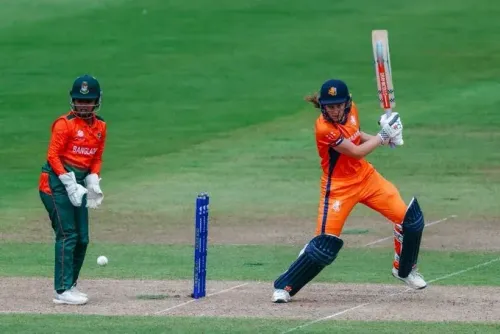
When Max O’Dowd and Michael Lewitt fell early during the chase of 157, de Leede took a measured approach before unleashing nine clean boundaries, finishing unbeaten on 72 off 48 balls at a strike rate of 150. Notably, he scored 36 runs through the mid-wicket and long-on regions.
This performance, marking the joint-highest individual score for the Netherlands at the Men's T20 World Cup, earned de Leede the Player of the Match award, making him the first player from his nation to achieve a fifty and take two wickets in a single T20 World Cup match.
In the post-match press conference, when asked by IANS how he adapted to the pitch conditions for a comprehensive performance, de Leede emphasized the need to adjust his bowling and batting strategies based on the evolving wicket. “I believe the pitch changed significantly during the game. While bowling, we aimed for a length that provided more bounce than usual.
“Initially, the wicket felt soft, but as the game progressed, it started skidding more. We adapted effectively with the ball to discover our optimal length, and with the bat, we aimed to play as straight as possible since the pitch was skidding,” he explained.
After the heartbreaking defeat to Pakistan, the Netherlands had a single practice session in New Delhi to regroup and prepare effectively for the clash against Namibia. De Leede noted that the experiences learned from adapting to conditions in Colombo were advantageous when playing in New Delhi, a city hosting T20 games post-IPL 2025.
“With limited training time due to extensive travel, we strive to focus specifically on our team's needs. I understand that I am likely more valuable towards the end of the innings and if I perform well, also in the death overs,” he stated.
“It was beneficial that we had the opportunity to assess the pitch conditions. Our team has numerous options, so it’s crucial to be prepared whenever the captain calls upon you.
“We were certainly disappointed after the match against Pakistan; it's one we felt was within our grasp. However, we aim to learn from each game, win or lose. We took valuable lessons from that experience, particularly with our bowling.”
De Leede further mentioned how they managed to restrict their opponents from 90 for 2 to 120 for 7 during that match, which provided critical insights for future encounters. He added, “On the batting side, we focused on extending the middle overs to set up for a solid finish, which we successfully executed today.”
Due to a last-minute precautionary rest for Paul van Meekeren and Kyle Klein's exclusion as part of a combination change, the Netherlands bowling lineup had greater variety. With eight bowling options available, de Leede made a significant impact despite not completing his full quota of overs.
“I believe our strength lies in our diverse bowling options. While I'm not entirely clear on the reasoning behind it, I think Scott wanted to utilize spinners early on and continuously rotate bowlers. Predictability is something we want to avoid, especially on smaller boundaries, and I think Scott managed this excellently,” de Leede added.
In his previous outing in New Delhi, de Leede had a forgettable experience when Australia’s explosive all-rounder Glenn Maxwell scored the fastest century in tournament history, leaving de Leede with a record of conceding 115 runs in ten overs – the most expensive spell recorded in the 50-over format.
This time, however, de Leede was central to a commanding performance by the Netherlands, a memory he will cherish due to his mastery over the challenging conditions in front of 6,139 fans in New Delhi.
“To be honest, it’s a record that no one desires, but I didn’t dwell on it today. I have a tendency to forget poor performances, so it was gratifying to deliver a strong performance today,” he concluded.
Point of View
I commend Bas de Leede's extraordinary all-round performance in the T20 World Cup. His ability to adapt to changing conditions is a testament to his skills and determination. Such performances bolster national pride and reflect the growing competitiveness of Dutch cricket on the world stage.
NationPress
30 Sept 2026
Frequently Asked Questions
What were Bas de Leede's key contributions in the match?
Bas de Leede took 2 wickets for 9 runs and scored an unbeaten 72 runs off 48 balls, making him the first player from the Netherlands to achieve a fifty and take two wickets in the same T20 World Cup match.
How did the pitch conditions change during the game?
The pitch initially felt soft and offered more bounce but started skidding more as the game progressed, prompting players to adapt their strategies.
What did de Leede learn from the previous matches?
He emphasized the importance of learning from past experiences, including their match against Pakistan, which helped them adapt their bowling strategies effectively.
What was the significance of this match for the Netherlands?
The victory against Namibia was crucial for the Netherlands, showcasing their ability to perform under pressure and marking a significant achievement in the T20 World Cup.
Why is variety important in the bowling lineup?
A diverse bowling lineup keeps opponents guessing and reduces predictability, allowing for more strategic play and better chances of taking wickets.