Is Beijing Promoting Soft Narratives to Reinforce Authority in Xinjiang and Tibet?
Synopsis
A recent report reveals the ongoing resistance of Uyghur Muslims against the Chinese Communist Party in Xinjiang, highlighting how Beijing is reshaping historical narratives. This effort aims to assert control over Xinjiang and Tibet, intertwining ancient heritage with modern political objectives.
Key Takeaways
Uyghur Muslims resist CCP control in Xinjiang .
Beijing promotes soft narratives to assert authority.
Historical sites are reframed as part of national heritage.
Claims of ancient control lack historical basis.
Experts challenge the legitimacy of these narratives.
Kathmandu, Jan 7 (NationPress) The Uyghur Muslims residing in Xinjiang province have persistently opposed the control of the Chinese Communist Party (CCP), even in the face of oppressive measures, revealing profound tensions surrounding identity, governance, and security, as highlighted in a report released on Wednesday.
The report further indicates that Beijing has been promoting softer narratives to solidify its authority, reframing historical sites like Jiaohe, an ancient city in Xinjiang, as a shared heritage of the Chinese nation. Chinese officials often reference this ancient site as part of the historic Silk Road.
“The government led by the Chinese Communist Party (CCP) has sought to reinterpret the histories of cultural and heritage sites in Tibet and Xinjiang. This is widely regarded as propaganda intended to reshape historical narratives to support current political objectives and reaffirm control over these tumultuous regions. Such efforts aim to connect the construction of these historic sites with the rulers of ancient and medieval China, thereby legitimizing CCP dominance in Tibet and Xinjiang,” detailed a report from Nepal Aaja.
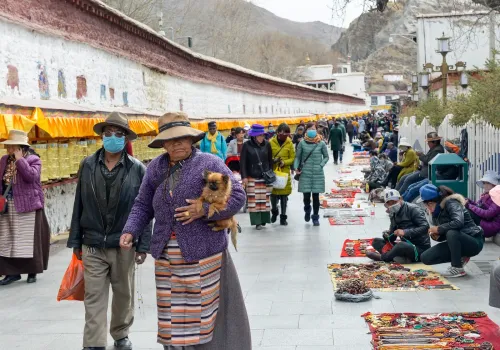
“However, historical facts indicate that the Chinese emperors did not construct these sites nor exert direct control over these regions previously. Landmark sites such as Jokhang Temple, Potala Palace, Kizil Caves, Bezeklik Caves, Karakhoja (Gaochang) Ruins, and Jiaohe Ancient City are among those targeted by the state's narrative of cultural assimilation and continuity with mainland China,” it elaborated.
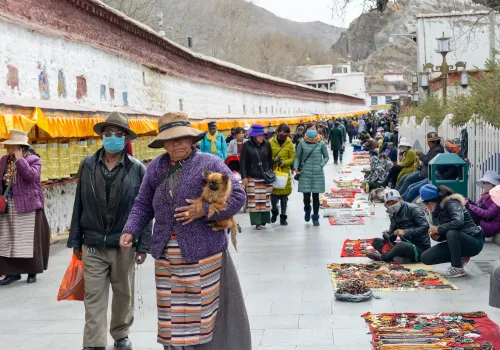
The report also mentioned that the Beijing government recently erected two pavilions in a Chinese architectural style at the Jokhang Temple, an act Tibetans argue contradicts the traditional architectural style of Tibet.
“The International Campaign for Tibet (ICT) has stated that one pavilion was constructed over a stone pillar inscribed with the imperial Sino-Tibetan Treaty of the ninth century, which clearly delineated the frontiers of the Tibetan Empire and Tang Dynasty China,” it noted.
Referring to a White Paper published two decades ago, Beijing asserts its military and administrative authority over Xinjiang, claiming its roots trace back to the establishment of a command in the region by the Han Dynasty in 60 BC.
Barry Sautman, an expert in China’s ethnic politics at the Hong Kong University of Science and Technology, dismissed this assertion as “unworthy,” stating, “What constituted a state then is not what constitutes a state now—the criteria have changed. Claims that our sovereignty dates back thousands of years will not be accepted by serious historians.”
Point of View
Our commitment remains with the truth. The ongoing situation in Xinjiang and Tibet reflects a struggle not just for cultural identity, but also for the recognition of historical facts against a backdrop of political maneuvering. Our focus will always be to present these narratives fairly and accurately.
NationPress
19 Sept 2026
Frequently Asked Questions
What is the role of the Chinese Communist Party in Xinjiang?
The Chinese Communist Party has consistently sought to exert control over Xinjiang , employing both repressive measures and cultural narratives to assert its authority in the region.
How does Beijing reinterpret historical narratives?
Beijing attempts to reshape historical narratives by framing cultural and heritage sites as integral to the national identity, linking them to ancient Chinese rulers to legitimize its current rule.
What are the implications of these narratives?
These narratives aim to foster a sense of national unity but often disregard the complex history and identities of the local populations, causing tensions.
What cultural sites are mentioned in the report?
The report highlights several significant cultural sites, including Jokhang Temple , Potala Palace , and Jiaohe Ancient City , among others.
What do experts say about Beijing's claims?
Experts argue that Beijing's claims of historical authority over these regions are not substantiated by historical evidence and that the criteria for what constitutes control have shifted over time.