BJP launches Rajasthan civic poll drive, bets on development record
Synopsis
The BJP's Rajasthan civic poll launch is as much a report card presentation as a campaign kickoff. With CM Bhajanlal Sharma anchoring the pitch on 1.89 lakh jobs and ₹35 lakh crore in investment proposals, the party is betting that state-level governance numbers can win hyperlocal battles — a calculation that has not always held in India's municipal contests.
Key Takeaways
The BJP formally launched its Rajasthan civic body election campaign at the BJP state office in Jaipur on 17 August .
Chief Minister Bhajanlal Sharma pitched a 'triple-engine government' model, adding civic administration to the existing state-Centre alignment.
The state government claims to have provided more than 1.89 lakh government jobs and attracted investment proposals worth around ₹35 lakh crore , with nearly ₹9 lakh crore moving towards implementation.
Farmers in Rajasthan are reportedly receiving ₹9,000 under the Kisan Samman Nidhi scheme.
State President Madan Rathore ruled out nepotism in candidate selection, promising priority for youth, women, and weaker sections.
The civic polls mark the BJP's first major electoral test in Rajasthan since its December 2023 state election victory.
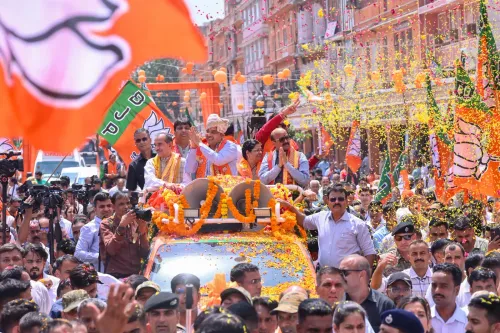
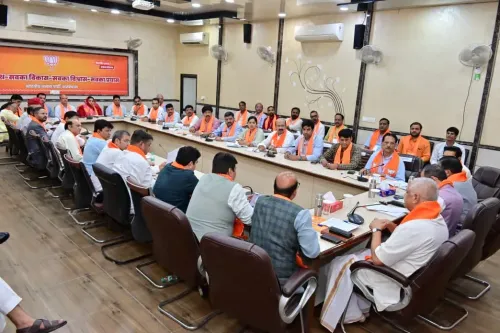
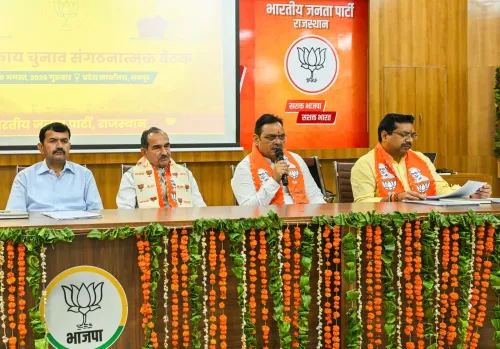
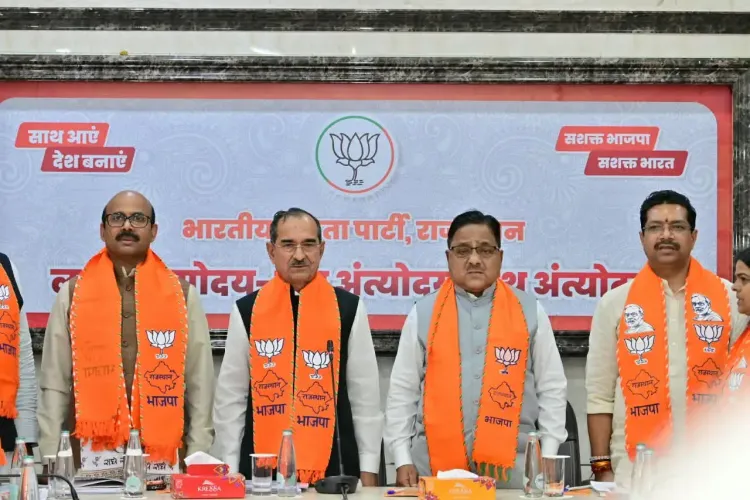
The Bharatiya Janata Party (BJP) formally launched its campaign for the upcoming Rajasthan civic body elections on Monday, 17 August, with the party's top leadership convening at the BJP state office in Jaipur to chart electoral strategy centred on governance achievements and welfare delivery. The meeting signalled the party's intent to convert its state and Central government record into local-body gains.
Key Developments at the Jaipur Meeting
Chief Minister Bhajanlal Sharma set the tone, declaring that a BJP victory in the civic polls would usher in a 'triple-engine government' — adding municipal governance to the existing 'double-engine' alignment of the state and Central administrations. The meeting drew a wide cross-section of the party apparatus, including BJP State In-charge Radha Mohan Das Agarwal, State President and Rajya Sabha MP Madan Rathore, State Organisation General Secretary Ajay, Civic Election In-charge and National General Secretary Harish Dwivedi, National General Secretary and MP Gajendra Singh Patel, National Secretary and MP Sangeeta Yadav, National Secretary Rohan Gupta, Maharashtra Minister Chandrashekhar Bawankule, and Delhi Minister Ravinder Indraj Singh, alongside divisional teams, manifesto committees, and divisional in-charges.
Discussions covered booth-level organisation, candidate selection criteria, local issue mapping, and communicating the achievements of both the Rajasthan state government and the Centre to voters.
What the Government Claims to Have Delivered
Sharma outlined a series of figures to anchor the BJP's campaign pitch. According to the Chief Minister, the state government has provided more than 1.89 lakh government jobs during its tenure. On water security, he pointed to the Yamuna Water Agreement and the Ram Jal Setu project as long-term structural interventions for a state chronically challenged by water scarcity.
On investment, Sharma said Rajasthan had attracted proposals worth around ₹35 lakh crore, of which projects worth nearly ₹9 lakh crore had already moved towards implementation. He also cited the Kisan Samman Nidhi scheme, under which farmers in Rajasthan are reportedly receiving ₹9,000, as evidence of the government's commitment to agrarian welfare.
Candidate Selection and Organisational Readiness
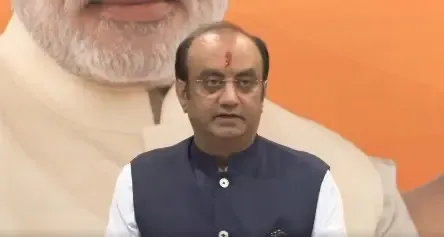
State President Madan Rathore, speaking to reporters after the meeting, said the party organisation was fully prepared at the booth level. He stated that candidates would be evaluated on public connect, organisational commitment, credibility, and electoral viability. 'Candidate selection will align with public aspirations; there is no room for nepotism or favouritism,' Rathore said, adding that the party would ensure meaningful participation of youth, women, and weaker sections.
Rathore also cited a range of Central schemes — including the Pradhan Mantri Awas Yojana, Swachh Bharat Abhiyan, and Ujjwala Yojana — as contributors to improved living standards. He said the state's startup ecosystem had expanded to more than 2.2 lakh startups, and that job fairs had generated employment for young people.
The Political Contrast
Both Sharma and Rathore drew sharp contrasts with the previous Indian National Congress (Congress) government, characterising it as an era of 'misgovernance and corruption.' Rathore argued that the Congress had no concrete achievements to present to voters and remained weakened by internal factionalism. The BJP framing positions the civic polls as a referendum on the incumbent state government's first term, a common electoral strategy when a party holds both state and Central power.
Notably, this is the first major electoral test for the Sharma government since it came to power in December 2023, making the civic body results a closely watched indicator of the BJP's standing in Rajasthan ahead of future electoral cycles.
What Comes Next
With booth-level groundwork already underway and candidate selection criteria now formalised, the BJP appears to be moving quickly towards a full campaign footing. The party's ability to translate its development narrative into civic-level wins — where hyperlocal issues often override state-level messaging — will be the key test in the weeks ahead.
Point of View
Water supply, sanitation — not crore-level investment tallies. The 'triple-engine government' framing is politically elegant but operationally untested; double-engine messaging did not prevent the BJP's civic losses in several states even when it held both state and Central power. The more telling signal will be whether candidate selection actually delivers on Rathore's anti-nepotism pledge, or whether local strongmen reassert themselves as they typically do in urban body polls. The Congress's internal factionalism gives the BJP a structural advantage, but complacency in candidate choice has historically been the BJP's undoing in municipal contests.
NationPress
2 Oct 2026
Frequently Asked Questions
Why is the BJP launching a civic poll campaign in Rajasthan now?
The BJP formally began civic body election preparations in Rajasthan on 17 August, convening a strategy meeting in Jaipur to align booth-level organisation, candidate selection, and campaign messaging. The civic polls are the first major electoral test for CM Bhajanlal Sharma's government since it won the state assembly election in December 2023.
What is the 'triple-engine government' that CM Bhajanlal Sharma mentioned?
Sharma used the phrase to describe the potential alignment of the BJP at the Central, state, and civic levels simultaneously. The 'double-engine' model — BJP governing both at the Centre and in a state — is an established party talking point; adding civic body control would complete a third tier of BJP administration in Rajasthan.
What development claims is the BJP making in its Rajasthan campaign?
The party claims the state government has provided more than 1.89 lakh government jobs, attracted investment proposals worth around ₹35 lakh crore (with nearly ₹9 lakh crore moving towards implementation), and advanced water security through the Yamuna Water Agreement and Ram Jal Setu project. Farmers are reportedly receiving ₹9,000 under the Kisan Samman Nidhi scheme.
How will BJP candidates be selected for the Rajasthan civic elections?
State President Madan Rathore said candidates will be chosen based on public connect, organisational commitment, credibility, and electoral potential. He explicitly ruled out nepotism and favouritism, and said the party would ensure significant participation of youth, women, and weaker sections in the candidate pool.
What is the BJP's position on the Congress ahead of the civic polls?
BJP leaders, including CM Sharma and State President Rathore, characterised the previous Congress government as marked by 'misgovernance and corruption.' Rathore argued that the Congress has no concrete achievements to present to voters and remains weakened by internal factionalism, framing the civic polls as a choice between two contrasting governance records.