Can Mark Carney's Davos Doctrine Provide Canada a Solution to Its Impasse with India?
Synopsis
Mark Carney's insightful speech at Davos presents a pragmatic approach for Canada to mend its diplomatic relations with India. By emphasizing procedural integrity over rhetoric, Carney's doctrine could redefine the way Canada addresses serious allegations and navigate through the current geopolitical tensions with India.
Key Takeaways
Carney's doctrine emphasizes procedural integrity over rhetoric.
Legitimacy must be based on robust institutions.
Evidence-based claims are essential for diplomatic credibility.
Unsubstantiated allegations can have severe diplomatic consequences.
Freedom of speech should not be a cover for hate or violence.
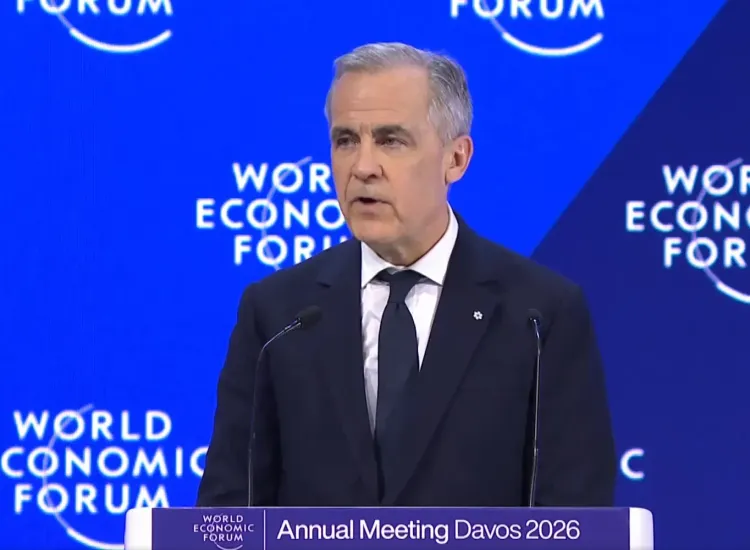
Ottawa/New Delhi, Jan 22 (NationPress) The remarks made by Canadian Prime Minister Mark Carney during the World Economic Forum (WEF) in Davos presented a potential solution for Canada to resolve the deadlock with India regarding baseless allegations. This approach is characterized by procedural discipline rather than surrender or aggressive rhetoric, according to a report released on Thursday.
The report highlighted Carney's recurring assertion in Davos that legitimacy is rooted in truth, which is cultivated through strong institutions.
“In his address at the World Economic Forum on January 20, 2026, Prime Minister Mark Carney provided a moment of profound clarity amidst the complexities of modern international politics. He rejected both the yearning for a romanticized rules-based order and the skepticism of mere transactional dealings. Carney proposed a doctrine of value-driven realism, which emphasizes transparency regarding power, unwavering commitment to core principles, institutional integrity domestically, and practical diplomacy internationally,” stated Sanjay Kumar Verma, a former Indian diplomat, in 'India Narrative'.
“Crucially, the address prioritized processes over superficial postures — emphasizing rules over rhetoric, evidence over mere assertions, and tangible outcomes over symbolic gestures. This doctrine serves as an insightful lens through which to evaluate Canada's recent actions in its relationship with India, a partnership that has faced an unprecedented fracture following public allegations of the Indian government's involvement in cross-border criminal activities on Canadian territory,” he added.
Verma, who previously held the position of High Commissioner of India to Canada, emphasized that the essence of Carney’s Davos doctrine lies in the belief that legitimacy stems from institutions rather than just proclamations. The rule of law should not be merely referenced; it must be demonstrated through procedures, adjudications, and standards of evidence that can withstand thorough scrutiny.
“Canada’s public identification of the Indian government concerning alleged transnational offenses marked a notable escalation in diplomatic relations. Such claims inherently carry severe repercussions: damage to reputation, downgrading of diplomatic ties, erosion of trust, and long-lasting strategic implications,” he wrote in 'India Narrative'.
Under Carney’s proposed framework, the report indicated that serious allegations should be supported by verifiable legal mechanisms — such as prosecutions, judicial conclusions, or independent investigations — rather than remaining in the ambiguous territory between intelligence assessments and political declarations.
“By publicly naming the Indian state without presenting evidence that could be independently verified or allowing due legal processes to unfold, the then Canadian government created a rupture that was both significant and unprecedented in its scope. The lack of established culpability turned what should have been a legal issue into a geopolitical clash. This is the very danger Carney cautions against, urging middle powers not to confuse performance with substance,” the seasoned diplomat noted.
The public inquiry in Canada, conducted by the Hogue Commission, referenced India concerning interference in Canadian elections, failing to acknowledge the distinction between diaspora political activity and state-directed electoral meddling.
“The Indian diaspora should not be automatically equated with the government of their home country. Routine interactions between Indian diplomats and diaspora members should not be interpreted as interference in Canada’s democratic processes. The lesson from this situation is not that Canada should lessen its commitment to the rule of law but that foreign policy must be grounded in evidence-based legal frameworks, rather than solely in serious allegations,” he remarked.
Verma asserted that one of the most detrimental effects of the rupture has been its exploitation by extremist secessionist factions advocating for Khalistan, allegedly with external backing, as indicated in various security evaluations.
Currently serving as the Chairperson of the Research and Information System for Developing Countries (RIS), Verma noted that Mark Carney's Davos doctrine provides Canada with a viable path to overcome the stalemate with India, which has arisen from unsubstantiated claims.
“Carney’s doctrine makes it clear that sovereignty and legitimacy begin at home. Permitting extremist intimidation, the glorification of violence, and targeted harassment under the broad umbrella of freedom of expression undermines the very principles Canada professes to uphold. Freedom of speech should never serve as a shield for hate, intimidation, or the endorsement of political violence, especially when such conduct threatens international relations and jeopardizes domestic peace,” he elaborated.
Point of View
It is crucial to recognize the significance of Carney's Davos doctrine in addressing the diplomatic tensions between Canada and India. This approach not only emphasizes the importance of procedural integrity and evidence-based claims, but also reflects the need for a balanced and measured foreign policy that upholds the values Canada stands for. In a global landscape marked by complexities, fostering dialogue and understanding is vital for maintaining international relations.
NationPress
19 Sept 2026
Frequently Asked Questions
What is Mark Carney's Davos doctrine?
Mark Carney's Davos doctrine is an approach that emphasizes procedural discipline, institutional integrity, and the importance of basing diplomatic relations on verifiable evidence rather than mere allegations.
How does Carney's doctrine relate to Canada's relationship with India?
Carney's doctrine provides a framework for Canada to navigate the current diplomatic impasse with India, suggesting that legitimacy must be anchored in robust institutions and evidence-based practices.
Why is the emphasis on evidence important?
Emphasizing evidence is crucial to maintain credibility in international relations. It ensures that claims are substantiated, preventing diplomatic tensions from escalating due to unverified allegations.
What are the potential consequences of unsubstantiated allegations?
Unsubstantiated allegations can lead to reputational damage, diplomatic downgrading, erosion of trust, and long-term strategic fallout between nations.
What role does freedom of expression play in this context?
While freedom of expression is vital, it should not be misused as a shield for hate or intimidation, especially when such actions can strain international relations and jeopardize domestic harmony.