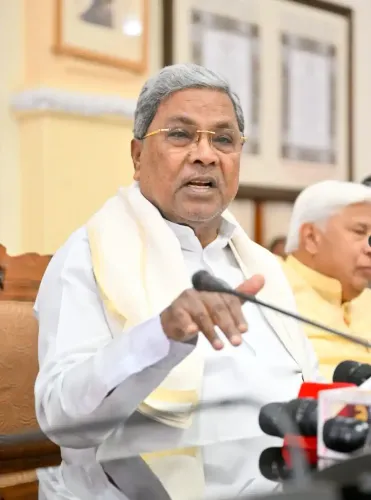
Is Casteism More Common Among the Educated? Karnataka CM Siddaramaiah Speaks Out
Synopsis
Karnataka CM Siddaramaiah highlights the alarming prevalence of casteism among the educated during a recent event. He underscores the urgent need for reform and education to foster rational thinking and equality in society. This significant discourse challenges societal norms and advocates for a change in mindset to eliminate caste-based discrimination.
Key Takeaways
Casteism is a significant concern among educated individuals.
Education should foster scientific thinking and rationality.
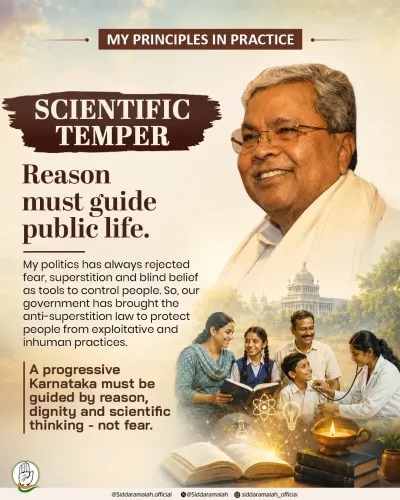
The Anti-Superstition Act aims to eliminate blind beliefs.
Religious teachings should promote humanity, not division.
Rao is a prominent figure in Indian science.
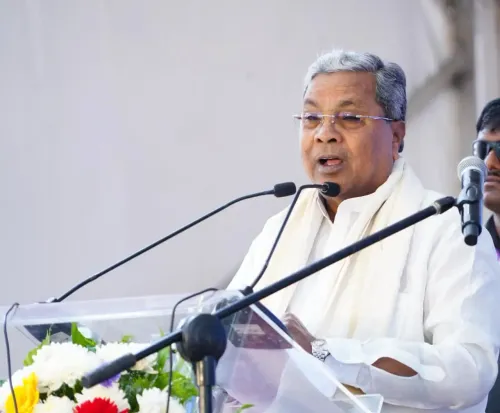
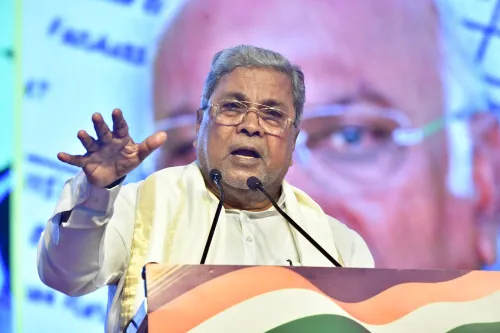
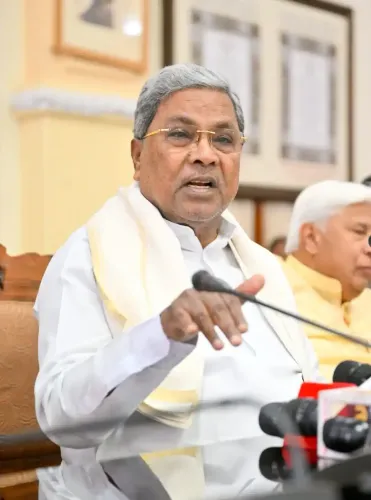
Bengaluru, Dec 13 (NationPress) Karnataka Chief Minister Siddaramaiah expressed his concern that casteism is increasingly prevalent among educated individuals and urged for its eradication.
He made these remarks after attending the Bharat Ratna Prof. C.N.R. Rao 10th Annual Science Outreach Programme-2025 in Lakshmeshwar, located in the Gadag district.
“The social reformer Basavanna declared, ‘Do not ask who he is,’ over 850 years ago. Yet, despite 79 years of independence and a literacy rate of 76 percent, casteism still persists. Alarmingly, it is more pronounced among the educated, and we must put an end to this,” the Chief Minister stated.
Siddaramaiah emphasized that the core purpose of education is to foster scientific thinking and rationality. “If we do not eliminate inequality and if educated individuals continue to indulge in blind practices, creating a truly humane society will remain impossible,” he asserted.
“We have enacted the Anti-Superstition Act. It is regrettable that superstitions still thrive in the land of Basavanna. Superstitions and blind beliefs need to be eliminated. The Constitution upholds fraternity, liberty, and equality. Without genuine adherence to these principles, neither casteism nor inequality will fade away. Education is crucial for developing one’s human potential,” he added.
“All religions advocate for humanity, but certain vested interests misinterpret their teachings. Instead of resigning to fate during crises, anyone can achieve success through determination and hard work, regardless of their background. Education is not limited to a specific class. With sincere effort and by seizing opportunities, one can achieve remarkable success. The essence of science is to promote a scientific outlook and rational thought,” he remarked.
Reflecting on his experiences with former bureaucrat B.S. Patil during official trips when Patil was Chief Secretary, Siddaramaiah shared that Patil hailed from a farming background, pursued education, joined the Army, and eventually became an IAS officer.
“Despite facing an accident, his strong willpower enabled him to pass the IAS examination. He retired as Chief Secretary, demonstrating integrity and a deep commitment to the state’s development,” Siddaramaiah noted.
Patil also served as Principal Secretary to former Chief Minister J.H. Patel. “J.H. Patel was exceptionally intelligent, and B.S. Patil ensured the efficient execution of work without undue pressure. Under J.H. Patel's leadership, a committee led by Patil assessed Bengaluru's division. Currently, another committee under his guidance has submitted a report, facilitating the division of Greater Bengaluru into five corporations. Patil has significantly contributed to the state, making it fitting for the Chandan Educational Institution to honor him,” he remarked.
Referring to Prof. C.N.R. Rao as one of India’s rare scientific luminaries, Siddaramaiah noted that Rao was educated in the Kannada medium until SSLC, while B.S. Patil was educated in English. “C.N.R. Rao ascended to the pinnacle of science. His research was his life’s work, supported significantly by his wife,” he stated.
Siddaramaiah recalled that India’s first Prime Minister, Jawaharlal Nehru, emphasized the importance of developing a scientific mindset. He urged that every Indian student should nurture scientific and rational thinking. India, with its diverse castes and religions, must strive to establish a secular and egalitarian society.
Point of View
It is imperative to recognize the significance of CM Siddaramaiah's statements regarding casteism among educated individuals. His call for a transformation in perspective and the urgent need for societal reform resonate deeply in today's context. Addressing caste-based discrimination is crucial for fostering a harmonious and equitable society, aligning with the values enshrined in our Constitution.
NationPress
1 Oct 2026
Frequently Asked Questions
What did CM Siddaramaiah say about casteism?
CM Siddaramaiah highlighted that casteism is alarmingly more prevalent among educated individuals and called for its eradication.
What is the purpose of education according to Siddaramaiah?
He stated that the core purpose of education is to instill a scientific temper and rational thinking in individuals.
What actions has the government taken against superstition?
The government has implemented the Anti-Superstition Act to combat superstitions and blind beliefs.
How does Siddaramaiah view the role of religion in society?
He believes that all religions preach humanity, but vested interests often misinterpret their teachings.
What is the significance of Prof. C.N.R. Rao in India?
Prof. C.N.R. Rao is regarded as one of India’s rare scientific luminaries, having made significant contributions to science.