How is CM Mann Committed to Protecting Punjab’s Water Rights?
Synopsis
In a significant move, Punjab's Chief Minister Bhagwant Mann has reaffirmed the state's dedication to safeguarding its water rights amid ongoing disputes with Haryana over the Sutlej-Yamuna Link canal. This commitment comes during collaborative discussions aimed at finding a peaceful resolution to a long-standing issue affecting both states. How will this impact Punjab's future?
Key Takeaways
Punjab's commitment to protect its water rights is reaffirmed by CM Mann.
The SYL canal dispute is a long-standing issue affecting both states.
Water scarcity is leading to serious groundwater exploitation in Punjab.
Regular discussions are being held to find an amicable resolution.
Both Punjab and Haryana must work collaboratively to ensure resource sustainability.
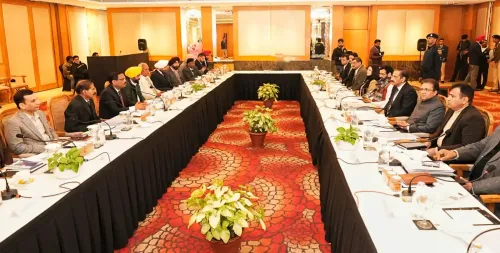
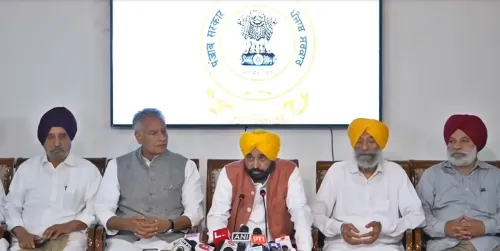
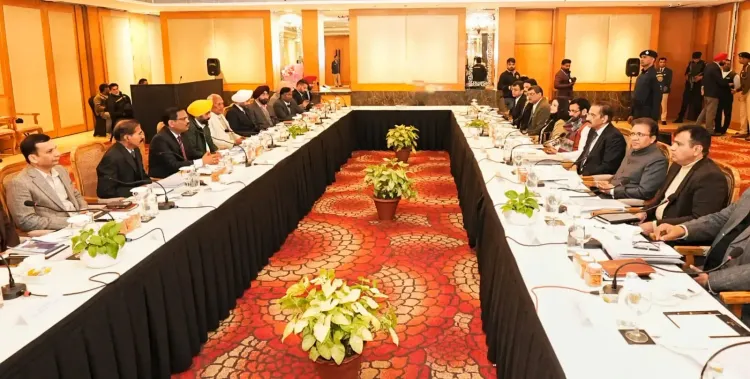
Chandigarh, Jan 27 (NationPress) The Chief Minister of Punjab, Bhagwant Mann, declared on Tuesday that the state government is unwavering in its commitment to protect Punjab’s interests amid the ongoing water dispute. He emphasized the importance of pursuing a mutually beneficial resolution to the Sutlej-Yamuna Link (SYL) canal matter during discussions with Haryana's Chief Minister, Nayab Singh Saini.
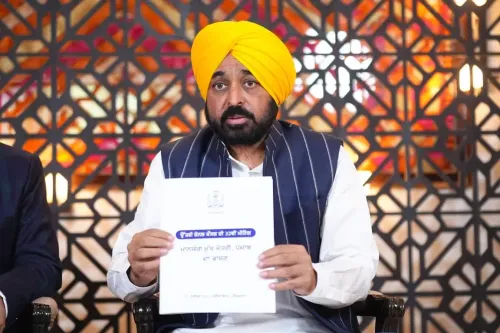
After the meeting, Mann addressed the press, stating, “We have no water to share with any other state, but as Haryana's elder sibling, we wish to avoid conflict and seek a swift resolution to this longstanding issue.”
He firmly stated, “Punjab possesses no surplus water to distribute to other states,” asserting, “Not a single drop of Punjab’s rightful water should be allowed to be diverted.”
He highlighted that the SYL canal is a deeply emotional matter for the state, cautioning, “Imposing this would lead to significant law and order challenges,” and clarified that “the land required for the SYL canal is not available in Punjab at present.”
Reaffirming Punjab’s stance, the Chief Minister remarked, “As the elder brother, both states are here to find an amicable resolution to this contentious issue,” noting that both the Supreme Court and the Government of India seek a mutually accepted solution. He expressed optimism that both states are collaborating to resolve the matter and end hostilities.
Mann emphasized that Punjab is not denying anyone their fair share, adding, “Of the total 34.34 million acre-feet (MAF) of water from the three rivers, Punjab’s allocation is merely 14.22 MAF, which is 40 percent, while the remaining 60 percent is assigned to Haryana, Delhi, and Rajasthan, despite the fact that none of these rivers flow through these states.”
Concerned about the ongoing water crisis, he remarked, “The declining availability of surface water is placing immense pressure on groundwater resources,” noting that 115 out of 153 blocks in Punjab have been declared overexploited.
He revealed that Punjab currently has the “highest rate of groundwater extraction in the nation.” The Chief Minister added, “Punjab often neglects its own water needs, supplying around 60 percent of its water to fulfill the demands of non-riparian states,” while stressing that although Punjab shares its river waters, it bears all flood-related damages, making it crucial to uphold Punjab’s rights.
The CM concluded, “For the first time in recent history, both state governments are engaged in serious discussions to address this issue,” asserting that there is no concept of winning or losing; instead, Punjab’s interests and sentiments must be respected.”
He emphasized that “water serves as the lifeline for both states,” proposing that regular meetings between officials of both states through a Joint Working Group are essential.
Mann expressed hope that the frequent gatherings of the Joint Working Group would pave the way for a harmonious resolution, ushering in a new era of progress and prosperity for both states.”
He was accompanied by Cabinet Minister Barinder Goyal, Chief Secretary K.A.P. Sinha, Principal Secretary to the Chief Minister Ravi Bhagat, Secretary of Irrigation Krishan Kumar, among others.
Point of View
It's essential to underscore that Punjab's water crisis not only affects local communities but also has broader implications for regional stability. The ongoing dialogue between Punjab and Haryana is a step towards collaboration, reflecting a commitment to amicable resolution while safeguarding the interests of all parties involved.
NationPress
11 Oct 2026
Frequently Asked Questions
What is the SYL canal dispute?
The SYL canal dispute involves the allocation of river water between Punjab and Haryana, where Punjab has been allocated significantly less water despite its geographical advantages.
Why is water sharing a critical issue?
Water is essential for agriculture, drinking, and industry, making its fair distribution crucial for the socio-economic stability of both Punjab and Haryana.
What are the consequences of not resolving this dispute?
Failure to resolve the dispute could lead to heightened tensions and potential law and order issues in both states.
How is Punjab's groundwater situation?
Punjab is currently facing a severe groundwater crisis, with most blocks over-exploited, leading to significant concerns about sustainable water management.
What measures are being taken to address the issue?
Regular meetings between state officials and the formation of a Joint Working Group have been proposed to facilitate dialogue and find solutions.