Congo's New 41-Member Government Unveiled After PM Makosso's Return
Synopsis
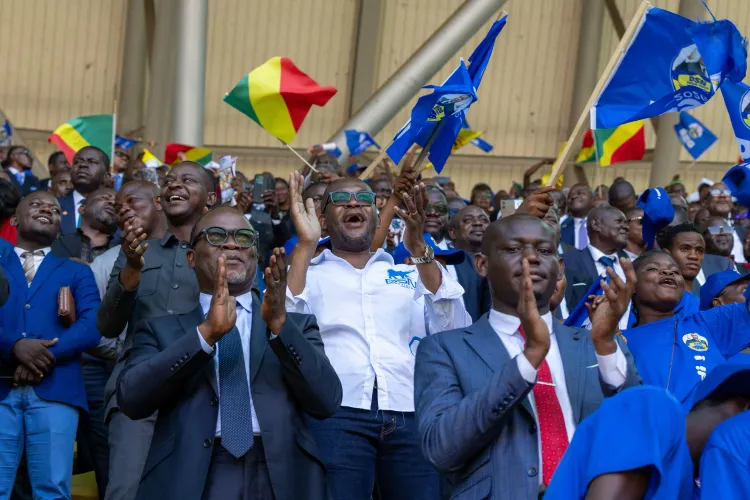
Congo unveiled a 41-member government on April 25 after President Sassou Nguesso reappointed PM Makosso, just days after his resignation was accepted. With Jean-Jacques Bouya elevated to Deputy PM and key ministers reassigned, the cabinet signals continuity — not change — following Sassou Nguesso's near-unanimous 94.9% election victory.
Key Takeaways
Prime Minister Anatole Collinet Makosso was reappointed on April 23, 2025 , just six days after his resignation was accepted by President Sassou Nguesso.
Congo's new government has 41 members : one Deputy PM, three Ministers of State, and 37 ministers, announced on April 25, 2025 .
Jean-Jacques Bouya was elevated to Deputy Prime Minister , tasked with infrastructure development and territorial planning.
President Denis Sassou Nguesso won re-election on March 15, 2025 with 94.9 per cent of the vote from a turnout of 84.65 per cent .
Key ministerial reshuffles include Pierre Oba moving to political affairs and Pierre Mabiala taking charge of civil service and labour.
The cabinet formation follows Congo's constitutional requirement that a re-elected president appoint a new Prime Minister to govern.
The Republic of the Congo officially unveiled its new government on April 25, 2025, following the reappointment of Prime Minister Anatole Collinet Makosso by President Denis Sassou Nguesso. The announcement was broadcast via a formal presidential statement on national television from Brazzaville, confirming a restructured cabinet comprising 41 members in total. The formation marks a significant political reset following Sassou Nguesso's landslide re-election victory in March 2025.
Cabinet Composition and Key Appointments
The newly formed government consists of one Deputy Prime Minister, three Ministers of State, and 37 ministers, alongside the Prime Minister. The structure reflects both continuity and strategic reshuffling within Congo's ruling political establishment.
Jean-Jacques Bouya, who previously served as Minister of State for Territorial Planning and Major Works, has been elevated to the position of Deputy Prime Minister in charge of Infrastructure Development and Territorial Planning — a role that signals the government's continued emphasis on large-scale infrastructure projects across the country.
Pierre Oba, formerly the Minister of State for Mines and Geology, has been reassigned as Minister of State at the Presidency in charge of Political Affairs, placing him at the center of the administration's political coordination machinery.
Claude Alphonse Nsilou, the former Minister of State for Trade, Supply and Consumption, was appointed Minister of State for Construction, Urban Planning and Housing. Meanwhile, Pierre Mabiala, previously overseeing Land Affairs and State Property Management, now heads the portfolio of Civil Service, Labour and Social Dialogue.
Electoral Mandate Behind the Reshuffle
The government formation is a constitutional consequence of President Denis Sassou Nguesso's decisive re-election on March 15, 2025, in which he secured a commanding 94.9 per cent of the total vote — an overwhelming mandate that critics and international observers have scrutinised given the country's political landscape.
Voter turnout stood at 84.65 per cent from a registered electorate of 3,167,099 voters. A total of seven candidates contested the election. Under Congo's electoral law, the president is elected through direct universal suffrage, with a two-round majority system applicable when no candidate achieves an outright majority in the first round — a threshold Sassou Nguesso crossed with ease.
Timeline: From Resignation to Reappointment
The political sequence leading to this cabinet was swift. Prime Minister Makosso and his outgoing government formally submitted their resignation on April 17, 2025, which was accepted by the president as a constitutional formality following the election. On April 23, 2025, the presidency announced Makosso's reappointment and tasked him with assembling the new administration.
The speed of the transition — from resignation to full cabinet announcement in under two weeks — underscores the consolidation of executive authority under Sassou Nguesso, who has governed Congo-Brazzaville for decades across two separate tenures.
Broader Context and Political Significance
This is not merely a routine cabinet reshuffle. Sassou Nguesso, one of Africa's longest-serving leaders, has held power since 1979 with a brief interruption in the 1990s. His re-election with nearly 95 per cent of the vote continues a pattern of dominant electoral outcomes that have drawn scrutiny from democratic governance watchdogs.
The retention of Makosso as Prime Minister, rather than appointing a new figure, suggests the president is prioritising administrative stability over political signalling. The reassignment of senior ministers to new portfolios — rather than their removal — similarly points to a preference for continuity within the ruling establishment.
Notably, the elevation of Jean-Jacques Bouya to Deputy Prime Minister with an infrastructure mandate aligns with Congo's ongoing push to develop its physical connectivity, a priority in a country where oil revenues have historically dominated the economy but infrastructure gaps remain wide.
As the new government settles into office, attention will turn to how it addresses Congo's economic challenges, including debt management, diversification away from oil dependency, and improving public service delivery for its citizens. The coming months will be a critical test of whether the reshuffled cabinet signals genuine policy renewal or simply a continuation of the status quo under a fresh mandate.
Point of View
And the speed with which this cabinet was assembled suggests the outcome was never truly in doubt. The elevation of infrastructure-focused technocrats like Jean-Jacques Bouya may reflect genuine development priorities, but Congo's deeper challenges — oil dependency, debt, and democratic accountability — remain conspicuously unaddressed by the reshuffle. The world is watching whether this mandate translates into governance or simply consolidates power.
NationPress
19 Sept 2026
Frequently Asked Questions
Who is the new Prime Minister of the Republic of Congo in 2025?
Anatole Collinet Makosso is the Prime Minister of the Republic of Congo, having been reappointed by President Denis Sassou Nguesso on April 23, 2025 . He had previously resigned on April 17 as a constitutional formality following the president's re-election.
How many ministers are in Congo's new government formed in April 2025?
Congo's new government comprises 41 members in total — one Deputy Prime Minister, three Ministers of State, and 37 ministers, in addition to Prime Minister Makosso. The cabinet was officially announced on April 25, 2025 .
Who won the Republic of Congo presidential election in March 2025?
Denis Sassou Nguesso won the presidential election held on March 15, 2025 , securing 94.9 per cent of the vote. Seven candidates contested the election, with voter turnout recorded at 84.65 per cent .
Who is Jean-Jacques Bouya and what is his new role in Congo?
Jean-Jacques Bouya is a senior Congolese politician who previously served as Minister of State for Territorial Planning and Major Works. He has been appointed Deputy Prime Minister in charge of Infrastructure Development and Territorial Planning in the new government.
Why did Congo's Prime Minister resign before being reappointed?
The resignation of PM Makosso and his cabinet on April 17, 2025 was a constitutional requirement following President Sassou Nguesso's re-election. Under Congo's constitution, a newly re-elected president must appoint a new Prime Minister to form a fresh government.