Congress Critiques Government for Vacancies in Higher Education and Opposes VBSA Bill
Synopsis
The Congress party has taken a strong stance against the central government regarding the alarming number of vacancies in key higher education regulatory bodies and has outright rejected the VBSA Bill, raising crucial constitutional and governance concerns.
Key Takeaways
Congress Critique: Strong opposition to government’s handling of higher education vacancies.
VBSA Bill Rejection: Congress raises constitutional concerns about proposed legislation.
State Consultation: Lack of input from state governments criticized.
Academic Autonomy: Concerns over potential loss of independence for Institutes of National Importance.
NEP 2020 Advocacy: Emphasis on the need for greater autonomy in higher education.
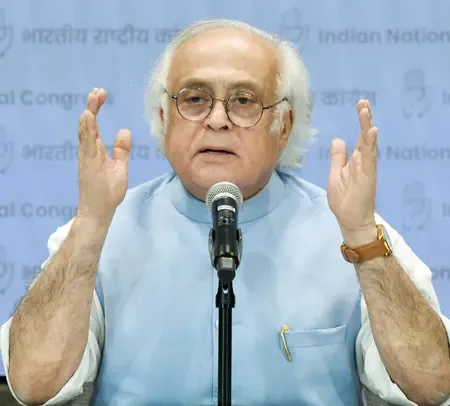
New Delhi, March 19 (NationPress) On Thursday, the Congress party strongly criticized the central government for the excessive number of vacancies in the nation's prominent higher education regulatory agencies, while also dismissing the proposed Viksit Bharat Shiksha Adhishthan (VBSA) Bill, 2025. In a statement referencing the most recent report from the Parliamentary Standing Committee on Education, Congress general secretary (communications) Jairam Ramesh expressed concerns about the administrative stagnation at the University Grants Commission (UGC) and the All India Council for Technical Education (AICTE), suggesting that this situation has become a justification for an overly centralized legislative change.
Ramesh raised multiple issues with the Bill as it currently stands. He pointed out that the ministry failed to consult state governments during the drafting process, even though education is included in the Concurrent List of the Constitution and the Bill directly impacts state universities.
Highlighting the constitutional framework, he noted that the Bill was introduced under Entry 66 of the Union List. However, he asserted that this entry grants limited legislative authority to Parliament, specifically for the coordination and determination of standards in institutions of higher education, as well as in research and scientific and technical institutions.
The Rajya Sabha MP contended that the proposed legislation transcends this authority and encroaches on state governments' powers. Citing constitutional provisions, he mentioned that Entry 44 of the Union List restricts Parliament from legislating on the establishment, regulation, and closure of universities, while Entry 32 of the State List assigns such powers to state legislatures.
“The Bill, therefore, contradicts the federal structure of the Constitution,” he stated.
Ramesh also noted a deviation from the framework outlined in the National Education Policy (NEP) 2020, which proposed establishing a Higher Education Council of India with various verticals, including a distinct body for grant allocation.
“In essence, grant-giving authority will revert from the autonomous bodies (the UGC and AICTE) overseen by academics to the Ministry, which is administrated by politicians. This centralization of authority diverges from current practices and undermines the NEP,” he remarked. On governance, the Congress leader criticized what he described as increasing bureaucratic influence.
“The new Bill stipulates that the executive management of the Commission and the three Councils be conducted by member secretaries (i.e., bureaucrats) appointed to these positions. The administration of education should be managed by academics (as is currently practiced), not bureaucrats,” he emphasized.
Ramesh further raised alarms regarding provisions related to Institutes of National Importance (INIs), including IITs, IIMs, NITs, IIITs, and IISERs, which have historically maintained academic independence. Referring to Clause 49 of the draft Bill, he noted it grants overriding authority over existing laws.
“Although it states that the autonomy of INIs cannot be compromised, the specifics remain unclear. Therefore, with this Bill, IITs and other INIs may also be subjected to the Commission's regulatory authority, which has never previously been the case and could jeopardize their academic and institutional independence,” he stated.
Ramesh also contrasted the proposed framework with current laws governing regulatory agencies. Under the existing UGC Act, he explained, the Commission is charged with determining and maintaining standards, framing regulations, and conducting inspections in collaboration with universities. “However, the proposed Bill, in stark contrast, grants absolute discretionary powers to the Councils to determine standards, conduct inspections, and exercise other unlimited and unspecified powers and functions. The regulator is now statutorily separated from the institutions,” he noted.
Concerning technical education, he pointed out that universities currently do not need to seek approval from the AICTE to launch new departments or programs. However, under the proposed Bill, they would require approval from a newly formed council to establish campuses.
“It is essential to remember that the National Education Policy 2020 advocates for greater autonomy for higher education institutions, not tighter regulation,” he concluded.
Point of View
The recent actions taken by the Congress party highlight the ongoing tension between state and central authorities in education governance. The concerns raised about vacancies and the proposed VBSA Bill reflect broader issues of autonomy and regulatory balance in India's higher education landscape.
NationPress
21 Sept 2026
Frequently Asked Questions
What is the VBSA Bill?
The VBSA Bill, or Viksit Bharat Shiksha Adhishthan Bill, 2025, aims to restructure higher education governance in India.
Why did Congress reject the VBSA Bill?
Congress rejected the Bill due to concerns over constitutional violations, lack of state consultation, and centralization of authority.
What are the key concerns raised by Congress?
Key concerns include administrative paralysis at regulatory bodies, encroachment on state powers, and potential threats to the autonomy of Institutes of National Importance.
How does the Bill affect existing higher education institutions?
The Bill could impose new regulatory requirements on institutions traditionally enjoying autonomy, potentially compromising their independence.
What is the National Education Policy's stance on autonomy?
The National Education Policy 2020 advocates for greater autonomy for higher education institutions, moving away from centralized control.