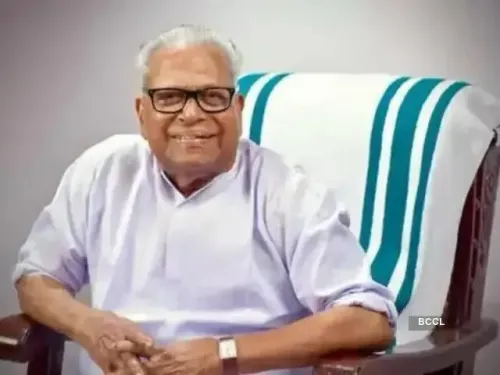
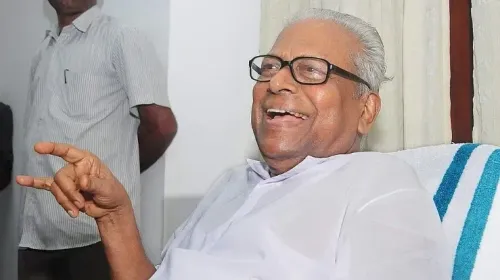
CPI(M)'s ideological dilemma: Padma Vibhushan for V.S. Achuthanandan reignites debate
Synopsis
The CPI(M) finds itself in a familiar bind: a posthumous Padma Vibhushan for V.S. Achuthanandan has reignited the party's unresolved tension between Communist ideology and state recognition — the same tension that led it to block K.K. Shailaja's Ramon Magsaysay Award in 2022. With the family having welcomed the honour, the party's ability to enforce its ideological line is, this time, effectively moot.
Key Takeaways
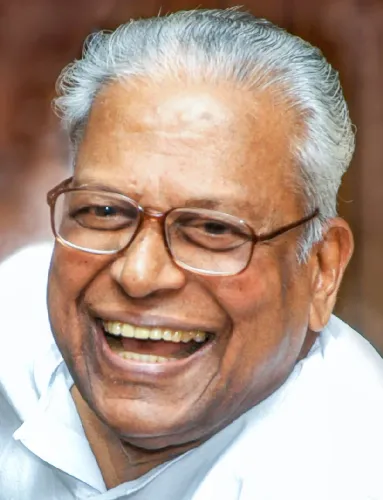
Achuthanandan was posthumously awarded the Padma Vibhushan , announced in January , seven months after his death.
The CPI(M) was reportedly uncomfortable with acceptance of the award, citing a Communist tradition of declining state honours.
Achuthanandan's family welcomed the honour, limiting the party's ability to enforce its ideological stance in a posthumous case.
In 2022 , the CPI(M) directed former Health Minister K.K.
Shailaja to decline the Ramon Magsaysay Award ; she complied.
Actor Mammootty and other Kerala personalities accepted national honours at the same ceremony, sharpening the contrast.
The episode exposes a recurring structural tension for the Indian Left between mass-based political legitimacy and ideological anti-establishment positioning.
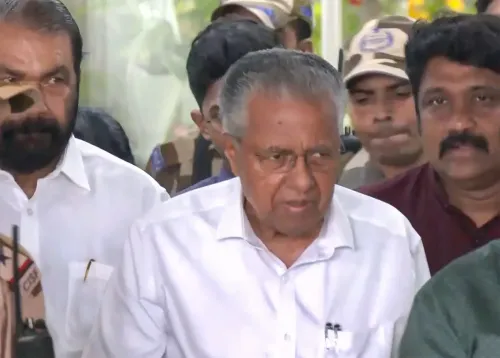
The posthumous conferment of the Padma Vibhushan — India's second-highest civilian honour — on former Kerala Chief Minister V.S. Achuthanandan has once again forced the Communist Party of India (Marxist) to confront a tension it has never fully resolved: how to respond when the establishment it critiques chooses to honour one of its own. The question resurfaced in Thiruvananthapuram this week as the national awards ceremony brought the issue back into public view.
The Award and the Reaction
When the Padma Vibhushan was announced in January — seven months after Achuthanandan's passing — the response across Kerala was broadly positive. Admirers regarded it as long-overdue recognition for a leader whose political identity frequently transcended party lines, despite a lifetime spent within the Communist movement. Achuthanandan's family also welcomed the honour, lending the acceptance a personal legitimacy that the party itself struggled to match.
The CPI(M), however, was reportedly uncomfortable. Senior party leaders invoked a longstanding Communist tradition of declining state honours, citing past instances where senior figures had refused such recognition. The award, in the party's view, sat uneasily with its ideological positioning.
The Shailaja Precedent
The current discomfort is not without precedent. In 2022, former Kerala Health Minister K.K. Shailaja was selected for the prestigious Ramon Magsaysay Award, widely regarded as Asia's Nobel Prize, following international acclaim for Kerala's management of the Covid-19 pandemic. The recognition was celebrated across the state, but the CPI(M) directed her not to accept it. As a disciplined party member, Shailaja complied — a decision that drew significant public debate at the time.
Notably, the Shailaja episode involved a living leader who could exercise agency. The Achuthanandan case, being posthumous, placed the family — rather than the party — in the position of deciding whether to receive the honour, complicating the CPI(M)'s ability to enforce its ideological stance.
A Contrast Kerala Could Not Miss
The optics this year were particularly pointed. Among the Keralites who accepted national honours with visible pride was superstar Mammootty, whose recognition drew widespread celebration. Against that backdrop, the CPI(M) once again found itself in the unusual position of receiving an award on behalf of a departed leader and then debating whether embracing it was ideologically permissible.
For many political observers, this contrast captures a deeper paradox. In a public life where individuals and institutions routinely compete for recognition, the CPI(M) remains perhaps the rare organisation that must explain, each time an honour arrives, why it would prefer not to accept it.
What the Dilemma Reveals
The recurring tension points to a structural challenge for the Left in contemporary India. Communist parties globally have historically maintained a critical distance from state-conferred honours, viewing them as instruments of establishment legitimacy. Yet as their leaders earn genuine mass affection — and as those leaders' families and supporters embrace recognition — the party's ideological position becomes increasingly difficult to sustain without appearing to diminish the very people it claims to represent.
For the millions who admired V.S. Achuthanandan, the Padma Vibhushan is a tribute to a people's leader. For the party he devoted his life to, it appears to remain, as ever, an ideological dilemma with no clean resolution in sight.
Point of View
And the party has no mechanism to override that in a posthumous case. More broadly, this is the second high-profile instance in three years where the party's anti-establishment reflex has collided with the genuine popular affection its leaders command. The Shailaja episode cost the party goodwill; this one risks making the CPI(M) look as though it is diminishing its own icon. The deeper question mainstream coverage misses is whether this ideological posture — coherent in theory — still resonates with a Kerala electorate that is simultaneously proud of its Left heritage and eager to see its leaders recognised on the national stage.
NationPress
24 Sept 2026
Frequently Asked Questions
What is the Padma Vibhushan awarded to V.S. Achuthanandan?
The Padma Vibhushan is India's second-highest civilian honour, awarded posthumously to former Kerala Chief Minister V.S. Achuthanandan. It was announced in January, approximately seven months after his death, in recognition of his decades-long contribution to public life.
Why is the CPI(M) uncomfortable with the Padma Vibhushan for Achuthanandan?
The CPI(M) has a longstanding tradition of declining state honours, viewing them as inconsistent with Communist ideology. Party leaders reportedly cited past instances where senior figures refused such recognition, reflecting discomfort with accepting establishment-conferred awards.
What happened with K.K. Shailaja and the Ramon Magsaysay Award in 2022?
In 2022, former Kerala Health Minister K.K. Shailaja was selected for the Ramon Magsaysay Award for her role in managing the Covid-19 pandemic. The CPI(M) directed her not to accept the award, and she complied as a disciplined party member — a decision that generated significant public debate.
How is the Achuthanandan case different from the Shailaja case?
Unlike the Shailaja case, where a living leader could be directed by the party, the Achuthanandan award is posthumous. His family has welcomed the honour, which effectively limits the CPI(M)'s ability to enforce its ideological stance on acceptance.
Who else from Kerala received national honours at the same ceremony?
Actor Mammootty was among the distinguished personalities from Kerala who accepted national honours at the Padma awards ceremony, a contrast that sharpened public attention on the CPI(M)'s recurring ideological discomfort with state recognition.