Are Over 3.2 Lakh Class 9 Students Failing in Delhi Gov't Schools Over 5 Years?

Synopsis
Recent revelations in the Rajya Sabha by MP Swati Maliwal have shed light on a troubling trend in Delhi's education system. With over 3.2 lakh Class 9 students failing in the past five years, policymakers face a critical challenge to reform and support young learners effectively.
Key Takeaways
Over 3.2 lakh students have failed Class 9 in Delhi government schools.
The failure rate has shown a significant increase over the years.
NIOS is involved in providing alternatives for failed students.
There are questions about the effectiveness of current education policies.
Systemic reforms are urgently needed to address these issues.
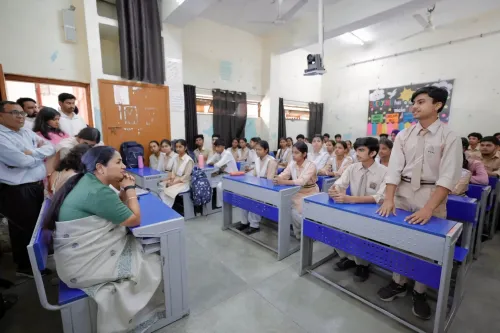
New Delhi, Dec 11 (NationPress) In the Rajya Sabha, a critical spotlight was directed at the educational framework of Delhi as MP Swati Maliwal voiced serious concerns regarding the disconcerting number of Class 9 students failing in government schools.
Citing statistics from the Ministry of Education, Maliwal questioned whether the Delhi government’s strategy of redirecting failed students to the National Institute of Open Schooling (NIOS) is contributing to rising dropout rates and artificially boosting school performance metrics.
Minister of State for Education Jayant Chaudhary, in a formal response, confirmed that over 3.20 lakh students have failed in Class 9 within Delhi government schools over the last five years.
Yearly data indicates a troubling pattern; 31,541 students failed in 2020–21, 28,548 in 2021–22, a significant increase to 88,421 in 2022–23, peaking at 1,01,344 in 2023–24, before slightly decreasing to 70,296 in 2024–25. The total failure count stands at 3,20,150.
In conjunction with these failures, more than 71,000 students were enrolled in NIOS during the same timeframe. The admissions breakdown shows 11,322 in 2020–21, 10,598 in 2021–22, 29,436 in 2022–23, 7,794 in 2023–24, and 11,974 in 2024–25.
Maliwal contended that this approach, while seemingly providing students with a second chance, risks alienating many from the mainstream educational pathway and raises accountability issues.
In response to these apprehensions, Chaudhary asserted that education is a concurrent subject, with states and Union Territories overseeing most schools. He defended NIOS, stating one of its primary goals is to avert repeated failures leading to permanent dropouts.
According to him, students successfully completing Class 10 through NIOS are often reintegrated into formal education, thereby continuing their academic journey. However, Maliwal’s pointed inquiries—whether this policy is being exploited to enhance school results, and what corrective measures are being implemented—emphasize a broader discussion regarding systemic reforms.
The statistics reveal not just a numerical crisis but a human one, as thousands of young learners grapple with challenges at a pivotal moment in their education.
As the figures escalate, the challenge for policymakers remains in balancing remedial options with accountability, ensuring that the promise of education does not fade away for students in Delhi.
Point of View
This situation highlights significant flaws in the educational framework, calling for immediate reforms and accountability. It is crucial for the government to address these issues to prevent further erosion of the educational standards and ensure that every child receives a quality education.
NationPress
30 Sept 2026
Frequently Asked Questions
What is the total number of Class 9 students who failed in Delhi government schools?
Over 3.20 lakh students have failed in Class 9 in Delhi government schools in the past five years.
What is the role of NIOS in this context?
NIOS aims to provide an alternative for students who fail, but concerns have been raised about its effectiveness and potential misuse.
What have been the yearly failure rates?
The yearly failure rates show an alarming increase, with 1,01,344 students failing in 2023-24 alone.
What are the implications of these failure rates?
These failure rates indicate a systemic issue in Delhi’s education system that needs urgent reform to prevent students from dropping out.
How is the government responding to these concerns?
The government is emphasizing the importance of NIOS while recognizing the need for accountability and systemic reform.