What Special Measures is the Centre Taking to Enhance MSME Growth?

Synopsis
Discover how the Centre is revolutionizing the MSME sector! With new regulations and credit access improvements, these changes aim to strengthen Micro, Small, and Medium Enterprises in India, ensuring easier business operations and enhanced growth opportunities.
Key Takeaways
MSMEs benefit from extended deadlines for compliance.
Special exemptions for imported goods support local production.
Financial concessions range from 10% to 80% on fees.
Collaboration with recognized labs for testing is encouraged.
Collateral-free loans up to Rs 10 lakh enhance credit access.
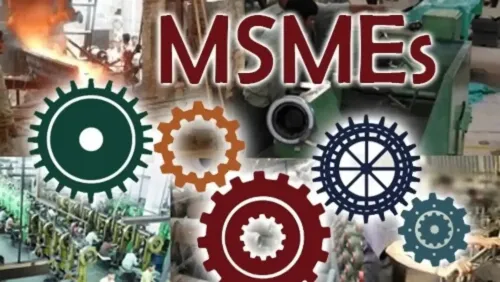
New Delhi, Dec 14 (NationPress) - The Central Government is implementing targeted initiatives to foster the growth of Micro, Small, and Medium Enterprises (MSMEs) by simplifying regulations to improve the ease of doing business and enhancing their access to credit for business expansion, as stated in an official announcement released on Sunday.
The Bureau of Indian Standards (BIS), responsible for enforcing Quality Control Orders (QCOs) from various ministries, is granting specific exemptions and relaxations to MSMEs to prevent disruptions in domestic production, the announcement highlighted.
Among the significant relaxations and exemptions are extensions ranging from 3 to 6 months for Micro and Small Enterprises (MSEs) and exemptions for imports by local manufacturers producing goods meant for export.
Furthermore, there is an exemption on the import of up to 200 units for research and development, along with provisions for clearing legacy stock (produced or imported before new regulations) within six months of implementation.
The BIS has introduced financial and technical relaxations for the MSME sector, which include discounts of 10 to 80 percent on the annual minimum marking fee. An additional 10 percent concession is available for enterprises operating in the northeast region or those run by women entrepreneurs.
Moreover, the requirement for MSME units to maintain an in-house laboratory has been made optional. MSMEs can now utilize services from BIS-recognized laboratories, NABL-accredited labs, or share resources with cluster-based labs or other manufacturing units. The 'Levels of Control' in the Scheme of Inspection and Testing (SIT) have also been made recommendatory, allowing manufacturers to define their own control unit/batch/lot and Levels of Control and communicate this to the BIS.
Additionally, the BIS has made the product certification process guidelines accessible online and is releasing product-specific manuals to aid in conformity assessment according to various Indian Standards.
To enhance monetary policy transmission, the Reserve Bank of India (RBI) has advised banks to link MSME loans to an external benchmark. The reset clause for these loans has been shortened to three months. Furthermore, banks are encouraged to offer existing borrowers a switch option to the new external benchmark interest rates on mutually agreed terms.
The RBI has also initiated various other measures to boost credit flow to the MSME sector, such as the Mutual Credit Guarantee Scheme, which provides a credit guarantee to facilitate loans for purchasing essential equipment and machinery. This scheme covers lenders (Scheduled Commercial Banks, All India Financial Institutions, NBFCs) for term loans up to Rs 100 crore for MSME projects.
Additionally, Scheduled Commercial Banks are now prohibited from requiring collateral for loans up to Rs 10 lakh for MSE units, further easing their access to credit and supporting business growth.
Point of View
The Centre's initiatives to support MSMEs reflect a commitment to economic growth and innovation. By easing regulations and improving access to credit, these measures can empower small businesses, driving job creation and sustainable development in the economy.
NationPress
2 Oct 2026
Frequently Asked Questions
What steps is the Centre taking to support MSMEs?
The Centre is easing regulations, providing better access to credit, and implementing special exemptions to support the growth of Micro, Small, and Medium Enterprises.
How will MSMEs benefit from the new measures?
MSMEs will benefit from extended deadlines, import exemptions, financial relaxations, and easier access to loans without collateral.
What is the Mutual Credit Guarantee Scheme?
This scheme offers a credit guarantee to facilitate loans for MSMEs, making it easier for them to obtain financing for essential equipment and machinery.
Are there any concessions for women entrepreneurs?
Yes, an additional concession of 10% is provided for MSMEs owned by women entrepreneurs.
What is the significance of linking MSME loans to external benchmarks?
Linking loans to external benchmarks enhances loan transparency and can lower interest rates for MSMEs, benefiting their financial operations.