Is India Set to Become a $5 Trillion Economy?
Synopsis
India's ambition to transform into a $5 trillion economy is on the rise, bolstered by significant advancements in financial inclusion and infrastructure development. Discover how innovative collaborations and AI-driven initiatives are paving the way for a prosperous future.
Key Takeaways
India is on a path to becoming a $5 trillion economy.
Financial inclusion has dramatically increased over the last decade.
Collaboration between various sectors is crucial for technological advancement.
The IndiaAI Mission is essential for developing necessary computational infrastructures.
AI and DPI convergence will enhance public service delivery.
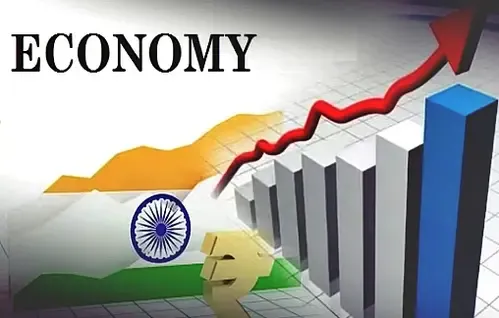
New Delhi, Dec 6 (NationPress) India is on a promising trajectory to achieve a $5 trillion economy, propelled by robust fundamentals, growth driven by infrastructure, and resilient supply chains, stated M. Nagaraju, Secretary of the Department of Financial Services. He emphasized that the past decade has been revolutionary, with initiatives like Jan Dhan and DPI boosting financial inclusion from 21% in 2008 to over 80% today, during a conference on AI and digital public infrastructure (DPI).
The event, organized by the National Institute for Smart Government (NISG), the Ministry of Electronics and Information Technology, and Tripura's Directorate of IT, featured EY as the Knowledge Partner.
S. Krishnan, Secretary of MeitY, highlighted the necessity for collaboration among government, private sector, civil society, and academia to optimize India’s technology ecosystem.
Bhuvnesh Kumar, CEO of UIDAI and NISG, pointed out how NISG’s framework effectively combines governmental decision-making speed with the private sector’s procurement efficiency.
Mahaveer Singhvi, Joint Secretary at the NEST Division of the Ministry of External Affairs, shared insights on the IndiaAI Mission, which aims to establish computing capacity, datasets, foundational models, innovation centers, and frameworks tailored to India’s unique realities and priorities.
A NISG-EY report presented at the conference underscored a strong consensus on technology's pivotal role in India’s advancement, indicating that the fusion of AI and India’s DPI stack will spur economic empowerment, enhance governance, and deliver citizen-focused services at scale.
Shankar Maruwada, Co-founder and CEO of EkStep Foundation, noted that DPI 1.0 addressed welfare needs, while DPI 2.0, with AI support, will fulfill the aspirations of 1.5 billion Indians. He stated that this decade presents a chance to transform digital public infrastructure into digital public intelligence.
The conference gathered policymakers, technologists, and industry leaders to discuss how AI and DPI can fortify governance and public service delivery, aiming for a developed India by 2047.
Point of View
The strides towards a $5 trillion economy reflect India's commitment to progress and innovation. The emphasis on collaboration among various sectors showcases a united approach to harnessing technology for economic growth, a crucial step towards achieving national goals by 2047.
NationPress
12 Oct 2026
Frequently Asked Questions
What is the current status of India's economy?
India is on track to become a $5 trillion economy, driven by strong financial inclusion and infrastructure growth.
How has financial inclusion changed in India?
Financial inclusion in India has expanded from 21% in 2008 to over 80% today, thanks to initiatives like Jan Dhan and DPI.
What role does AI play in India's economic strategy?
AI is pivotal in enhancing governance and public service delivery, helping to achieve economic empowerment and citizen-centric services.