Is Natural Farming Gujarat's Path to a Poison-Free Future?
Synopsis
Gujarat Governor Acharya Devvrat champions natural farming as a sustainable solution for a chemical-free future, emphasizing ethical responsibility and ecological balance. His mission, aligned with Prime Minister Modi's vision, highlights the need for farmers to adopt traditional wisdom for long-term prosperity.
Key Takeaways
Natural farming promotes sustainability and ecological balance.
It requires no external market inputs, reducing costs significantly.
Adopting traditional wisdom can enhance soil health and crop yields.
Widespread adoption could mitigate the impacts of floods and droughts.
Governor Devvrat's initiative is aligned with national goals for sustainable development.
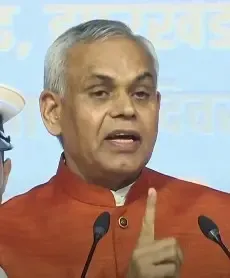
Ahmedabad, Dec 14 (NationPress) Highlighting sustainability as a fundamental scientific necessity and ethical obligation, Gujarat Governor Acharya Devvrat on Sunday advocated for a significant transition towards natural farming. He emphasized that his mission is to transform Gujarat into a chemical-free and environmentally friendly region, guided by Prime Minister Narendra Modi.
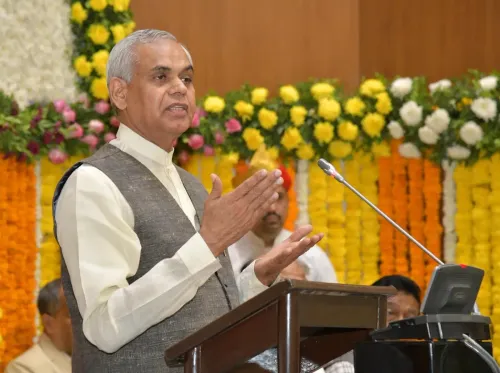
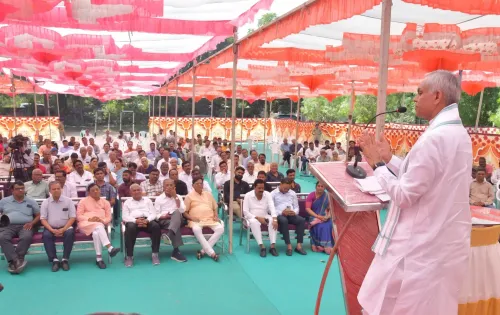
Speaking at a large assembly of farmers during a seminar focused on natural agriculture at Anand Agricultural University's Bansilal Amrutlal College of Agriculture Auditorium, the Governor characterized natural farming as “the cultivation of microorganisms” and referred to its adoption as a “divine act” aimed at protecting future generations.
Governor Devvrat highlighted that the pursuit of natural farming in Gujarat is being undertaken with a mission-driven approach, elucidating its five core dimensions through a scientific framework.
He stressed the intergenerational responsibility, asserting that it is our collective moral duty to ensure fertile soil, clean air, and pure water for future generations.
Promoting desi cow-based natural farming, the Governor claimed that this model presents a sustainable route towards a developed India while restoring ecological balance.
Reflecting on the Green Revolution, he provided data-driven insights contrasting past and present conditions.
He noted that 60–70 years ago, India's soil organic carbon was at 2–2.5 percent—comparable to the fertility of forest land—but has now plummeted below 0.5 percent due to excessive application of chemical fertilizers and pesticides.
Although India has achieved food security and export capability, he warned that the overuse of urea, DAP, and pesticides has hardened soils and depleted fertility, compelling farmers to resort to increasingly higher inputs.
In contrast, he asserted that natural farming requires no external market inputs, brings production costs near zero, and guarantees long-term prosperity for farmers.
Identifying natural farming as the need of the hour, the Governor claimed that widespread implementation across the nation could consign floods and droughts to history.
He described the method as essential not only for farmers and agriculture but also for the survival and holistic advancement of humanity.
Connecting the movement to Prime Minister Narendra Modi's Swadeshi vision, he stated that natural farming is anchored in India's traditional wisdom, which needs to be reclaimed.
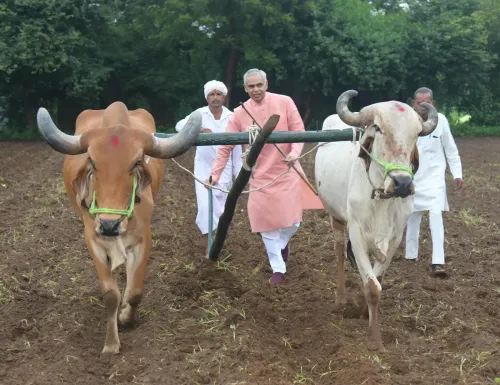
Sharing personal experiences from his agricultural life, Governor Devvrat provided practical advice to farmers who have adopted or intend to embrace natural farming.
He assured them that adhering to the five principles of natural farming could yield higher outputs and incomes from the very first year, detailing methods such as jeevamrut, ghan jeevamrut, and the preparation of natural fertilizers.
The Governor also praised Anand Agricultural University for its three-year research on combating nematode disease via natural farming techniques and for documenting successful experiments.
Encouraging Krushi Sakhis and Kisan Mitras, he noted that their role in promoting natural farming could “transform the nation's destiny”, asserting that Gujaratis have a unique capacity to adopt and spread effective practices globally.
The event concluded with the Governor leading a pledge to endorse natural farming.
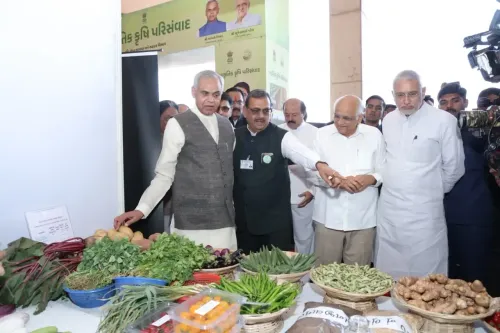
Previously, Governor Devvrat received a guard of honour and later explored awareness posters exhibited under the Agricultural Technology Management Agency project.
District Collector Pravin Chaudhary, in his welcome address, labeled natural farming as a pillar of sustainable development, aligning it with the Prime Minister's Mission LiFE.
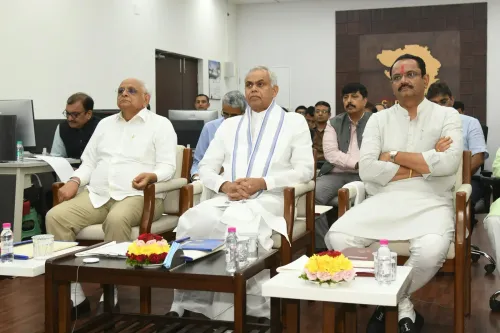
Ministers, MPs, local representatives, university scientists, officials, farmers, livestock breeders, and master trainers involved in natural farming were in significant attendance.
Point of View
The movement towards natural farming in Gujarat signifies a crucial step towards sustainable agriculture. Governor Devvrat's calls for a shift in farming practices resonate with a growing global awareness of environmental issues, making this initiative essential for the nation’s future. It emphasizes the need for tradition and innovation to coexist, ensuring both agricultural productivity and ecological preservation.
NationPress
24 Sept 2026
Frequently Asked Questions
What is natural farming?
Natural farming is an agricultural approach that emphasizes the use of local resources, including microorganisms, to enhance soil fertility and crop yields without chemical fertilizers or pesticides.
Why is natural farming important?
Natural farming is crucial for promoting sustainability , restoring ecological balance, and providing a healthier environment for future generations.
How can farmers transition to natural farming?
Farmers can transition by adopting practices such as jivamrut and ghan jivamrut, which are traditional methods of organic fertilization, and by following the five principles of natural farming.
What are the benefits of natural farming?
The benefits include reduced production costs, improved soil health, and increased long-term profitability for farmers.
How does natural farming relate to Prime Minister Modi's vision?
Natural farming aligns with Prime Minister Modi's Swadeshi vision by reclaiming India's traditional agricultural practices, promoting self-reliance, and fostering sustainable development.