Is There a Disparity in the Issuance of Reserved Category Certificates Between Jammu Division and Kashmir Valley?

Synopsis
Recent data presented by the Jammu and Kashmir government shows a stark difference in the issuance of reserved category certificates between Jammu Division and Kashmir Valley, raising questions about equity in access to government benefits. This article explores the implications of these disparities.
Key Takeaways
Significant regional imbalance in certificate issuance between Jammu and Kashmir.
Jammu Division receives the majority of reserved category certificates.
Disparities in Scheduled Tribe and Scheduled Caste categories are particularly pronounced.
Equal distribution in Reserved Backward Area category.
Implications for representation and access to benefits are profound.
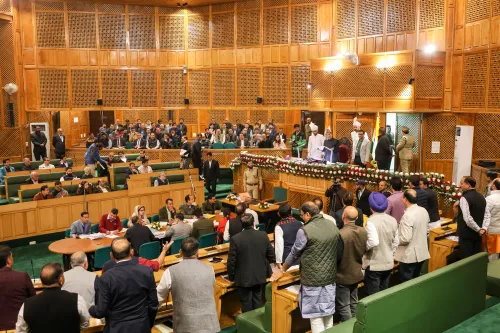
Jammu, Feb 11 (NationPress) The government of Jammu and Kashmir presented data in the Legislative Assembly on Wednesday that reveals a discrepancy in the distribution of reserved category certificates between the Jammu Division and the Kashmir Valley.
The official statistics shared by the Jammu and Kashmir government during the Assembly session highlighted a notable regional imbalance regarding the issuance of these certificates.
This data was submitted in response to a cut motion proposed by Peoples Conference (PC) president and MLA Sajad Gani Lone.
The statistics indicate that Jammu Division is predominant in nearly all seven reserved categories, with particularly stark differences in the Scheduled Tribe (ST) and Scheduled Caste (SC) categories.
In the Scheduled Tribe (ST) category, out of a total of 749,970 certificates issued throughout the Union Territory, a staggering 693,781 were allocated in Jammu, which constitutes over 92.5 percent.
Conversely, only 56,189 certificates, or 7.4 percent, were distributed in the Kashmir division.
The disparity is even more pronounced in the Scheduled Caste (SC) category. Out of 141,419 SC certificates issued, an astonishing 139,664 (over 98 percent) were issued in Jammu, whereas Kashmir received just 1,755 certificates, making up a mere 1.24 percent.
In the Reserved Backward Area (RBA) category, however, the figures suggest a fairly equal distribution. Of the 100,848 certificates issued, 50,982 (50.5 percent) were granted in Jammu, while 49,866 (49.4 percent) were allocated in Kashmir.
Likewise, under the Actual Line of Control (ALC) category, a total of 7,192 certificates were issued, with Jammu acquiring 6,732 (93.6 percent) and Kashmir just 460 (6.3 percent).
Notably, all 6,732 International Border (IB) certificates were exclusively issued in the Jammu division.
In the Other Backward Classes (OBC) category, Jammu continues to excel with 78,324 certificates (59.8 percent), while Kashmir accounts for 52,652 certificates (40.2 percent).
This data underscores the disparities in the allocation of reserved category certificates, prompting Valley-centric politicians to argue that this situation has broader implications for representation and access to government benefits across Jammu and Kashmir.
Point of View
It is crucial to recognize the implications of the reported discrepancies in reserved category certificate issuance. This data not only highlights regional imbalances but also raises questions about equity and representation in governance. It is essential for policymakers to address these disparities to ensure fair access to benefits for all communities in Jammu and Kashmir.
NationPress
2 Oct 2026
Frequently Asked Questions
What are reserved category certificates?
Reserved category certificates are official documents that grant individuals belonging to specific marginalized groups access to certain benefits, quotas, and schemes offered by the government.
Why is there a disparity in certificate issuance?
The disparity may stem from various factors, including population demographics, administrative differences, and historical contexts that influence the distribution of government resources.
What are the implications of these disparities?
These disparities can affect representation and access to government benefits, leading to a sense of inequity among communities in different regions.