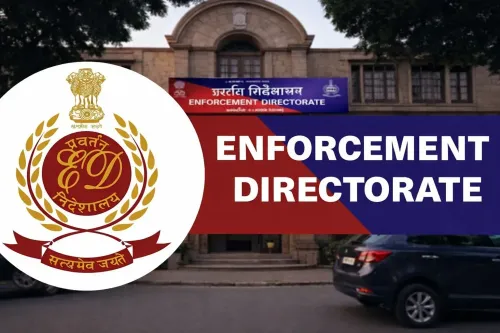
ED freezes ₹1,023 crore Salgaocar assets in Goa iron-ore mining case
Synopsis
The ED has frozen ₹1,023.85 crore in Salgaocar Group assets — spanning India and Singapore — in a Goa illegal iron-ore mining case where total proceeds of crime are pegged at nearly ₹5,237.84 crore. The cross-border money trail, allegedly routed through British Virgin Islands shell companies and resold to China, makes this one of the most complex natural-resources laundering probes in recent memory.
Key Takeaways
The ED issued a Provisional Attachment Order on 19 June freezing assets worth ₹1,023.85 crore linked to the Salgaocar Group .
Attached assets include 99 properties in India (₹459.10 crore) , 31 properties in Singapore (₹471.32 crore) , and equity shares worth ₹93.42 crore .
The AVS Group allegedly operated 10 mining leases in Goa (2007–2012) , generating domestic proceeds of crime of ₹2,492.95 crore .
Ore was allegedly exported undervalued to BVI shell companies and resold to China , generating additional offshore profits of ₹2,744.89 crore .
Total proceeds of crime identified by the ED stand at nearly ₹5,237.84 crore .
The Supreme Court had ruled in 2014 and 2018 that all Goa mining after 22 November 2007 was illegal.
The Enforcement Directorate (ED) has provisionally attached movable and immovable properties worth ₹1,023.85 crore — including assets held in Singapore — in connection with large-scale illegal iron-ore mining in Goa by the Salgaocar Group and its associated firms. The Provisional Attachment Order, issued on 19 June under the Prevention of Money-Laundering Act (PMLA), 2002, marks a significant escalation in a money-laundering probe that investigators say generated proceeds of crime totalling nearly ₹5,237.84 crore.
What Was Attached and Where
The attached portfolio spans 99 immovable properties in India valued at ₹459.10 crore, 31 immovable properties in Singapore valued at ₹471.32 crore, and equity shares in Indian companies worth ₹93.42 crore. The assets were held across multiple entities, including the Estate of Late Anil Vassudeva Salgaocar (administered by Lakshmi Anil Salgaocar), Salgaocar Mining Industries, Shantilal Khushaldas & Brothers, S. Kantilal & Co, Salitho Ores, Vertex Newton Projects, and Subarnarekha Port.
How the Alleged Fraud Was Structured
According to the ED, the AVS Group — the collective label for the Salgaocar Group and its associates — operated 10 mining leases in Goa between 2007 and 2012, generating proceeds of crime of ₹2,492.95 crore from the illegal extraction, sale, and export of iron ore. The illegally mined ore was reportedly exported at grossly undervalued prices to shell entities — Special Purpose Vehicles (SPVs) — incorporated in the British Virgin Islands (BVI). These paper intermediaries then resold the ore to China, generating further offshore trade profits of ₹2,744.89 crore, the agency said.
The funds were allegedly layered through BVI and Singapore-based SPVs, used to acquire assets abroad, and partly routed back into India in the guise of share capital — a classic round-tripping structure, according to investigators.
Supreme Court Backdrop
The ED's action rests partly on two landmark Supreme Court judgments — dated 21 April 2014 and 7 February 2018 — which held that all mining undertaken in Goa after 22 November 2007 (until the issuance of fresh mining leases) was illegal and without lawful authority. The investigation was initiated on the basis of an FIR registered by the CID Crime Branch, Goa, for offences under the Indian Penal Code, 1860, the Prevention of Corruption Act, 1988, and the Mines and Minerals (Development and Regulation) Act, 1957.
Scale of the Alleged Money Laundering
The total proceeds of crime identified by the ED stand at nearly ₹5,237.84 crore — combining domestic extraction proceeds and offshore resale profits. The current attachment of ₹1,023.85 crore represents a partial freeze; investigators are expected to pursue further attachments as the probe advances. This is among the largest single attachment orders in a natural-resources money-laundering case in recent years.
What Comes Next
A provisional attachment under PMLA is subject to confirmation by the Adjudicating Authority within a statutory timeframe. The ED is likely to file a prosecution complaint before a special PMLA court as the investigation matures. The cross-border dimension — spanning BVI and Singapore — suggests the agency may also invoke mutual legal assistance treaties (MLATs) for further asset recovery abroad.
Point of View
023.85 crore attachment is striking not just for its size but for its geography — over ₹471 crore in Singapore properties suggests a sophisticated offshore layering structure that domestic enforcement agencies have historically struggled to unwind. The BVI-to-China ore resale trail, if proven, would represent a textbook transfer-pricing fraud layered onto an already illegal extraction operation. What mainstream coverage underplays is that the Supreme Court settled the illegality question years ago; the real test now is whether MLAT mechanisms can claw back the Singapore assets before they are further dissipated. The gap between the ₹5,237.84 crore in identified proceeds and the ₹1,023.85 crore attached so far is a number worth watching.
NationPress
20 Sept 2026
Frequently Asked Questions
What assets has the ED attached in the Goa iron-ore mining case?
The ED has provisionally attached assets worth ₹1,023.85 crore, comprising 99 immovable properties in India (₹459.10 crore), 31 immovable properties in Singapore (₹471.32 crore), and equity shares in Indian companies (₹93.42 crore). The assets are linked to the Salgaocar Group and associated entities.
Who is the Salgaocar Group and what is it accused of?
The Salgaocar Group, referred to collectively as the AVS Group in the ED investigation, is accused of operating 10 mining leases in Goa between 2007 and 2012 and illegally extracting and exporting iron ore. The Supreme Court had ruled that all Goa mining after 22 November 2007 was illegal, and the ED alleges the group generated proceeds of crime of nearly ₹5,237.84 crore.
How were the alleged proceeds of crime laundered?
According to the ED, illegally mined ore was exported at undervalued prices to shell companies in the British Virgin Islands, which resold it to China at market rates, generating offshore profits of ₹2,744.89 crore. These funds were then allegedly layered through BVI and Singapore-based entities and partly routed back into India as share capital.
What is the legal basis for the ED's action?
The ED acted under the Prevention of Money-Laundering Act (PMLA), 2002, issuing a Provisional Attachment Order on 19 June. The investigation was triggered by an FIR filed by the CID Crime Branch, Goa, and is backed by two Supreme Court rulings — dated 21 April 2014 and 7 February 2018 — that declared post-November 2007 mining in Goa illegal.
What happens after a provisional attachment under PMLA?
A provisional attachment must be confirmed by the Adjudicating Authority within a statutory period. If confirmed, the ED can proceed to file a prosecution complaint before a special PMLA court. Given the cross-border assets in Singapore, the agency may also invoke mutual legal assistance treaties to pursue recovery abroad.