Rajasthan CM Bhajanlal pushes AI-driven TB elimination drive
Synopsis
Rajasthan, under CM Bhajanlal Sharma, has launched a multi-dimensional TB elimination strategy combining artificial intelligence, microbiological diagnostic networks, and community-based active case-finding — aligning the state with India's national goal to eliminate tuberculosis by 2025.
Key Takeaways
Rajasthan is implementing a multi-dimensional TB elimination strategy under CM Bhajanlal Sharma , announced on 5 August 2026 .
The strategy integrates artificial intelligence , a microbiological testing network, and community-based active screening campaigns.
The government says early detection, quality diagnostics, and treatment access have seen notable improvement under the initiative.
The approach aligns with India's national target to eliminate TB by 2025 , set by PM Modi in 2018 — ahead of the global SDG deadline.
The National TB Elimination Programme and the Ni-kshay digital portal provide the central framework Rajasthan is building on.
State-level incidence data and central health ministry assessments will be the key metrics to watch for measuring programme impact.
Rajasthan is taking its fight against tuberculosis into the algorithmic age. Under Chief Minister Bhajanlal Sharma, the state government has woven together artificial intelligence, microbiological diagnostic networks, and community-level active case-finding into a single, coordinated strategy — one designed to find every potential TB patient before the infection chain can extend further.
A multi-pronged strategy to break transmission
The Chief Minister's Office of Rajasthan announced on Wednesday, 5 August 2026 that the state is advancing rapidly toward TB elimination through what it describes as a 'multi-dimensional strategy' — बहु-आयामी रणनीति — integrating modern technology with mass public participation. The approach combines AI-assisted diagnostics, an expanded microbiological testing network, and community-based active screening campaigns to detect cases early and cut transmission at the source.
The announcement frames the initiative under the hashtag #आपणो_अग्रणी_राजस्थान ('Our Leading Rajasthan'), signalling the state's intent to position itself as a frontrunner in India's national health agenda. Early detection, quality testing, and access to treatment are the three pillars the government says have seen 'notable improvement' under this drive.
Where Rajasthan fits India's 2025 TB elimination clock
The backdrop matters here. In 2018, Prime Minister Narendra Modi set an ambitious national target: eliminate tuberculosis in India by 2025, a full decade ahead of the global Sustainable Development Goal deadline. That target has kept pressure on every state government to accelerate detection and treatment — and digital tools have become the primary lever.
Across India, the National TB Elimination Programme has expanded AI-assisted diagnostics and the Ni-kshay portal — a digital platform tracking patient notification and treatment adherence — to close the gap between suspected and confirmed cases. Rajasthan's move to integrate these tools with ground-level community screening aligns squarely with that national push, aiming to ensure no patient falls through the cracks between a positive test and completed treatment.
The community link that technology alone cannot replace
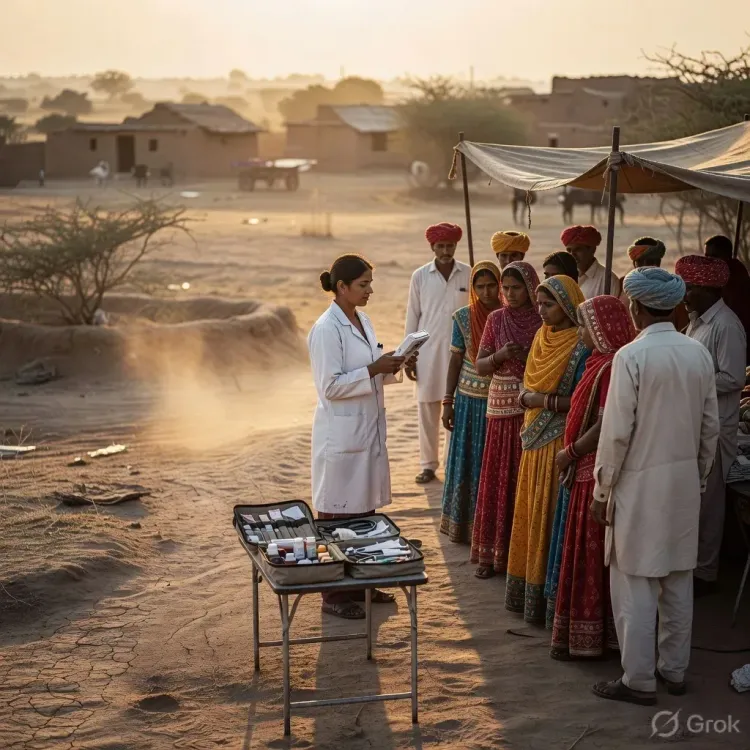
Technology is only as effective as the networks that carry it to the last mile. Rajasthan's strategy explicitly includes community health workers and active case-finding campaigns — the human layer that surfaces patients who might otherwise never walk into a clinic. By combining algorithmic detection with door-to-door outreach, the state is betting that the fastest path to elimination runs through both a server room and a village lane.
The real test will come when state-level TB incidence data and central health ministry assessments land — numbers that will reveal whether Rajasthan's integrated model is bending the curve or still building momentum. Until then, the architecture is in place. The question is how fast it delivers.
Point of View
In power since December 2023, is using a high-visibility national health target to demonstrate governance competence ahead of future electoral cycles. By anchoring the state's effort to AI and digital infrastructure, the BJP government is also reinforcing its broader 'technology-led governance' brand. The real policy question is whether community health worker capacity has kept pace with the digital layer — historically, India's TB programmes have struggled less with detection technology and more with the last-mile human infrastructure needed to ensure treatment completion. If Rajasthan's incidence numbers fall meaningfully, it could become a template other states are pressed to replicate.
NationPress
19 Sept 2026
Frequently Asked Questions
What is Rajasthan doing to eliminate tuberculosis?
Rajasthan is running a multi-dimensional TB elimination strategy that combines artificial intelligence-assisted diagnostics, an expanded microbiological testing network, and community-based active case-finding campaigns to detect and treat every potential TB patient.
What is India's TB elimination target?
India aims to eliminate tuberculosis by 2025, a goal set by Prime Minister Narendra Modi in 2018 — a decade ahead of the global Sustainable Development Goal deadline of 2030.
What is the National TB Elimination Programme?
The National TB Elimination Programme is India's central health initiative to eradicate tuberculosis through improved case detection, treatment adherence, and prevention, supported by digital tools like the Ni-kshay patient-tracking portal.
How is AI being used for TB detection in Rajasthan?
Rajasthan is integrating AI-assisted diagnostics into its TB screening process to identify suspected cases faster and more accurately, complementing its microbiological laboratory network and community outreach campaigns.
Who is Bhajanlal Sharma and what is his role in Rajasthan's TB drive?
Bhajanlal Sharma is the Chief Minister of Rajasthan, in office since December 2023 from the BJP. He is leading the state's push to eliminate TB by combining technology, diagnostic networks, and public participation under a unified government strategy.