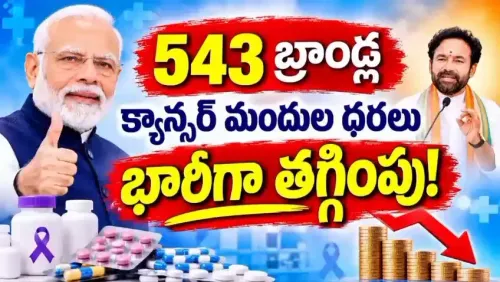
Kishan Reddy: Modi Govt Caps Trade Margins on Cancer Drugs

Synopsis
The Modi government has capped trade margins at 30% on non-scheduled anti-cancer medicines, potentially cutting MRP by up to 70% and saving patients ₹2,500 crore annually, Union Minister G. Kishan Reddy announced on Tuesday.
Key Takeaways
The Modi government has capped trade margins at 30% on non-scheduled anti-cancer medicines.
The cap could reduce the maximum retail price (MRP) of affected drugs by up to 70% .
Annual patient savings are estimated at ₹2,500 crore .
Non-scheduled medicines fall outside standard price controls under the Drugs (Prices Control) Order, 2013 .
The National Pharmaceutical Pricing Authority (NPPA) is responsible for issuing and enforcing margin-cap notifications.
Exact medicines covered and state-level enforcement remain key variables pending detailed NPPA notifications .
A potentially transformative shift in cancer treatment affordability is underway — the Modi government has moved to cap trade margins at 30% on non-scheduled anti-cancer medicines, a step that could reduce the maximum retail price of these drugs by as much as 70% and save patients an estimated ₹2,500 crore annually, according to Union Coal and Mines Minister G. Kishan Reddy.
What the 30% Cap Actually Means for Cancer Patients
For families already battered by the financial toll of cancer, the margin cap targets one of the cruellest inefficiencies in the supply chain: the markup that accumulates between manufacturer and patient without any corresponding medical value. Non-scheduled medicines — those outside the National List of Essential Medicines — sit beyond the standard price-control net, meaning traders and distributors have historically enjoyed uncapped margins on some of the costliest oncology drugs in the market.
By setting a hard ceiling of 30% on trade margins for this category, the government uses a mechanism distinct from full price control — it does not fix the manufacturer's price, but it squeezes out the supply-chain inflation that pushes MRPs into unaffordable territory. The National Pharmaceutical Pricing Authority (NPPA), which administers drug-price regulation under the Department of Pharmaceuticals, is the regulatory body that would issue and enforce such notifications.
The Legal Scaffolding: DPCO 2013 and Beyond
The move draws on a framework built by the Drugs (Prices Control) Order, 2013, which gave the government the architecture to regulate scheduled drugs and extend oversight to non-scheduled formulations. Trade-margin rationalisation — as opposed to outright price caps — has become a preferred instrument precisely because it preserves market competition while attacking the markup chain that inflates out-of-pocket costs for patients. India's oncology drug market, where treatment regimens can run to lakhs of rupees per year, has long been a focal point of this tension.
Periodic interventions on oncology drug pricing have been a recurring theme across administrations, but the scale of the claimed relief — ₹2,500 crore in annual patient savings — would place this among the more significant single-category pricing actions in recent memory. Exact lists of medicines covered and state-level enforcement mechanisms will be the critical variables to watch once the NPPA issues detailed notifications.
The Broader Push Toward Affordable Treatment Access
The announcement fits into a wider pattern of the current government deploying pharmaceutical pricing tools to address the catastrophic out-of-pocket health expenditure that pushes millions of Indian households into financial distress each year. Cancer, with its long treatment horizon and expensive specialty drugs, represents one of the sharpest pressure points in that picture.
Trade-margin caps, generic drug promotion through Jan Aushadhi Kendras, and selective price notifications have been layered together as complementary levers — no single instrument closes the access gap alone, but in combination they can meaningfully shift what a patient pays at the chemist's counter. The ₹2,500 crore figure, if it holds after full implementation, would represent real relief translated directly into household budgets across the country.
The implementation trail — which medicines are listed, how swiftly state drug controllers enforce the cap, and whether manufacturers adjust ex-factory prices in response — will determine whether the promise of a 70% MRP reduction on affected drugs becomes a lived reality for patients or remains a headline number.
Point of View
500 crore savings claim, if substantiated by NPPA notifications, would mark one of the larger single-category affordability interventions in recent pharmaceutical policy. The announcement also signals that the government is prepared to extend pricing discipline beyond the essential medicines list into the high-cost specialty drug segment — an area long flagged as a driver of catastrophic out-of-pocket expenditure. How rigorously state drug controllers enforce the cap will ultimately determine whether the policy reshapes patient spending or fades into implementation ambiguity.
NationPress
4 Nov 2026
Frequently Asked Questions
What does the 30% trade margin cap on anti-cancer medicines mean?
It means that traders, distributors and retailers across the supply chain can collectively charge no more than 30% over the manufacturer's price on the notified non-scheduled anti-cancer drugs, which the government says could reduce the MRP patients pay by up to 70%.
Which anti-cancer medicines are covered by the new trade margin cap?
The cap applies to non-scheduled anti-cancer medicines — those outside the National List of Essential Medicines. The precise list of covered drugs will be detailed in notifications issued by the National Pharmaceutical Pricing Authority (NPPA).
How much will cancer patients save under this policy?
The government estimates annual savings of ₹2,500 crore for patients collectively; individual savings will depend on which specific medicines a patient uses and the size of the existing margin on those drugs.
What is the NPPA and what role does it play in drug pricing?
The National Pharmaceutical Pricing Authority (NPPA) is the government body under the Department of Pharmaceuticals that regulates drug prices and trade margins. It issues price notifications and oversees compliance with the Drugs (Prices Control) Order, 2013.
What is the difference between scheduled and non-scheduled medicines in India?
Scheduled medicines are listed under the Drugs (Prices Control) Order and subject to direct price caps set by the NPPA. Non-scheduled medicines are not under outright price control but can be regulated through trade-margin caps and periodic price monitoring.