India-Canada ties strongest ever, Ontario minister Fedeli says
Synopsis
Ontario minister Victor Fedeli says India-Canada relations are at their strongest ever and sees AI and defence receiving greater attention. He also credits Donald Trump’s worldwide tariffs with accelerating international business partnerships.
Key Takeaways
Ontario minister Victor Fedeli said India-Canada relations were at their strongest ever.
Fedeli identified artificial intelligence and defence as areas likely to receive greater attention.
He said Ontario has two offices in India and visits the country twice a year .
According to Fedeli, Ontario has 1,600 AI companies and added 17,000 AI employees last year.
Fedeli said Donald Trump ’s worldwide tariffs had accelerated international business partnerships.
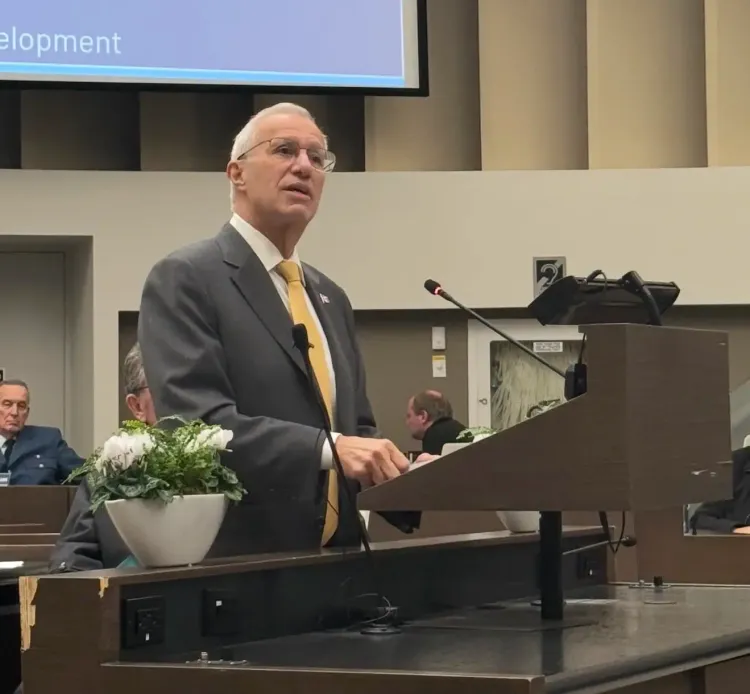
India-Canada relations are at their strongest ever, Ontario Minister of Economic Development, Job Creation and Trade and Chair of Cabinet Victor Fedeli said on 25 November, pointing to business ties and cooperation between the countries’ prime ministers. In an interview, he identified artificial intelligence and defence as areas likely to receive greater attention.
Fedeli said trade was moving in a positive direction and that Ontario, a major Canadian manufacturing centre, was pursuing business and education partnerships with India. His assessment is a ministerial view rather than a measure of the overall relationship.
Business ties and manufacturing
Fedeli linked his assessment to interactions between the two prime ministers at international forums and during visits to each other’s countries. He said their rapport was reflected in growing business between the countries, although he did not provide trade figures in the interview.
The minister described Ontario as a manufacturing centre producing aircraft, trains, automobiles and chips. He said the province makes both VATO chips and computer chips.
Fedeli said he expected Prime Minister Narendra Modi’s visit to Canada to strengthen goodwill between the countries. The interview did not provide a date for the visit.
Technology and defence priorities
Technology remains the biggest area of interest, Fedeli said, adding that the focus within the sector would increasingly turn to artificial intelligence rather than technology in general.
He also anticipated greater attention to defence cooperation. Fedeli said an estimated $6–7 trillion would be spent on defence worldwide over the next 10 years, and that both countries were interested in supplying defence products to global markets. The estimate was his; the interview did not identify its source.
His comments point to areas of prospective cooperation, but the interview did not detail a new defence agreement, specific contracts or a timetable for joint projects.
Education links and Ontario’s AI workforce
Fedeli argued that collaboration between India and Ontario in AI, technology and innovation must also run through education systems. He said he often meets Ontario university presidents during visits to India and that they are developing memorandums of understanding and partnerships with Indian institutions.
He said Ontario visits India twice a year and has secured business deals. The province also has two offices in India that work throughout the year to identify and develop opportunities, according to the minister.
Fedeli said Ontario has 1,600 AI companies, while 1,700 students enrolled in AI master’s programmes this year and 1,400 graduated last year. He added that the province gained 17,000 AI employees last year. The interview did not specify the sources or definitions behind the figures.
The minister also referred to Geoffrey Hinton and his Nobel Prize for pioneering work in machine learning. The source described the award as having been received last year, without specifying a calendar year for the interview.
Tariffs and international partnerships
Fedeli said stronger business partnerships were developing beyond India as well. He attributed the pace in part to worldwide tariffs imposed by United States President Donald Trump, describing their effect as the “Trump Accelerator”.
In his account, countries had already wanted to do business together, but the tariffs accelerated those partnerships. The interview did not provide examples or figures to quantify that effect.
For businesses and educational institutions considering partnerships, the areas Fedeli identified offer a picture of Ontario’s priorities. Any future announcements may show whether those interests lead to specific agreements or projects.
Point of View
But it should not be mistaken for a complete account of bilateral relations. The test for India is whether proposed AI, education and defence cooperation produces transparent agreements and tangible opportunities for Indian institutions and firms. Fedeli’s defence spending estimate and tariff argument also warrant scrutiny against independently sourced evidence.
NationPress
25 Nov 2026
Frequently Asked Questions
What did Victor Fedeli say about India-Canada relations?
Ontario minister Victor Fedeli said India-Canada relations were at their strongest ever. He pointed to the prime ministers’ interactions and what he described as growing business between the countries.
Which sectors did Fedeli identify for India-Canada cooperation?
Fedeli identified artificial intelligence and defence as areas likely to receive greater attention. He said technology remained the biggest area of interest.
How is Ontario pursuing business opportunities in India?
Fedeli said Ontario visits India twice a year and has two offices in the country that work throughout the year to develop opportunities. He also said Ontario universities were developing partnerships with Indian institutions.
What did Fedeli say about Ontario's AI sector?
Fedeli said Ontario has 1,600 AI companies and added 17,000 AI employees last year. He also cited enrolment of 1,700 students in AI master’s programmes this year and 1,400 graduates last year.
What did Fedeli say about Donald Trump's tariffs?
Fedeli said Donald Trump’s worldwide tariffs had accelerated international business partnerships. He described that effect as the ‘Trump Accelerator’.