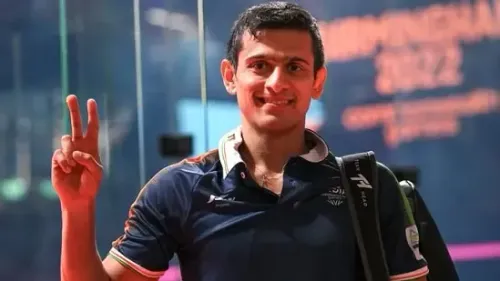
Saurav Ghosal Sets Ambitious Goals for Anahat Singh in Indian Squash

Synopsis
Saurav Ghosal emphasizes that Anahat Singh must aim for a top-10 world ranking to meet expectations. He advocates for a significant reform in Indian squash to enhance talent through mass participation, highlighting the importance of enjoyment and support in an athlete's journey.
Key Takeaways
Saurav Ghosal sets high expectations for Anahat Singh , aiming for a top-10 ranking.
A call for a comprehensive reform in Indian squash is emphasized.
The importance of a supportive environment for young athletes is highlighted.
Ghosal stresses the need for enjoyment in sports for long-term success.
Increased participation in public schools could uncover new talent.
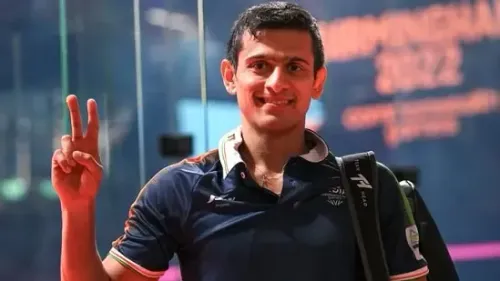
New Delhi, March 21 (NationPress) Former India No. 1 Saurav Ghosal has established an ambitious standard for the promising young player Anahat Singh, asserting that securing a spot in the world’s top-10 should be considered the ‘minimum requirement. Ghosal also advocates for a comprehensive reform in both men’s and women’s squash to broaden India’s talent pool through increased participation.
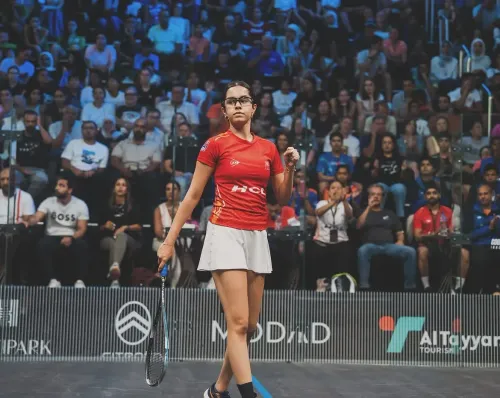
Recognizing Anahat as an exceptional talent, Ghosal noted that she has a nearly complete game along with a supportive environment to thrive at the elite level.
“Anahat is undoubtedly a standout. She excels at what she does, and her potential is extraordinarily high. She has performed admirably thus far. Her mentality is fantastic, and physically she is in good shape. We are just working on enhancing her strength, which will be beneficial. She's excellent at returning shots and other key aspects,” Ghosal shared in an exclusive interview with IANS.
He emphasized her strategic insight and poise as remarkable attributes, stating, “She possesses both skill and a deep understanding of the game, including the ability to vary her tactics, which is quite rare. Additionally, she maintains the composure to execute these variations effectively. Moreover, she is surrounded by a strong support system.”
Ghosal pointed out the robust network that supports Anahat, including the guidance of former World No. 1 Grégory Gaultier, seasoned coach Stéphane Galifi, and himself, which he believes plays a crucial role in her growth.
“She benefits from coaching by Grégory Gaultier, a former world champion. Stéphane Galifi, an accomplished player, has been training her in India, and I am mentoring her as well. She has the ideal combination of support that one could wish for,” he explained.
He made it clear what his expectations are while also cautioning against exerting excessive pressure on the young athlete. He highlighted the importance of enjoyment for long-term success.
“If she continues to listen, learn, work hard, and stay focused, there’s no reason she can’t be a consistent presence in the top 10 for a significant time. She may even reach higher levels. However, I emphasize that the top 10 is merely a starting point. If she fails to achieve that, something must have gone awry. With Anahat, we must avoid putting too much pressure on her. She genuinely enjoys playing, which is crucial for her career,” he said.
Regarding the broader Indian squash scenario, Ghosal acknowledged the promising signs in men’s squash but expressed concern over depth and stressed the necessity for stronger domestic competition to elevate elite players.
“Regarding the boys, we currently have four players in the top 50, which is promising. However, we lack a player akin to Anahat who can break into the top 10. Yet, circumstances can change, and players can develop later. What I want to stress is the need to cultivate more depth, both in women’s and men’s squash. Outside the top three or four players, we lack adequate competition pushing them from behind. Having more players in the mix only enhances everyone’s performance,” he noted.
Drawing parallels with leading global players, Ghosal pointed to the competitive environment in countries like Egypt and called for a mass-participation approach, advocating for squash to be introduced widely in public schools across India.
“Training with these players daily is crucial. Egypt has that model where the world’s top players consistently practice with each other, improving overall performance. I would propose collaborating with the Indian sports ministry and the education sector to ensure every public school student tries squash at some point before they turn 12 or 13,” he stated.
He believes this strategy could reveal untapped talent and foster a pipeline of future champions, mentioning that existing facilities, such as Kendriya Vidyalaya schools with squash courts, could serve as hubs for expanding access.
“With enough children trying squash, we will undoubtedly produce champions. When champions emerge, interest in the sport will surge, and parents will become more engaged, envisioning their children as potential world or Olympic champions. Some public schools, like Kendriya Vidyalaya, already have squash courts, making it a straightforward solution. We should consider transforming these schools into satellite centers, inviting neighboring schools to participate,” Ghosal elaborated.
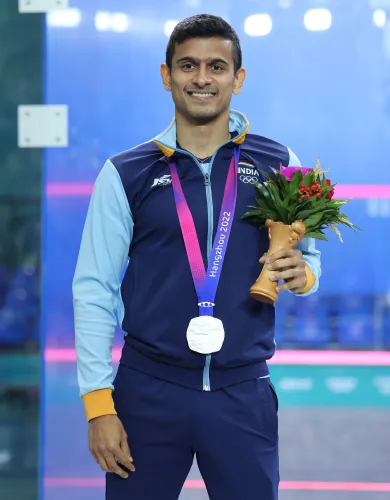
Reflecting on his personal journey, Ghosal discussed how his definition of success has matured over time, evolving from a win/loss perspective. He highlighted his experience at the 2022 Asian Games as a pivotal moment in his outlook after narrowly missing out on an individual gold medal.
“In my youth, success was solely defined by winning or losing. After significant preparation for the Asian Games, missing out felt disheartening,” he admitted.
However, he noted that introspection led to a more profound understanding of his purpose.
“Ultimately, we engage in this sport because we love it. Would I exchange the time spent on the squash court for something else that brought me more happiness? The answer is no,” he concluded.
Summarizing his evolved perspective, Ghosal stated that fulfillment lies in the journey rather than merely the results. Nonetheless, he emphasized that the desire to win remains crucial.
“If the answer to that question is no and you’ve cherished that time, then you’ve essentially fulfilled your life during that period, which has become my new definition of success. Of course, you strive hard, aiming to win, and should possess a certain aversion to losing, but that should primarily be viewed as an outcome,” he stated.
Point of View
This article highlights the significant expectations placed on young athletes like Anahat Singh by established players like Saurav Ghosal. It brings attention to the vital need for systemic changes in Indian squash to foster greater talent and participation, ensuring a sustainable future for the sport.
NationPress
22 Sept 2026
Frequently Asked Questions
What are Saurav Ghosal's expectations for Anahat Singh?
Saurav Ghosal expects Anahat Singh to aim for a top-10 world ranking, which he considers the bare minimum for her potential.
What changes does Ghosal suggest for Indian squash?
He advocates for a structural overhaul to increase mass participation in the sport to develop a broader talent pool.
What support system does Anahat Singh have?
Anahat is mentored by Ghosal, coached by former World No. 1 Grégory Gaultier, and trained by Stéphane Galifi, creating a robust support network.
Why is enjoyment important for young athletes?
Ghosal emphasizes that enjoying the sport is crucial for sustaining long-term success and preventing undue pressure on young players.
How does Ghosal propose to increase squash participation in India?
He suggests that squash should be introduced in public schools to encourage early exposure and participation among students.