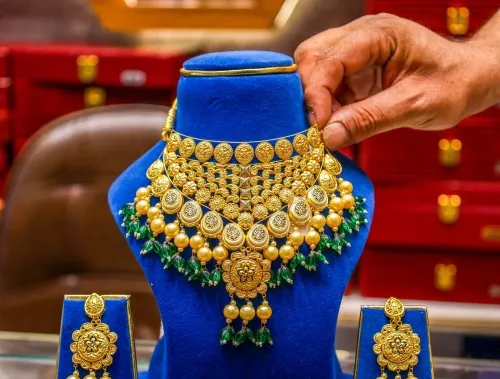
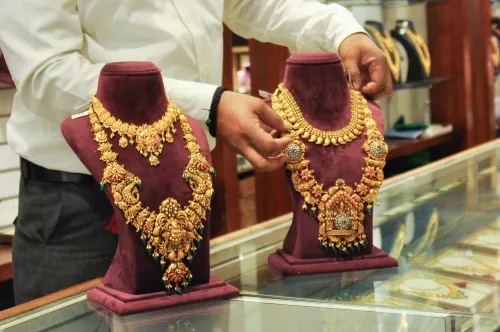
Gold's 9% surge redirects investor flows into cash and debt funds

Synopsis
Gold's 9% July surge — five times the equity market's return — did not trigger a rush back into precious metals. Instead, investors funnelled capital into money market funds and fixed income, with a ₹1,40,390 crore inflow into money markets alone. The data from Vallum Capital reveals a market in risk-off mode even as micro-cap and PSU banks quietly delivered strong returns.
Key Takeaways
Gold prices rose over 9% in July 2024 , approximately five times the return of broader equity markets.
Precious metal fund inflows fell from ₹8,680 crore in June to ₹4,084 crore in July, per the Vallum Capital report.
Money market funds received ₹1,40,390 crore in July, reversing ₹65,530 crore of outflows in June.
Fixed income swung by ₹58,954 crore — from outflows of ₹53,006 crore in June to inflows of ₹5,947 crore in July.
Micro-cap funds led equity performance at 4.6% for the month and 15.9% year-to-date.
Large-cap funds remain -3.9% year-to-date yet attracted ₹14,977 crore in July inflows.
Gold prices surged more than 9% in July 2024 — roughly five times the returns posted by broader equity markets — yet investors largely chose to pocket those gains and rotate into safer assets rather than double down on precious metals, according to a report by Vallum Capital released on Wednesday, 19 August.
Precious Metal Inflows Cool Sharply
Despite gold's outsized rally, inflows into precious metal funds fell steeply — from ₹8,680 crore in June to ₹4,084 crore in July. The retreat signals that investors treated the rally as a profit-booking opportunity rather than a signal to add exposure. The immediate catalyst for gold's climb, according to the Vallum Capital report, was a far weaker-than-expected US jobs report, which briefly eased fears of another Federal Reserve interest rate hike and lifted bullion.
Money Markets and Fixed Income See Massive Reversals
The capital that left precious metals did not sit idle. Money market funds absorbed a striking ₹1,40,390 crore in July — a dramatic reversal from the ₹65,530 crore of outflows recorded the previous month. Fixed income staged an equally sharp turnaround, swinging from ₹53,006 crore of outflows in June to ₹5,947 crore of inflows in July — a single-month swing of ₹58,954 crore, according to the report.
Sectoral Highlights: Auto, PSU Banks, and Micro-Caps Lead
Within India, the auto and transport sector had an exceptional month, buoyed by the country's first-ever monthly passenger vehicle sales crossing the 4-lakh mark in July. PSU banks gained over 3.8% on the back of strong quarterly results, while private banks shed 4% as the flow gap between the two widened sharply. Healthcare absorbed ₹737 crore in fresh inflows, quietly building on a year-to-date gain of over 16.4%.
Technology funds saw a recovery in sentiment as global investors rotated out of Korean semiconductor stocks into Indian software companies, yet ₹1,345 crore still left technology funds in the month — underscoring that sentiment recovery and actual inflows do not always move in tandem.
Micro-Cap and Small-Cap Outperform; Large-Cap in the Red YTD
Micro-cap funds emerged as the month's strongest performer, delivering 4.6% in July, 15.9% year-to-date, and 12.7% over one year. Small-cap funds returned 2.8% for the month, 11.4% year-to-date, and 13.3% over one year. In contrast, large-cap funds sit at -3.9% year-to-date, yet still absorbed ₹14,977 crore in July flows — up ₹5,291 crore from June — suggesting institutional and retail investors are using the dip to accumulate.
What This Signals for Markets
The broad pattern — gold rallying, yet inflows rotating to cash and debt — reflects a risk-averse posture among Indian investors even as pockets of domestic equity (micro-cap, PSU banks, healthcare) continue to attract capital. With the US macro outlook still uncertain and the Fed's rate path in flux, the direction of money market and fixed-income flows in the coming months will be a key indicator of whether this caution persists or reverses.
Point of View
Signalling a market that is uncertain about the next move. The US jobs-report trigger matters here — if one weak print can move gold 9%, the same macro sensitivity could rapidly reverse flows if the Fed pivots more hawkishly. Meanwhile, the widening gap between PSU and private bank flows is a structural story that mainstream coverage tends to underplay: it reflects not just quarterly earnings but a longer rerating of state-owned lenders that has been building for over a year.
NationPress
3 Oct 2026
Frequently Asked Questions
Why did gold prices surge over 9% in July 2024?
Gold surged over 9% in July 2024 primarily because a weaker-than-expected US jobs report briefly reduced fears of another Federal Reserve interest rate hike, lifting bullion. The gain was roughly five times the return of broader equity markets during the same period, according to the Vallum Capital report.
Where did investors move their money after gold's rally?
Rather than reinvesting in precious metals, investors rotated gains into safer assets. Money market funds received ₹1,40,390 crore in July, reversing ₹65,530 crore of outflows from June, while fixed income also swung to ₹5,947 crore of inflows from ₹53,006 crore of outflows the previous month.
Which equity segments performed best in July 2024?
Micro-cap funds were the top performers, delivering 4.6% in July, 15.9% year-to-date, and 12.7% over one year. PSU banks also gained over 3.8% on strong quarterly results, while healthcare funds absorbed ₹737 crore in fresh inflows on a year-to-date gain of over 16.4%.
Why did precious metal fund inflows fall despite gold's rally?
Precious metal inflows dropped from ₹8,680 crore in June to ₹4,084 crore in July, suggesting investors used the rally to book profits rather than increase exposure. The shift indicates a risk-averse sentiment, with capital moving toward money markets and debt instruments instead.
How did large-cap funds perform in July 2024?
Large-cap funds remain in negative territory at -3.9% year-to-date, yet attracted ₹14,977 crore in July — up ₹5,291 crore from June — indicating that investors are selectively accumulating large-cap positions despite the underperformance.