NITI Aayog's Rajiv Gauba calls for regulation reform to match tech, geopolitical shifts
Synopsis
NITI Aayog Member Rajiv Gauba used the 5th Kautilya Economic Conclave to make a pointed case: India's regulatory frameworks are not keeping pace with AI, geopolitical disruption or multi-sector business models. His call for clarity, accountability and inter-regulator coordination signals that a rethink of India's governance architecture may be overdue.
Key Takeaways
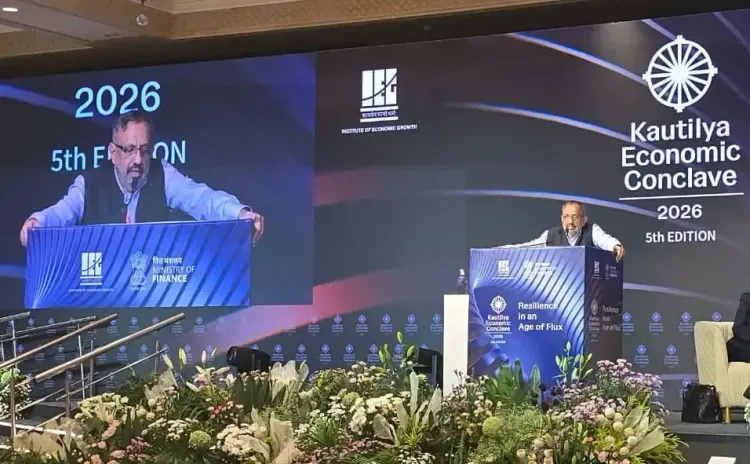
Rajiv Gauba , Member of NITI Aayog , spoke at the 5th Kautilya Economic Conclave in New Delhi on 4 October 2025 .
He argued that regulatory frameworks must evolve alongside fast-moving shifts in geopolitics , technology and business models .
Gauba flagged artificial intelligence , cybersecurity and digital technologies as areas where regulation is lagging behind innovation.
He warned that excessive or poorly designed regulation can impede investment, competition and innovation .
Gauba stressed that regulatory independence must be matched with transparency, accountability and effective review mechanisms.
He called for greater inter-regulatory coordination to address overlapping mandates and close governance gaps.
Rajiv Gauba, Member of NITI Aayog, on Saturday, 4 October 2025 urged policymakers to move beyond the false choice between regulation and growth, arguing instead for regulatory frameworks that manage emerging risks while actively supporting innovation, competition and investment. He was speaking at the 5th Kautilya Economic Conclave in New Delhi, at a plenary session titled 'Regulatory Oversight in an Age of Disruption'.
Why Frameworks Must Keep Pace
Gauba underlined that regulatory architecture is under simultaneous pressure from multiple directions. Geopolitical uncertainty, disruptions to global trade routes and supply chains, and the growing deployment of tariffs, export controls and investment restrictions as strategic instruments are collectively reshaping the economic landscape, he noted. At the same time, technological change — particularly in artificial intelligence, cybersecurity and digital technologies — is advancing faster than most institutions and regulatory structures can respond.
He also pointed to the rising complexity of modern business models, which increasingly straddle multiple sectors and technology stacks. As conventional industry boundaries erode, he stressed, regulators risk creating fragmented or conflicting obligations unless frameworks are redesigned to address interconnected risks coherently.
Balancing Oversight With Growth
Gauba was explicit that regulation is indispensable — for safety, consumer protection, market integrity and systemic stability — but cautioned that excessive or poorly designed rules can blunt innovation and deter investment. He argued that national competitiveness now hinges not just on physical infrastructure, labour laws and fiscal incentives, but equally on the clarity, consistency and predictability of the regulatory environment. For businesses weighing large-scale investments, the ability to operate at scale and innovate with certainty is, he said, an increasingly decisive factor.
Accountability Must Accompany Independence
A key theme in Gauba's address was the relationship between regulatory autonomy and public accountability. Regulators need sufficient independence to take difficult decisions without undue influence, he acknowledged, but stressed that this autonomy must be paired with transparent decision-making, clear procedures, effective review mechanisms and measurable accountability for regulatory performance. Without these safeguards, public confidence in regulatory institutions erodes.
The Case for Inter-Regulatory Coordination
Gauba also called for stronger coordination among regulators to tackle overlapping mandates, eliminate duplication and close gaps that open up as businesses increasingly operate across traditional regulatory domains. This comes amid a broader global debate about whether legacy single-sector regulators — designed for industries with clear boundaries — are structurally equipped to govern the platform economy, AI-driven services and cross-border digital commerce. Notably, India has been actively reviewing its regulatory architecture across sectors including fintech, telecommunications and data governance, making Gauba's remarks particularly timely.
The Kautilya Economic Conclave, hosted annually, brings together policymakers, economists and business leaders to deliberate on pressing economic governance challenges. The 5th edition's focus on regulatory disruption reflects a widening consensus that the institutional frameworks inherited from earlier decades require fundamental redesign.
Point of View
Covering fintech, telecom, data and AI, is precisely the 'fragmented obligations' problem he describes, yet no structural fix was proposed. The call for regulatory predictability rings hollow without a timeline or mechanism for reform. More tellingly, the same government that champions ease of doing business has seen regulatory uncertainty in sectors like online gaming, digital lending and drone manufacturing cited repeatedly by investors as a deterrent. The Conclave is a useful platform, but India needs binding inter-regulatory coordination mandates, not another round of aspirational framing.
NationPress
3 Oct 2026
Frequently Asked Questions
What did NITI Aayog's Rajiv Gauba say at the Kautilya Economic Conclave?
Rajiv Gauba, Member of NITI Aayog, argued that policymakers must design regulations that manage risks while supporting innovation, competition and investment, rather than treating regulation and growth as opposing goals. He made the remarks at the 5th Kautilya Economic Conclave in New Delhi on 4 October 2025, at a plenary session on regulatory oversight.
Why did Gauba say regulatory frameworks need to change?
Gauba cited three converging pressures: geopolitical uncertainty reshaping trade and supply chains, rapid technological advances in AI and cybersecurity outpacing institutions, and increasingly complex multi-sector business models that blur traditional regulatory boundaries. He argued these forces together demand a fundamental rethink of how oversight is structured.
What did Gauba say about regulatory independence and accountability?
Gauba stressed that regulatory independence must be accompanied by accountability. While regulators need autonomy to make difficult decisions free from undue influence, he said public confidence requires transparent processes, clear procedures, effective review mechanisms and measurable accountability for performance.
What is the Kautilya Economic Conclave?
The Kautilya Economic Conclave is an annual policy forum that brings together policymakers, economists and business leaders to discuss economic governance. The 5th edition focused on regulatory challenges in an era of technological and geopolitical disruption.
How does Gauba's call for coordination affect Indian businesses?
Gauba called for stronger coordination among regulators to eliminate overlapping mandates and close governance gaps, particularly as businesses increasingly operate across traditional sector boundaries. For Indian companies in areas like fintech, digital services and AI, clearer and more consistent regulatory signals could reduce compliance uncertainty and encourage investment at scale.