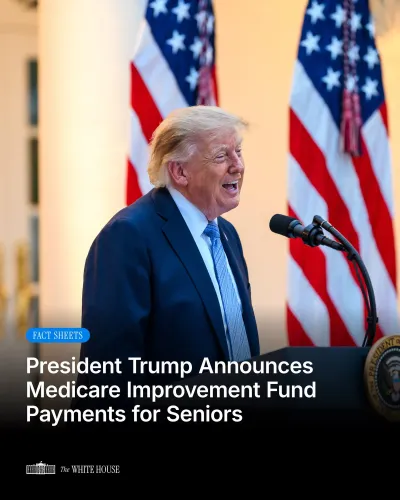
White House Directs Public to Medicare Improvement Fund Fact Sheet

Synopsis
The White House on October 3, 2026, directed the public to an official fact sheet detailing President Trump's Medicare Improvement Fund payment announcement for seniors, urging Americans to 'Read the facts' via a whitehouse.gov link.
Key Takeaways
The White House posted on October 3, 2026 , directing followers to an official fact sheet on Medicare payments.
The post responded to @POTUS with the message 'Read the facts,' linking to whitehouse.gov .
The announcement concerns Medicare Improvement Fund payments specifically targeting senior citizens .
The Medicare Improvement Fund is a federal statutory reserve used to enhance Medicare fee-for-service programs.
The administration's communications strategy centers on directing the public to official government data rather than third-party reporting.
The White House is pointing Americans directly to the numbers — urging the public to cut through the noise and read the official record on President Donald J. Trump's Medicare Improvement Fund payments for seniors, announced on Saturday, October 3, 2026.
The post, shared from the official White House X account, responded to @POTUS with a pointed directive: 'Read the facts,' linking to a formal fact sheet published on whitehouse.gov. The document outlines the administration's announced changes to Medicare Improvement Fund payments — a federal mechanism that channels money into improving services and coverage for senior citizens enrolled in Medicare across the United States.
What the Medicare Improvement Fund Does
The Medicare Improvement Fund is a statutory reserve established by the U.S. Congress to allow the federal government to make targeted enhancements to the Medicare fee-for-service program. Adjustments to this fund can directly affect reimbursement rates for healthcare providers and, by extension, the quality and breadth of services available to America's seniors. Any significant payment announcement tied to this fund carries real weight for tens of millions of enrolled beneficiaries.
Why the White House Is Pushing the Fact Sheet
The terse 'Read the facts' framing signals the administration is eager to set the record straight — likely in response to public debate or criticism surrounding the policy. Directing traffic to an official government fact sheet is a deliberate communications strategy: it anchors the narrative in the administration's own language and data, bypassing interpretation. The link goes directly to whitehouse.gov, making the sourcing unambiguous.
For senior Americans — and for the broader healthcare policy conversation — the details inside that fact sheet will determine whether this announcement represents a meaningful funding boost or a reallocation with trade-offs. The administration's choice to amplify it publicly suggests confidence in what those numbers show.
The ball is now in the public's court — and the White House wants every senior, caregiver, and policymaker to know exactly where to look.
Point of View
And the administration wants to own the primary source. Medicare payment policy is perennially high-stakes in U.S. politics: any shift in fund allocations can ripple through provider reimbursements and senior care quality, making it a potent electoral and policy flashpoint. By anchoring the debate to its own fact sheet, the Trump administration is attempting to foreclose rival narratives before they solidify. Whether the underlying numbers hold up to independent scrutiny will determine how durable that strategy proves.
NationPress
3 Oct 2026
Frequently Asked Questions
What is the Medicare Improvement Fund?
The Medicare Improvement Fund is a U.S. federal statutory reserve that Congress created to allow targeted enhancements to the Medicare fee-for-service program, including adjustments to provider payment rates.
What did the White House announce about Medicare payments for seniors?
On October 3, 2026, the White House directed the public to an official fact sheet detailing President Trump's Medicare Improvement Fund payment announcement, though the specific payment figures are contained in the linked whitehouse.gov document.
Why did the White House say 'Read the facts' on X?
The phrase signals the administration wants the public to consult its official fact sheet directly, likely in response to public debate or media coverage questioning the policy's details.
How does the Medicare Improvement Fund affect senior citizens?
Changes to the Medicare Improvement Fund can alter reimbursement rates for healthcare providers, which in turn affects the quality and availability of services for tens of millions of seniors enrolled in Medicare.
Where can I find the official White House fact sheet on Medicare payments?
The White House linked directly to whitehouse.gov in its October 3, 2026 post, where the full fact sheet on President Trump's Medicare Improvement Fund payment announcement is published.