Baha'i World Centre Haifa: Israel's sacred terraced gardens explained
Synopsis
Nineteen terraced gardens on Mount Carmel in Haifa are more than a UNESCO-listed marvel — they lead to the Shrine of the Bab, the second holiest site in the Baha'i Faith. With India home to the world's largest Baha'i community of roughly two million, the connection between this Israeli landmark and the subcontinent is deeper than most visitors realise.
Key Takeaways
The Baha'i World Centre in Haifa features 19 terraced gardens on the slopes of Mount Carmel , overlooking the Mediterranean Sea .
The site houses the Shrine of the Bab , the second holiest place in the Baha'i Faith, after the Shrine of Baha'u'llah in Acre (Akko) .
India has the world's largest Baha'i community, with an estimated two million followers, according to community estimates.
Volunteers from more than 90 countries serve at the World Centre; there is no local Baha'i community in Israel by deliberate choice.
The Baha'i Faith has no clergy — governance is through elected Spiritual Assemblies at local, national and international levels.
The Lotus Temple in New Delhi serves as the Baha'i House of Worship for the Asian continent.
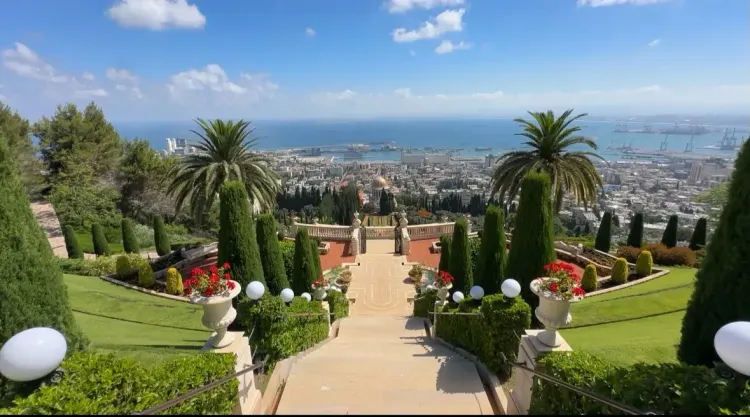
High above the Mediterranean port city of Haifa, the Baha'i World Centre stretches across the slopes of Mount Carmel in 19 precisely symmetrical terraced gardens, forming one of Israel's most visited cultural and spiritual landmarks. Cypress-lined pathways, geometric flower beds and flowing water channels descend to a golden-domed shrine that commands panoramic views of Haifa Bay, the city's layered skyline and the open Mediterranean Sea.
The Shrine at the Heart of the Site
For followers of the Baha'i Faith, the golden dome marks the Shrine of the Bab — the second holiest site in the faith, after the Shrine of Baha'u'llah in nearby Acre (Akko). Tjireya Tjitendero Juzgado, Senior Advisor within the Baha'i International Community, describes its significance directly: 'This golden-domed building you see here is the second most holy place for Baha'is around the world. The remains of the Prophet-herald of the Baha'i Faith are buried here.'
She adds that the gardens are not merely ornamental. 'These gardens are designed to prepare you to enter the holy place and to help you leave it in a spirit of calm, spirituality and beauty,' she says.
What the Baha'i Faith Teaches
The Baha'i Faith is an independent world religion founded in 19th-century Persia, rooted in the teachings of the Bab and Baha'u'llah, who is regarded as its founder. Its central tenets are the oneness of God, the unity of all religions, and the oneness of humanity.
David Ruhestein, Secretary General of the Baha'i International Community, articulates the faith's inclusive theology: 'We believe in Muhammad, Krishna, Buddha, Moses, Jesus Christ. There is unity among religions because it comes from one divine source.' On human diversity, he adds: 'The human race is one race. We are diverse in culture, background and history, but fundamentally we are one.'
One of the faith's most distinctive structural features is the complete absence of clergy. 'We have no priests, no mullahs, no rabbis, no monks,' Ruhestein says. 'There is no intermediary between the individual and a divine source.' Governance instead flows through elected Spiritual Assemblies at local, national and international levels.
India's Deep Connection to the Faith
India holds a singular place in the global Baha'i community. According to community estimates, the country is home to approximately two million Baha'i followers — the largest national community in the world. It also hosts the Lotus Temple in New Delhi, the Baha'i House of Worship for the Asian continent and one of the most visited religious buildings globally.
'Our community in India is very significant. It happens to be the country on earth with the largest Baha'i community,' Ruhestein says. 'From all walks of life, from all castes and from all religious backgrounds.'
How the World Centre Operates
Despite the global prominence of the Baha'i World Centre, there is no local Baha'i community in Israel. 'This is a showpiece for the world,' Ruhestein explains. 'We don't establish local communities here out of respect for the host country.' Instead, volunteers drawn from more than 90 countries serve at the World Centre for fixed periods, maintaining the holy sites and supporting administrative functions.
On the question of global conflict, Ruhestein reflects the faith's pacifist orientation: 'For Baha'is, military conflict is a failing of inter-human relations. Peace comes through changing the hearts of individuals one at a time.'
A Landmark Open to the World
The status of the Baha'i Faith varies internationally — it enjoys full recognition and freedom in many countries while facing restrictions in others. The Baha'i World Centre in Haifa, however, remains open to visitors of all backgrounds, functioning simultaneously as a religious headquarters and a global cultural landmark. Community members say they hope people from across the world will continue to experience the gardens and the atmosphere of unity they are designed to embody.
Point of View
But the more significant angle is geopolitical and demographic: a faith with its global headquarters in Israel has its largest national community in India, a country with no diplomatic relations with Israel for much of its post-independence history. The absence of a local Israeli Baha'i community — a deliberate act of deference to the host state — is an unusual model of religious soft power that rarely gets examined. As interfaith dialogue struggles globally, the Baha'i model of elected, clergy-free governance and explicit doctrinal pluralism offers a structural case study that mainstream coverage consistently underreports.
NationPress
5 Oct 2026
Frequently Asked Questions
What is the Baha'i World Centre in Haifa?
The Baha'i World Centre in Haifa is the global administrative and spiritual headquarters of the Baha'i Faith, situated on the slopes of Mount Carmel in northern Israel. It comprises 19 terraced gardens and the Shrine of the Bab, the faith's second holiest site, and draws visitors from around the world.
Why is the Shrine of the Bab significant?
The Shrine of the Bab is the second holiest site in the Baha'i Faith, housing the remains of the Bab, regarded as the Prophet-herald of the religion. It ranks below only the Shrine of Baha'u'llah in nearby Acre (Akko) in religious importance.
Which country has the largest Baha'i community in the world?
India has the largest Baha'i community in the world, with an estimated two million followers according to community estimates. India also hosts the Lotus Temple in New Delhi, the Baha'i House of Worship for the Asian continent.
Why is there no Baha'i community in Israel despite the World Centre being there?
The Baha'i Faith deliberately refrains from establishing a local community in Israel out of respect for the host country, according to community leadership. Volunteers from more than 90 countries serve at the World Centre for fixed periods instead.
What are the core beliefs of the Baha'i Faith?
The Baha'i Faith teaches the oneness of God, the unity of all religions, and the oneness of humanity. It recognises figures including Muhammad, Krishna, Buddha, Moses and Jesus Christ as messengers from a single divine source, and is governed through elected Spiritual Assemblies with no clergy.