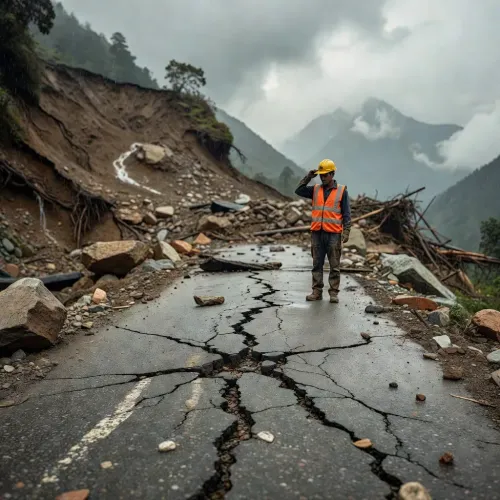
Himachal Pradesh hit by 86 cloudbursts, 121 flash floods since 2023; losses at ₹12,500 crore

Synopsis
Himachal Pradesh suffered 86 cloudbursts, 234 landslides, and 121 flash floods in just three years — racking up ₹12,500 crore in losses. Now, Chief Minister Sukhu is betting a ₹2,687 crore resilience project can break the state's costly cycle of destruction and recovery in the fragile Himalayas.
Key Takeaways
Himachal Pradesh recorded 86 cloudbursts , 234 landslides , and 121 flash floods between 2023 and 2025 .
Cumulative disaster losses over the three-year period stand at ₹12,500 crore .
The READY-HP project has a total outlay of ₹2,687 crore aimed at disaster recovery and resilience building.
Key focus areas include restoring roads , water supply , power infrastructure , and protecting farmer and horticulturist livelihoods .
The project will also promote green panchayats and risk-informed social safety and insurance mechanisms .
The review meeting was chaired by Chief Minister Sukhvinder Singh Sukhu in Chandigarh on 12 May .
Himachal Pradesh recorded 86 cloudbursts, 234 landslides, and 121 flash floods between 2023 and 2025, inflicting a cumulative loss of ₹12,500 crore on the state. The figures emerged at a high-level review meeting chaired by Chief Minister Sukhvinder Singh Sukhu to assess the progress of the Resilient Action for Development and Disaster Recovery – Himachal Pradesh (READY-HP) project.
Scale of the Disaster Crisis
The data underscores the mounting climate vulnerability of the hill state, which sits in the geologically young and tectonically active Himalayan belt. Over just three years, the compounding effect of cloudbursts, landslides, and flash floods has eroded infrastructure, disrupted livelihoods, and strained state finances. Notably, this is not an isolated spike — Himachal Pradesh has consistently ranked among India's most disaster-prone states, with each monsoon season intensifying the cycle of damage and recovery.
Chief Minister Sukhu acknowledged the structural challenge, stating that the state's location in the fragile Himalayan region makes it inherently susceptible to natural calamities. The scale of losses — ₹12,500 crore over three years — has made a structured recovery and resilience framework not just desirable but essential.
What READY-HP Aims to Do
The READY-HP project carries a total outlay of ₹2,687 crore and is described by the state government as a crucial initiative to strengthen disaster management capacity and reduce future damage. The project focuses on restoring disaster-affected infrastructure including roads, water supply schemes, power networks, and livelihoods projects.
Beyond physical reconstruction, READY-HP is designed to build systemic resilience. It will promote green panchayats, develop risk-informed social safety nets, and strengthen insurance mechanisms for vulnerable communities. The Chief Minister specifically stressed the need for robust infrastructure to protect the livelihoods of farmers and horticulturists — two groups disproportionately exposed to crop and orchard losses during disaster events.
Senior Officials at the Review Meeting
The meeting, held in Chandigarh on Tuesday, 12 May, was attended by Chief Secretary Sanjay Gupta, Additional Chief Secretary (Revenue) K.K. Pant, Principal Secretary (Finance) Devesh Kumar, Advisor (Planning) Ravinder Kumar, Director (Energy) Rakesh Kumar Prajapati, Director (Rural Development and Panchayati Raj) Raghav Sharma, Deputy Project Director Surender Maltu, and other senior officers.
Broader Context and What Comes Next
Himachal Pradesh's disaster losses mirror a wider Himalayan crisis: climate scientists have repeatedly flagged that warming temperatures are accelerating glacial instability and intensifying extreme precipitation events across the western Himalayas. The ₹12,500 crore loss figure over three years also places significant pressure on the state's fiscal position, making external project financing like READY-HP critical to recovery. How effectively the state translates the ₹2,687 crore outlay into verifiable, on-ground resilience — particularly for rural and agricultural communities — will determine whether the next monsoon cycle finds Himachal better prepared.
Point of View
500 crore loss figure is striking, but the more telling number is the frequency — 86 cloudbursts and 121 flash floods in three years suggests this is no longer an episodic crisis but a structural one. READY-HP's ₹2,687 crore outlay is a meaningful start, yet it covers barely a fifth of losses already incurred. The deeper question is whether the project's green panchayat and insurance mechanisms will reach the farmers and horticulturists who bear the sharpest livelihood risk, or whether — as with many state disaster funds — the money will flow disproportionately to infrastructure contracts. Himachal's fiscal constraints make credible, outcome-linked disbursement non-negotiable.
NationPress
21 Oct 2026
Frequently Asked Questions
How many natural disasters did Himachal Pradesh face between 2023 and 2025?
Himachal Pradesh recorded 86 cloudbursts, 234 landslides, and 121 flash floods between 2023 and 2025, according to data presented at a state government review meeting on 12 May. The combined losses from these events amount to ₹12,500 crore.
What is the READY-HP project?
READY-HP stands for Resilient Action for Development and Disaster Recovery – Himachal Pradesh. It is a ₹2,687 crore state initiative aimed at restoring disaster-damaged infrastructure, strengthening disaster management capacity, and building long-term resilience across roads, water supply, power, and livelihoods sectors.
Why is Himachal Pradesh so vulnerable to natural disasters?
Himachal Pradesh lies in the geologically young and tectonically active Himalayan region, making it inherently prone to cloudbursts, landslides, and flash floods. Climate scientists have also linked increasing extreme precipitation events in the western Himalayas to rising temperatures.
Who will benefit from the READY-HP project?
The project targets communities affected by natural disasters, with a specific emphasis on farmers and horticulturists whose livelihoods are disrupted during calamities. It also aims to strengthen social safety nets and insurance mechanisms for vulnerable populations through initiatives like green panchayats.
How does the READY-HP outlay compare to the losses incurred?
The READY-HP project outlay of ₹2,687 crore represents roughly one-fifth of the ₹12,500 crore in losses recorded between 2023 and 2025, highlighting the significant gap between disaster costs and the funds allocated for recovery and resilience building.