India as global anchor: Experts at Resilient Futures Summit 2026
Synopsis
At the Economist Enterprise Resilient Futures Summit 2026 in New Delhi, global experts made a striking case: India isn't just growing — it's being looked to for global leadership. From brokering peace amid multilateral erosion to leading AI adoption with rare public optimism, India's role is being reframed from emerging market to emerging anchor.
Key Takeaways
Global experts at the Resilient Futures Summit 2026 in New Delhi on 29 April identified India as a key force in global peace and economic stability.
Danny Quah of the Lee Kuan Yew School of Public Policy said erosion of global trust and weakening multilateral systems make India's leadership role critical.
Ian Blatchford , Director of the Science Museum London , noted that unlike the US and Europe, the majority of India's public is optimistic about artificial intelligence.
India is actively building AI capacity centres while simultaneously deliberating on ethical and governance frameworks, according to Blatchford.
Experts highlighted India's challenge of balancing high economic growth with quality-of-life improvements and rising energy demand.
India is increasingly being viewed as a pivotal force capable of shaping global peace, economic stability, and technological progress, according to global experts who spoke on the sidelines of the Economist Enterprise 'Resilient Futures Summit 2026' in New Delhi on Wednesday, 29 April. The assessments, shared with IANS, underscored India's growing influence in navigating geopolitical uncertainty, strengthening multilateral cooperation, and driving innovation in artificial intelligence and emerging technologies.
India's Role in Global Peace and Multilateralism
Danny Quah, Li Ka Shing Professor in Economics at the Lee Kuan Yew School of Public Policy, National University of Singapore, noted that the evolving nature of global terrorism and shifting trade dynamics have injected significant uncertainty into the world economy. He emphasised that beyond trade disruptions, a deeper concern lies in the erosion of global trust and the weakening of multilateral systems that have traditionally underpinned international cooperation.
"India can play a big role in it and if India tries, there will be peace. People are looking towards India to bring a peace. I think people are looking to India to exercise appropriate leadership. It is still up to India to decide what appropriate," Quah told IANS. His remarks reflect a broader sentiment among international observers that India's strategic positioning makes it uniquely suited to serve as a bridge between competing global blocs at a time when Western-led multilateral frameworks are under strain.
India's Optimistic Embrace of Artificial Intelligence
Ian Blatchford, Director of the Science Museum in London, highlighted India's distinctive and notably optimistic approach towards artificial intelligence — a contrast that stands out sharply against prevailing attitudes in the West. "If you look at public surveys in America and Europe, the majority of the population is nervous about artificial intelligence. The opposite is true in India. India is building capacity for artificial intelligence centres while also thinking deeply about what that means," Blatchford said.
This enthusiasm, experts argue, positions India as a potential standard-setter in responsible AI governance at a time when global regulatory frameworks remain fragmented. India's domestic AI infrastructure push, combined with a population that is broadly receptive to technological change, could give it an outsized role in shaping how emerging economies adopt and regulate AI.
Balancing Growth and Quality of Life
Blatchford also praised the broader achievements of the Global South, singling out India's developmental trajectory as particularly instructive. "The country is striving to balance economic growth with the need to improve quality of life, even as it grapples with challenges such as rising energy demand," he told IANS, adding that "this stands in contrast to Western economies that have already benefited from decades of prosperity."
The observation points to a structural challenge India faces: sustaining high-growth momentum while managing the social and environmental costs that historically accompanied industrialisation in the developed world. Notably, India's approach — attempting to leapfrog legacy infrastructure through digital and renewable platforms — is being watched closely by other emerging economies navigating the same tension.
What the Summit Signals
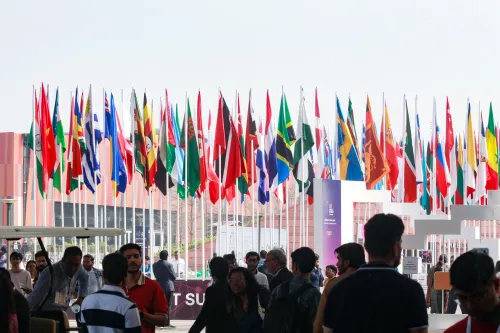
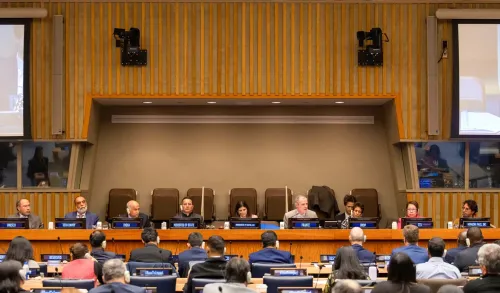
The Resilient Futures Summit 2026, organised by Economist Enterprise, brought together policymakers, academics, and business leaders to examine how nations can build durable frameworks for stability amid compounding global crises. India's prominence in the discourse at such forums reflects a shift in how the international community is recalibrating its expectations of New Delhi — not merely as a large emerging market, but as an active architect of global order. As geopolitical fault lines deepen, the question is no longer whether India has the capacity for leadership, but whether it will choose to exercise it.
Point of View
Which is diplomatic shorthand for saying India has not yet committed. On AI, the optimism data is real, but building AI centres and building AI governance are different things. India's advantage is a window, not a guarantee — and windows close.
NationPress
16 Sept 2026
Frequently Asked Questions
What was the Resilient Futures Summit 2026?
The Resilient Futures Summit 2026 was an event organised by Economist Enterprise in New Delhi, bringing together global policymakers, academics, and business leaders to discuss frameworks for stability amid geopolitical and economic uncertainty. India's role in global peace, AI, and growth was a central theme of the discussions.
What did Danny Quah say about India's role in global peace?
Danny Quah, Li Ka Shing Professor in Economics at the Lee Kuan Yew School of Public Policy, National University of Singapore, said India can play a big role in restoring global peace and that people are looking to India to exercise appropriate leadership. He also flagged the erosion of global trust and weakening multilateral systems as key threats to international stability.
Why is India considered optimistic about artificial intelligence compared to the West?
According to Ian Blatchford, Director of the Science Museum in London, public surveys in the US and Europe show majority nervousness about AI, whereas the opposite sentiment prevails in India. India is also actively building AI capacity centres while engaging in deeper reflection on the implications of the technology.
What challenges does India face in its development trajectory?
Experts highlighted that India is striving to balance rapid economic growth with improving quality of life, while also managing rising energy demand — challenges that Western economies navigated over decades of prior prosperity. India's approach of leapfrogging legacy infrastructure through digital and renewable platforms is being closely watched by other emerging economies.
Why are global experts viewing India as an anchor of global stability?
Experts point to India's strategic positioning as a bridge between competing global blocs, its receptive public attitude toward emerging technologies like AI, and its developmental model as reasons it is increasingly seen as a stabilising force. At a time when Western-led multilateral frameworks are under strain, India's scale and neutrality make it a natural focal point for international expectations.