AI-Driven Digital Ecosystem: India's 5G & 6G Vision at COAI Summit 2026
Synopsis
At the COAI DigiCom Summit 2026, India's top officials revealed the country has crossed 1 billion internet users and is now actively preparing for a 6G-ready ecosystem — while warning that digital fraud and spectrum management remain the biggest threats to this ambition.
Key Takeaways
COAI DigiCom Summit 2026 held in New Delhi on April 25, 2026 called for a secure, AI-driven digital ecosystem powered by 5G and emerging technologies.
Manish Sinha, DoT Member (Finance) , warned that 5G expansion increases the risk of digital fraud and spam , demanding stronger regulatory frameworks.
NK Bhola, Wireless Advisor , confirmed India is preparing for a 6G-ready ecosystem , with a target deployment year of 2030 .
India has crossed 1 billion internet users , with the next growth phase expected from Tier 2 and Tier 3 cities , per NIXI CEO Dr.
Experts stressed investment in fibre networks, submarine cables, and domestic AI compute capacity to build a resilient digital infrastructure value chain.
The summit concluded that India is positioned to become a global digital infrastructure hub , contingent on sustained government-industry-global partner collaboration.
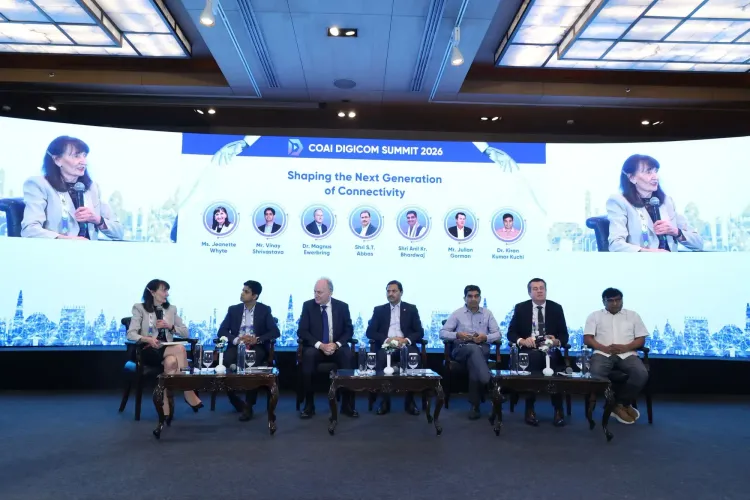
India's top government officials, telecom regulators, and industry leaders converged at the COAI DigiCom Summit 2026 in New Delhi on Saturday, April 25, unanimously calling for a secure, resilient, and AI-driven digital ecosystem powered by next-generation telecom networks, including 5G and the emerging 6G framework. The high-profile summit underscored India's ambition to position itself as a global digital infrastructure powerhouse.
Government's Call for Digital Trust and Security
Manish Sinha, Member (Finance) at the Department of Telecommunications (DoT), addressed the critical issue of digital trust, warning that the rapid expansion of 5G and digital services brings heightened responsibilities around security and accountability. He stressed that safeguarding citizens in the digital age requires stronger regulatory frameworks and coordinated action across all stakeholders.
Sinha specifically flagged the growing menace of spam and digital fraud, calling for a unified, multi-stakeholder response. His remarks come at a time when India has witnessed an alarming surge in cyber fraud cases, with the Indian Cyber Crime Coordination Centre (I4C) recording losses worth thousands of crores annually — a challenge that grows proportionally with digital adoption.
India's 6G Readiness and Spectrum Strategy
NK Bhola, Wireless Advisor, highlighted India's steady momentum towards a digitally empowered future, anchored by advancements in 4G and 5G infrastructure. He confirmed that the country is actively preparing for a 6G-ready ecosystem, signalling India's intent to not be a late mover in the next wave of global connectivity.
Bhola emphasised efficient spectrum management as a cornerstone of this vision, alongside the growing role of artificial intelligence in predictive maintenance and dynamic spectrum utilisation. Notably, India's 6G Technology Innovation Group under the DoT has already published a technology vision document, setting a target for 6G deployment by 2030.
Sajan Paul, General Manager at Hewlett Packard Enterprise Networking India, elaborated on how AI is fundamentally transforming network architecture and operations, with increasing focus on edge computing and the emergence of agentic AI — autonomous AI systems capable of making real-time decisions — to enable more intelligent and efficient telecom systems.
Intelligent Networks, IoT and Real-Time Applications
A dedicated panel discussion on building intelligent and scalable networks brought together senior leaders from India's major telecom companies. Participants stressed that future networks will be increasingly AI-led, demanding robust, energy-efficient infrastructure and deeper industry collaboration to support emerging use cases across Internet of Things (IoT) and real-time applications.
The consensus was clear: 5G Advanced and the evolution towards 6G will drive exponential demand for higher bandwidth and novel use cases, requiring proactive policy support and sustainable monetisation models to attract continued investments. This is particularly significant as India's telecom sector has seen consolidation down to three major private players — Reliance Jio, Bharti Airtel, and Vodafone Idea — making network investment decisions critically consequential for the entire ecosystem.
Bridging the Digital Divide: Tier 2 and Tier 3 Cities in Focus
Dr. Devesh Tyagi, Chief Executive Officer of the National Internet Exchange of India (NIXI), highlighted a landmark milestone: India has surpassed 1 billion internet users, a figure that places the country among the most connected nations on earth. He noted that the next phase of digital growth will be driven by Tier 2 and Tier 3 cities, where digital penetration still lags significantly behind metro centres.
Dr. Tyagi underlined the critical role of ISPs, peer-to-peer (P2P) providers, and content delivery networks (CDNs) in ensuring that citizens in smaller cities receive services at par with those in metropolitan areas. This focus on digital equity is central to the government's broader Digital India mission, which aims to bridge the urban-rural digital divide by 2026.
Building India's Digital Infrastructure Value Chain
Speakers at the summit also spotlighted the urgent need to strengthen India's digital infrastructure value chain — encompassing the expansion of fibre optic networks, strategic investments in submarine cables, and building domestic AI compute capacity to support emerging technologies. India currently relies heavily on foreign-owned submarine cable infrastructure, a strategic vulnerability that policymakers are now actively seeking to address.
The summit concluded with a broad consensus: India is well-positioned to emerge as a global digital infrastructure hub, backed by its unparalleled scale, deep talent pool, and supportive policy environment. However, sustained and structured collaboration between the government, industry, and global technology partners will be the decisive factor in realising this vision.
With the Telecom Regulatory Authority of India (TRAI) expected to release updated spectrum pricing recommendations and the DoT advancing its BharatNet Phase III rollout, the next 12–18 months will be pivotal in determining whether India's digital ambitions translate into ground-level infrastructure reality.
Point of View
But the gap between summit consensus and ground-level execution remains dangerously wide — Vodafone Idea's financial fragility, patchy rural fibre rollout under BharatNet, and India's near-total dependence on foreign submarine cable infrastructure are inconvenient truths that no summit panel fully confronts. The push for 6G is strategically sound, but if the 5G monetisation crisis isn't resolved, operators won't have the capital to fund the next leap. The 1-billion internet user milestone is a triumph, but quality of connectivity — not just headcount — is what will determine whether India leads or lags in the AI-driven digital era.
NationPress
5 Oct 2026
Frequently Asked Questions
What was the COAI DigiCom Summit 2026 about?
The COAI DigiCom Summit 2026 was a major industry event held in New Delhi on April 25, 2026, bringing together government officials, telecom regulators, and industry leaders to discuss India's digital future. Key themes included AI-driven networks, 5G and 6G readiness, digital security, and expanding connectivity to Tier 2 and Tier 3 cities.
Is India preparing for 6G technology?
Yes, India is actively preparing for a 6G-ready ecosystem, as confirmed by NK Bhola, Wireless Advisor at the Department of Telecommunications, at the COAI DigiCom Summit 2026. India's DoT has already published a 6G Technology Vision document targeting deployment by 2030.
How many internet users does India have in 2026?
India has surpassed 1 billion internet users, as highlighted by Dr. Devesh Tyagi, CEO of the National Internet Exchange of India (NIXI), at the COAI DigiCom Summit 2026. The next phase of growth is expected to be driven by Tier 2 and Tier 3 cities.
What role will AI play in India's telecom networks?
Artificial intelligence is set to transform India's telecom networks through predictive maintenance, dynamic spectrum utilisation, edge computing, and the emergence of agentic AI for real-time decision-making. Experts at the COAI Summit 2026 confirmed that future networks will be increasingly AI-led.
What are the biggest challenges for India's digital ecosystem?
Key challenges include rising digital fraud and spam, the need for efficient spectrum management, bridging the urban-rural digital divide, and building domestic AI compute capacity. Officials at the COAI DigiCom Summit 2026 also stressed the need to invest in fibre networks and submarine cable infrastructure.